
Redline Roadside & Towing LLC

Tire Change

Driver waiting beside an SUV with a flat tire as a tow truck arrives on a Phoenix highway shoulder
Tire Change

How Much Is Roadside Assistance for a Flat Tire? Cheapest Options Compared

So, how much is roadside assistance for a flat tire? Without a plan, a tech usually charges about $50 to $100 in labor to change the tire. The final price shifts with your plan type, your location, and your vehicle. The cheapest route is often coverage you already own. Redline Roadside & Towing LLC wrote this guide to help you compare every option before you need one. You will see real price ranges, plan limits, and ways to save. What Affects Flat Tire Roadside Assistance Cost? No two calls cost the same. Five things move the price up or down. Distance from the provider. The farther the truck drives to reach you, the higher the fee can go. Time of day. Nights, weekends, and holidays often cost more than a weekday afternoon. Vehicle and tire size. A small car is quick work. SUVs, trucks, and motorcycles can need more time or special gear. Location. A city street is easy to reach. A highway shoulder or a remote road can add fees. Spare, no spare, or repair. This one matters most. A flat tire change with spare tire is the cheapest job. The tech swaps the wheel and you drive off. Without a usable spare, one source puts the extra cost at $20 to $100. A roadside tire repair service is a middle path. If a nail sits in the tread, a tech can often plug or patch it on site. Sidewall damage cannot be fixed. You need a new tire. Roadside Assistance Membership Cost: What You Pay and What You Get A membership works like a yearly subscription. You pay one fee up front. After that, each call costs little or nothing. When people ask how much is roadside assistance for a flat tire under a plan, the answer is often $0 per call. One insurer lists a $0 cost for a flat tire, but you must have a spare. Your roadside assistance membership cost depends on a few things: Tier. Entry plans tow about 3 to 5 miles, while higher tiers tow up to 100 miles. Call limits. Some plans cap how many times you can call each year. Number of drivers or cars. Family and multi-vehicle plans cost more, but often less than separate plans. Insurance add-ons sit at the low end. One large insurer puts its add-on at $10 to $20 per year. Another source says add-ons average $15 to $60 per year. Club-style plans usually cost more but tow farther. Check each provider’s current rate page. Pros and Cons of a Membership Pros One yearly price you can plan for One phone number for tows, jump-starts, lockouts, and flats Often $0 per call within the plan limits Cons You pay even if you never call Tow distance and call limits can run out You still need a working spare Parts, like a new tire, are not included Roadside Assistance Without Membership: Pay-Per-Use Options Paying per call makes sense if you rarely break down. It also fits short-term needs, like a rental car or a road trip. Local tow companies charge a flat service fee, plus mileage for tows. On-demand apps show a price before you book. Some credit cards also offer pay-per-call help. One bank charges $59.95 per call on its Visa cards, and some others charge $79.95. One premium card covers up to $50 per incident, four times a year. One-Time Roadside Assistance Fee: What It Usually Includes A one-time roadside assistance fee normally has three parts: Service call or hookup fee. This covers the trip and the work. Mileage. Tows add a per-mile charge after a set distance. After-hours charges. Late calls can cost extra. One guide says a tow starts around $99, while other services start near $75. Another puts a tow without a plan at $75 to $125. Always ask for the total price before the truck rolls. Cost to Change a Flat Tire: Spare, Repair, or Replace The cost to change a flat tire depends on the job: Spare tire swap. Labor runs about $50 to $100. This is the lowest price. Repair. A plug or patch costs extra, but far less than a new tire. Replace. You pay for the tire and the fitting. A tow to a shop may be needed. Quotes differ for simple reasons. A stuck lug nut, a missing jack, or a remote spot can add time. Time costs money. Coverage You May Already Have (Often the Cheapest Route) Check these before you buy anything new: Auto insurance add-on. Many insurers offer it for a low yearly fee. Some cover a tire change at no cost per call. Credit card benefits. Look at the benefits guide for your card. Some cards pay for help, and some only set up the call. New car or certified pre-owned perks. Many come with roadside help for a set number of years. Car maker programs. Look in your owner’s booklet or app. Phone carrier or bundled perks. Some phone plans and rewards programs include it. Free state programs. Some states run highway patrols that help drivers at no charge. See the Connecticut DOT Safety Patrol for one example. Call your insurer or read your policy. Ask four questions: Does it cover a tire change? How many calls do I get each year? Do I need a spare? How far will it tow? What Roadside Assistance Covers and Where the Limits Are Most plans cover a short list of jobs. Here is what each one means for your wallet. Flat tire help. A plan pays for the labor to change the tire. It does not pay for repair parts. A new tire is on you. Towing. Distance caps apply. A tow can run $75 to $125 out of pocket. Battery jump-start. Without a plan, this runs about $50 to $100. Lockout service. Without a plan, expect $50 to $150. Fuel delivery. The plan covers the trip, not the gas. Out of pocket, it runs $50 to $75 plus the fuel.
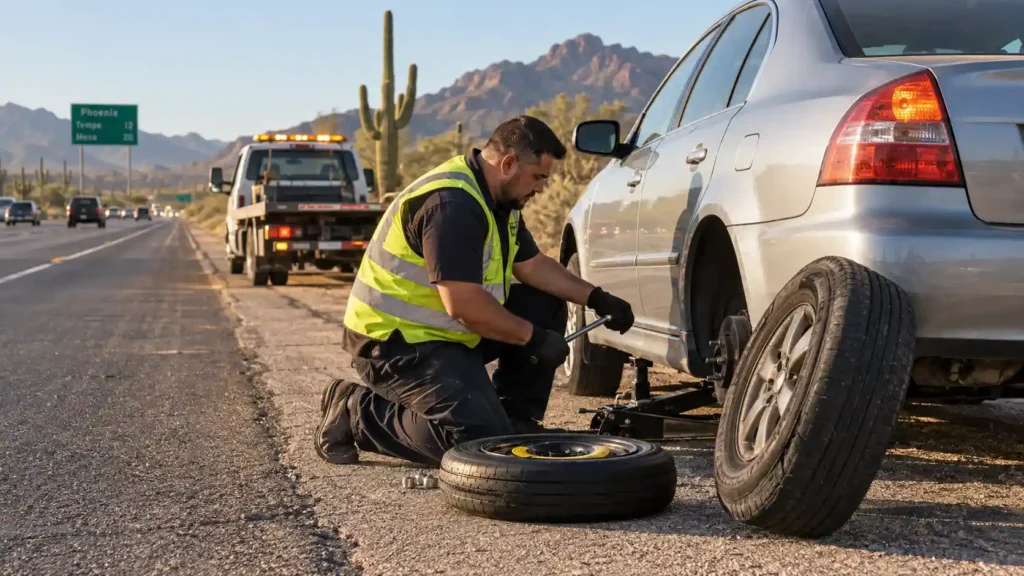

Roadside technician changing a flat tire with a spare on a Phoenix highway shoulder
Tire Change

Does Roadside Assistance Replace Your Tire?

Roadside assistance usually changes your flat tire using the spare already in your vehicle. It does not normally provide or pay for a brand-new tire. The technician removes the damaged wheel and installs your spare if it is safe to use. If you have no spare, a damaged rim, or another problem, you may need a tow to a tire shop. This guide explains what roadside assistance covers, when a tire can be repaired, and what happens when you need a new one. It also covers typical costs, spare tire safety, and what Phoenix drivers should know before calling for help. The Short Answer: Roadside Help Changes the Tire, It Does Not Replace It People mix up two words here. Does roadside assistance replace your tire? It does not. It changes your tire, and those are two different jobs. Use this table to see what each flat tire case looks like. Situation What roadside help does Good spare Swaps the spare on. You drive to a shop. No spare Adds air for a slow leak, or tows you to a shop Flat spare Adds air if the spare holds it, or tows you Small puncture Adds air, seals it with a string plug, or swaps the spare Damaged rim Cannot fix it. Tows you to a shop. Change vs Replace: What Each Word Means A tire change means the crew takes the flat off and bolts your spare tire on. You still own the same flat tire. It sits in your trunk, and you still have a flat to deal with. Tire replacement means a shop sells you a new tire and mounts it. Roadside crews do not carry stock for that. If a tow is the only way to reach a shop, the tow truck becomes your bridge to a replacement. What Roadside Assistance Does for a Flat Tire The work is simple and quick. The crew arrives with a jack and gear, and they handle the swap so you stay out of traffic. Does Roadside Assistance Change a Flat Tire? Yes, with your spare. The technician sets the jack on solid ground and loosens the lug nuts with a lug wrench. Then the flat tire change begins. They lift the car, pull the wheel, mount the spare, and torque the lug nuts in a star pattern. Most swaps take under 30 minutes. Will Roadside Assistance Put on a Spare Tire? Yes, if the spare is usable. The technician checks three things first: The spare has air. They test the pressure with a gauge. The spare is not cracked, dry, or flat. You have the locking wheel nut key, if your wheels use locking nuts. If the spare fails any check, the crew cannot mount it safely. Does Roadside Assistance Provide a Spare Tire? No. The technician does not bring one. The spare must be yours, inflated, and in the car. Pop your trunk floor before you call and confirm it is there. That one check saves a lot of waiting. Air, Tow, or Both Slow leaks are a different story. A crew can run an inflator and add air to get you moving. That works when the tire holds pressure long enough to reach a shop. When a swap is not possible, a tow is the fix. Many plans cap the tow distance. A mileage limit of about 5 miles on a basic plan is common, so a long haul can cost extra. Will Roadside Assistance Plug a Tire? Sometimes, but rarely. A plug sounds easy, yet the tire industry has strict rules about it. Why Most Roadside Crews Skip the Plug The tire industry says a proper repair means taking the tire off the wheel. Experts call that step a dismount. You cannot do it safely on a highway shoulder. The U.S. Tire Manufacturers Association also says a plug alone is not an acceptable repair. A good repair needs a plug-patch combo: a rubber stem fills the hole, and a patch seals the inner liner. Some crews will push a string plug into a small hole from the outside. Treat that as a short-term seal. It gets you off the road and to a tire shop. It is not a fix to live with. When a Puncture Can Be Repaired The industry limit is a hole no bigger than 1/4 inch (6 mm), and only in the tread area. Here is how common damage stacks up. Damage type Repairable? Why Center tread nail Yes, at a shop It sits in the tread and is under 1/4 inch Large hole No Over 1/4 inch is past the repair limit Sidewall No The sidewall flexes too much to hold a repair Shoulder No The edge area is outside the safe repair zone Run-flat driven flat Usually no Driving on it can damage the inside walls What to Do After a Temporary Fix Drive straight to a tire shop. Do not wait a week. The shop pulls the tire off for a full inspection and decides on repair vs replace. If the inner liner is chewed up, you need a new tire. If the tire is clean, a plug-patch combo may save it. When Roadside Help Cannot Change Your Tire Some flats stop a swap cold. This table shows what happens next. Problem Result No spare Air for a slow leak, or a tow to a shop Flat spare Crew inflates it if it holds air, or tows you Bent rim No swap. Tow to a shop. Locked lug nut with no key Crew cannot remove the wheel. Tow. Two flats Only one spare, so one tire is fixed. Tow is likely. No jack or tools Crew brings tools, so this one is usually fine Run-flat tire No spare exists. Tow or short drive per the manual. Unsafe spot Crew may tow you to a safer place first A tow brings mileage into play. Many plans include a set number of miles, and a per-mile fee kicks in after

A mechanic using a lug wrench to change a flat tire on the side of a road, showing how long does it take to change a tire.
Tire Change

How Long Does It Take to Change a Tire? Times by Situation

How long does it take to change a tire​? It can take 15 to 30 minutes for a person to change one flat tire to a spare tire while a professional technician with hydraulic lift can do it in 5 to 15 minutes. A professional shop will spend 30 to 60 minutes mounting and balancing full set of four new tires for normal maintenance, although if you include a wheel alignment, that will add another hour to the time required. If you’re stuck on a dangerous roadside or out in the intense Phoenix heat, calling a service like Redline Roadside & Towing LLC is your safest bet. If you have a working jack and an inflated spare tire, a DIY swap is the fastest way to get going.  How Long Does It Take to Change a Tire? The Quick Answer Here are the typical times for each situation. Situation Typical time Who does it Spare swap (practiced) 10 to 15 minutes You Spare swap (first time) 20 to 30 minutes You Roadside pro 15 to 30 minutes after arrival Roadside service One tire at a shop 15 to 30 minutes of work Tire shop Four tires at a shop 30 to 60 minutes Tire shop The three jobs are: a spare swap, a roadside change, and a shop mount and balance. A shop job includes taking the tire off the wheel. That is why it needs a mounting machine and a balancing machine, not just a jack and a lug wrench. How Long to Change a Flat Tire on the Road Most people ask how long does it take to change a flat tire because they are stuck right now. The answer is about 10 to 20 minutes if you know the steps. Here is where the time goes. Time Step by Step Step Minutes Safe stop (hazard lights, parking brake, wheel chocks) 2 to 5 Loosen lug nuts 1 to 2 Jack up at the jack point 2 to 4 Swap the wheel 2 to 4 Tighten lug nuts by hand 1 to 2 Lower the car 1 Final torque 1 to 2 The stop takes the longest. Do not rush it. Find flat, firm ground. Turn on your hazard lights and set the parking brake. Place chocks behind a wheel that stays on the ground. First-Timer vs Practiced A first-timer needs 20 to 30 minutes. A practiced driver needs 10 to 15. The gap comes from hunting for tools and guessing at steps. Open your owner’s manual once. Learn where the spare location is and where the jack is stored. Then practice in your driveway on a cool morning. One dry run saves real minutes later. What Adds Minutes Some problems stretch a 15-minute job to an hour. Night: you need a flashlight, and you work slower. Rain: wet tools and slick ground slow every step. A soft shoulder: the jack sinks, so you must find a firmer spot. Seized lug nuts: rust or an over-tight impact wrench can lock them. A missing locking key: a locking lug nut will not budge without it. Heat: hot asphalt in a Phoenix summer can burn your hands, and slow you down. What Makes a Tire Change Take Longer? Factor Effect on time Sedan Fastest, light and low SUV Adds 5 to 10 minutes, heavier wheel Pickup or heavy-duty truck Adds 10 to 20 minutes, bigger jack and nuts EV Adds a few minutes, extra weight and jack rules Lug wrench only Slower, more effort per nut Impact wrench Fastest, loosens nuts in seconds Rust-seized wheel Can add 15 minutes or more Run-flat or low-profile tire Stiff sidewalls, slower to handle No spare (sealant kit) Quick, but only a short-term fix Skill The biggest factor of all A torque wrench helps you finish right. It sets each nut to the exact spec. TPMS sensors can also slow a shop job, because some cars need a relearn after the swap. How Long Does It Take to Get a Tire Change at a Shop? If you wonder how long does it take to get a tire change at a shop, split it into work time and wait time. One Tire The work itself takes 15 to 30 minutes. An automatic lift and an impact wrench make it fast. The total visit can run an hour or more if you walk in during a rush. An appointment skips the queue. A walk-in depends on the shop’s workload that day. All Four Tires A set of four takes 30 to 60 minutes at most tire shops. Busy Saturdays can push it to 2 hours. Big truck tires add time too, because they are heavy and harder to seat. Wait Time vs Work Time A “10-minute job” can eat an hour. The mechanic is not slow. The line is long, and the bay may be busy with another car. Book ahead and ask for the next open slot. How Long Does Tire Installation Take? People often ask how long does tire installation take. For one tire, the steps look like this. Step What happens Remove old tire Wheel comes off, air is released Inspect wheel Tech checks for bends and rust Mount Mounting machine fits the new tire Balance Balancing machine adds small weights Valve stem or TPMS New stem or sensor service kit Torque Lug nuts set to spec Set pressure Tire pressure set to the placard PSI The placard PSI is on a sticker inside your driver’s door. Use that number, not the one on the tire sidewall. Add-Ons That Extend the Visit Alignment: 30 to 60 minutes is typical. Rotation: adds about 20 to 30 minutes. TPMS relearn: adds a few minutes, and more on some cars. Run-flat handling: the shop may need extra time and a special setup. DIY, Roadside Service or Tire Shop: Which Is Fastest? Option Door-to-door time Cost Best when DIY spare swap 10 to 30 minutes Free, if you have tools Safe spot, you know the steps

Scroll to Top