What is the scrap value of a car? Most cars bring $150 to $750 as scrap. You can estimate yours with one formula: curb weight in pounds, divided by 2,000, times the price per ton. Heavier cars, an intact catalytic converter, and a clean title push the offer toward the top.
This guide gives you the math, three worked examples, and the deductions that shrink an offer. Redline Roadside & Towing LLC buys junk cars in Phoenix, 24/7, so the steps below match how local buyers price a car.
Average Scrap Car Value by Vehicle Type
So what is the scrap value of a car like yours? Start with weight. The average scrap car value tracks how many tons of metal a yard can sell.
The table runs the weight formula at $165 and $215 per net ton. These are metal-only numbers. A complete car with its converter often brings more. Fees and missing parts bring it down.
| Vehicle Type | Typical Curb Weight | Metal-Only Estimate |
| Compact car | 2,500 lb | $206 to $269 |
| Midsize sedan | 3,300 lb | $272 to $355 |
| Minivan | 4,300 lb | $355 to $462 |
| Full-size SUV | 4,800 lb | $396 to $516 |
| Pickup truck | 5,200 lb | $429 to $559 |
Weights are typical figures. Your owner’s manual lists the exact number for your car.
Scrap Value vs Junk Value vs Salvage Value
These three terms get mixed up. Each one answers a different question.
| Term | What It Means |
| Scrap value | What the car’s metal is worth by weight. |
| Junk value | What a junk car buyer pays you. It adds the converter and other parts, then subtracts the buyer’s costs. |
| Salvage value | What a salvage buyer pays for a car they can rebuild or sell for parts value. |
A car with a good engine and body panels can carry a salvage value well above its scrap value. A crushed, stripped car has only scrap value.
How to Calculate Scrap Car Value With the Weight Formula
The formula has three steps. You need a scale of the car’s weight and one phone call.
Step 1, Find Your Curb Weight
Curb weight is what the car weighs empty, with fluids but no people or cargo. Look in the owner’s manual. You can also check the sticker inside the driver’s door jamb.
Step 2, Get the Price Per Ton and Ask Which Ton
A scrap yard quotes a price per ton. Ask which ton they mean. A net ton is 2,000 pounds. A gross ton is 2,240 pounds. The same price means a different amount per pound.
| Ton Type | Pounds | What $200 Per Ton Equals |
| Net ton | 2,000 | 10.0 cents per pound |
| Gross ton | 2,240 | 8.9 cents per pound |
This one question explains many quotes that don’t match the math. Reading about short and long tons takes two minutes and saves you from a bad deal.
Step 3, Multiply, Then Adjust for Parts and Fees
Divide the curb weight by 2,000. Multiply by the price per net ton. That gives the metal value.
Take a 3,000 lb car at $190 per net ton. That is 1.5 tons times $190, or $285. Add the value of the catalytic converter if the buyer pays for it separately. Subtract any tow fee. Subtract money for parts that are missing.
Three Worked Examples With Real Car Weights
Here is the formula at work. The low column uses $165 per net ton. The high column uses $215. Prepared steel prices at yards sat in that band in September 2026.
| Car | Curb Weight | Tons | Low ($165) | High ($215) |
| Compact car | 2,500 lb | 1.25 | $206 | $269 |
| Midsize sedan | 3,300 lb | 1.65 | $272 | $355 |
| Full-size pickup | 5,200 lb | 2.6 | $429 | $559 |
These totals come before the converter and fees. A midsize sedan with a good converter can land well above $355. The same car with a $75 tow fee can land below it.
What the Formula Leaves Out
The scale reads every pound in the car. The buyer pays for the metal they can sell. Glass, plastic, rubber, and seat foam have little or no resale value. Fluids add weight but need paid cleanup.
Then there is the yard’s own margin. A yard pays you less than the shredder pays them. Call two or three yards for a whole-car price per ton. Don’t rely on the posted steel price alone.
Scrap Metal Value of a Car and What It Is Made Of
The scrap metal value of a car comes from a few materials. Most of the weight is steel and iron. The smaller parts hold higher-priced metals.
Where the Metal Sits in a Car
| Material | Where You Find It | Why It Matters |
| Steel and iron | Body, frame, engine block, brake rotors | Most of the weight, so it sets the base price |
| Aluminum | Wheels, some engine parts | Pays more per pound than steel |
| Copper | Wiring harness, starter, alternator | Pays well per pound, but the amount is small |
| Brass | Some radiators and fittings | Small amount, small payoff |
A shredder breaks the car into pieces. Magnets and sorting machines then separate the metals. Buyers price the car by what the shredder will pay back.
Why Per-Pound Metal Prices Mislead
You may see copper at several dollars a pound online. Those prices are for clean, sorted metal. A car holds a few pounds of copper wire wrapped in plastic. The rest is mixed steel. Use the per-ton car price instead.
Catalytic Converter Value: The Biggest Single Part
The catalytic converter is usually the most valuable part on a junk car. Many gas car converters bring about $80 to $250. Some trucks and hybrids bring much more.
Why Platinum, Palladium, and Rhodium Matter
Inside the converter is a honeycomb coated with three costly metals: platinum, palladium, and rhodium. These are called PGMs. Their prices move every day, so converter quotes move too. Buyers usually pay a share of the metal value. They keep the rest to cover refining and risk. The catalytic converter article on Wikipedia explains how the coating works.
OEM vs Aftermarket and Hybrids
An OEM converter comes from the car’s maker. It holds more of the costly metals. An aftermarket converter is a cheaper replacement and holds less, so it pays less. Hybrid cars often pay the most, because their converters can carry more rhodium.
Should You Remove It Before Selling?
No. A complete car sells for more than one with parts pulled. Taking the converter off can also change how the buyer prices the car. Ask each buyer one question: does your quote include the converter?
Factors That Affect Junk Car Value
Eight things move an offer up or down. Weight is the biggest. The rest decide whether you land at the low or high end of your range.
| Factor | Effect on Offer | Why |
| Weight | Heavier pays more | More metal to sell |
| Complete car | Complete pays more | Buyer keeps every part |
| Converter | Present pays more | It holds costly metals |
| Running condition | Running pays more | Engine and parts have resale value |
| Title | Clean title pays more | Buyers skip extra paperwork |
| Buyer type | Varies | Yards, online buyers, and local buyers price differently |
| Location and tow distance | Closer pays more | Towing costs money |
| Scrap market timing | Varies | Steel prices change month to month |
What Lowers Your Offer
A missing converter is the biggest drop. A missing battery, wheels, or tires also cut the price. So does a missing title, since the buyer takes on extra work. Tell the buyer about any missing part up front. A surprise at pickup leads to a lower price on the spot.
What Counts as a Complete Car
Buyers use the term complete car for a vehicle with all its major parts. An incomplete vehicle is missing some of them. A complete car has:
- Engine
- Transmission
- Catalytic converter
- Battery
- Radiator
- Rims and tires
- Wiring harness
If the car has a loan, the lender holds the title. You need a lien release before the sale can close.
Scrap, Sell, or Part It Out? How to Decide
Scrapping is not always the best move. Compare your options before you call a yard.
| Option | Best For | Trade-Off |
| Scrap it | A car that no longer runs and has little resale value | Lowest payout, fastest result |
| Sell to a junk buyer | Most non-running cars | Price depends on weight and parts |
| Part it out | Owners with tools, space, and time | Weeks of work and leftover pieces |
| Sell as is | A car that still runs | Private sale means strangers and paperwork |
| Salvage | A newer car with body or engine damage | Needs a buyer who rebuilds or resells parts |
| When scrap is the wrong move | A car that runs, is newer, or has low miles | Scrap price will be far below market price |
If your car runs and drives, check its market price before you scrap it. A scrap offer can be hundreds of dollars below what it is worth.
Is Selling Parts Yourself Worth It?
Sometimes. A good engine or set of wheels can bring more than the scrap price. But you pay for tools, storage space, listing and payment fees, and a lot of time. Many parts never sell. You then still need to haul the shell to a yard.
How to Get the Most Money for Your Scrap Car
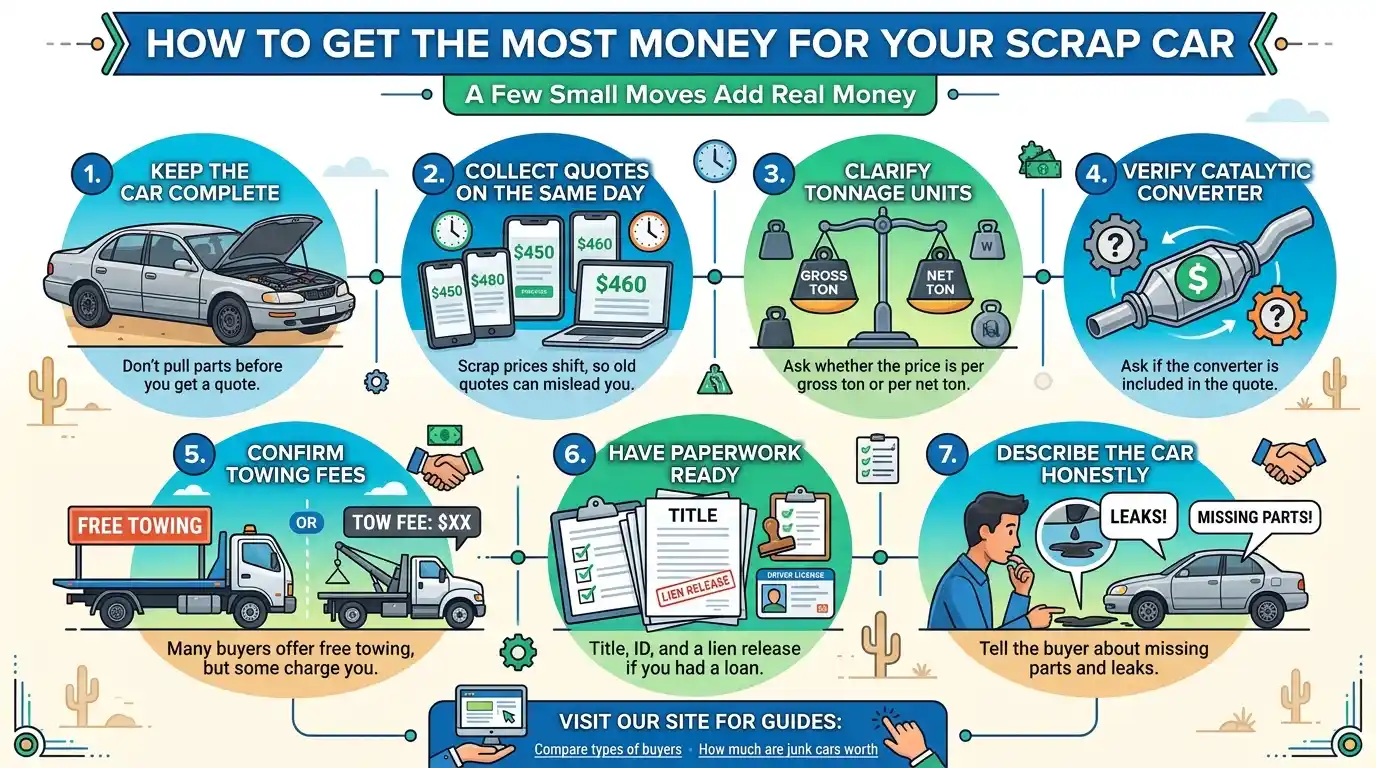
A few small moves add real money.
- Keep the car complete. Don’t pull parts before you get a quote.
- Collect quotes on the same day. Scrap prices shift, so old quotes can mislead you.
- Ask whether the price is per gross ton or per net ton.
- Ask if the converter is included in the quote.
- Ask about the tow fee. Many buyers offer free towing, but some charge you.
- Have your paperwork ready: title, ID, and a lien release if you had a loan.
- Describe the car honestly. Tell the buyer about missing parts and leaks.
Our guide on who pays the highest price for a junk car compares the types of buyers. Our post on how much junk cars are worth covers more price ranges.
Paperwork and Rules for Scrapping a Car in Arizona
Arizona buyers follow a few state rules. Knowing them keeps the sale clean.
Title, ID, and Lien Release
Bring your title and a photo ID. The title shows the VIN, which is your car’s 17-character ID number. If you lost it, you can order a duplicate title from ADOT MVD. If you have no title at all, read how to sell a junk car with no title.
After the Sale
Tell ADOT MVD that you sold the car. This protects you if the buyer gets a ticket later. Ask MVD what to do with the plates. Check the current steps on the ADOT site, since the process can change.
Fluids and Battery Rules
A junk car holds oil, coolant, brake fluid, transmission fluid, and gas. The battery holds lead and acid. These must be drained and recycled under rules that the EPA and state agencies set. A licensed dismantler has the equipment to do this. You never need to drain anything yourself. Be careful with any buyer who skips the title or doesn’t ask about fluids.
Sell Your Scrap Car to Redline Roadside & Towing LLC
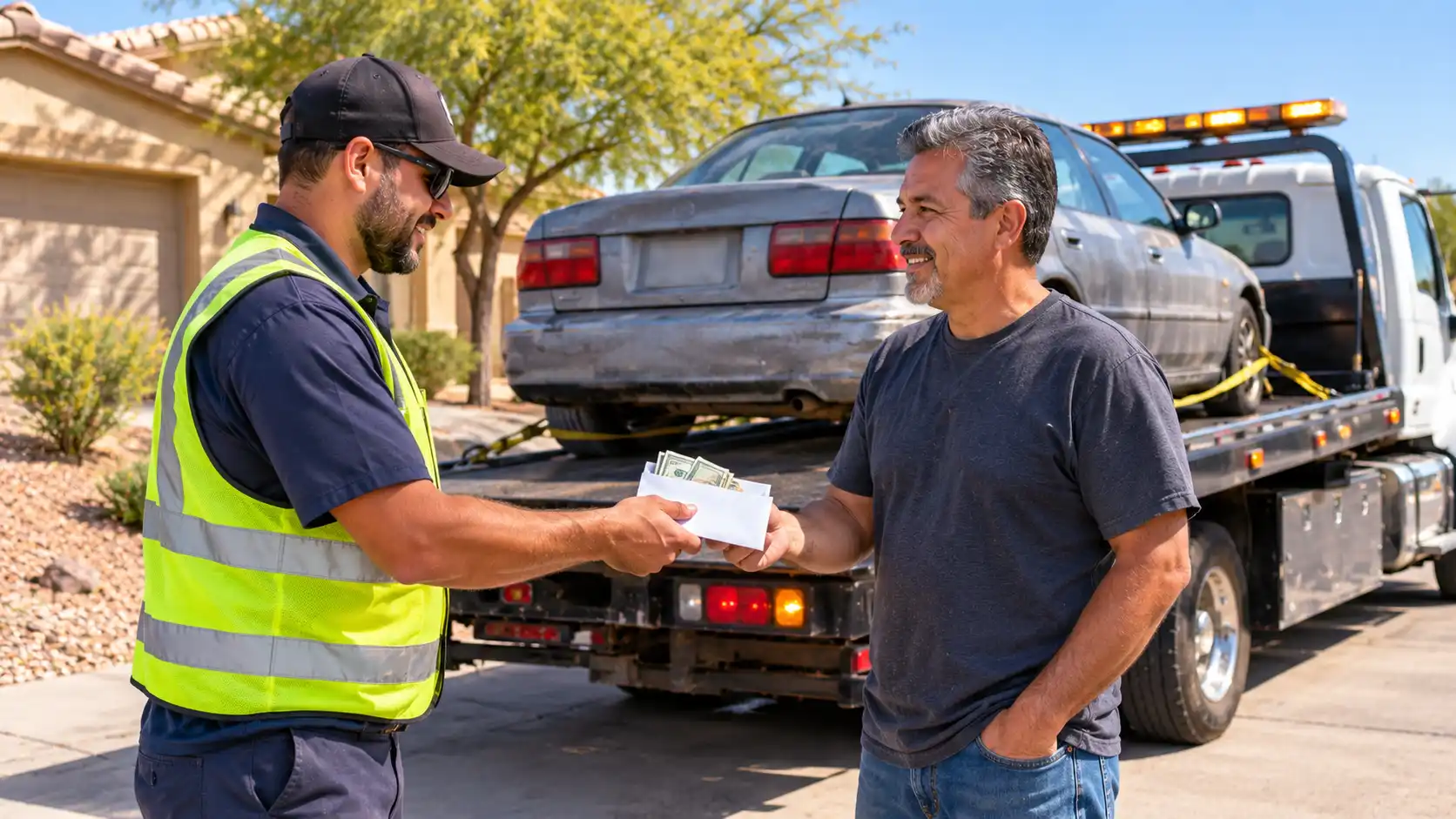
What is the scrap value of a car in Phoenix today? A phone call gives you the real number. Redline Roadside & Towing LLC offers a 24/7 We Buy Junk Cars in Phoenix AZ service. We pay cash for running and non-running cars, trucks, and SUVs.
Confirm Redline’s actual minimum and maximum purchase amounts before publishing a specific payout range. It’s better to make a truthful offer than promise customers money you cannot guarantee.
We buy junk cars in Phoenix, Avondale, Tolleson, Laveen, and across the West Valley.
Ready for a real number? Call (602) 549-8722 now. A Redline dispatcher answers 24/7 and sends a flatbed to your door.
Know Your Number Before You Call
You now know what is the scrap value of a car, how to work it out, and what moves the price. Use the weight formula, ask about the ton and the converter, Redline Roadside & Towing LLC for a real offer today.
Have questions about your own car? Contact us today and tell us the make, model, and condition. We will get back to you fast.
FAQs
How much is a car worth for scrap?
Most cars bring $150 to $750. Weight, the converter, and the buyer decide where yours lands.
What is the scrap value per pound?
At $165 to $215 per net ton, a car pays about 8 to 11 cents per pound. Gross-ton quotes work out lower per pound.
Do I need a title to scrap a car?
In most cases, yes. Some buyers accept other papers, but expect a lower offer.
Does a running car change the value?
Yes. A car that runs has resale value above its metal weight. Check its market price before you scrap it.
How often do scrap prices change?
Mills post new prices every month, and yards adjust from there. Get same-day quotes.
Is the converter worth more than the car’s metal?
Often, yes. On many cars the converter is the single most valuable part.