A tow truck wheel lift raises and supports one end of a disabled vehicle while the other wheels remain on the road. It uses a hydraulic system, a wheel-support yoke, and secure straps to hold the vehicle during transport.
Learning how to use a tow truck wheel lift involves more than raising a car. The operator must inspect the equipment, check the vehicle’s drivetrain, position the wheel supports, secure the tires, and confirm the setup before driving.
What Is a Tow Truck Wheel Lift and How Does It Work?
A tow truck wheel lift is a hydraulic device fitted to the rear of a tow truck. It lifts either the front or rear wheels of another vehicle off the ground. The remaining wheels stay on the road when the vehicle’s towing instructions allow it.
The system uses a metal support called a yoke or wheel cradle. It moves beneath the selected tires and supports them during lifting. Hydraulic controls operate the lifting arm and adjust its position.
Wheel-lift towing is different from older hook-and-chain towing. A wheel lift supports the tires instead of placing chains around the vehicle’s axle or frame. This reduces the risk of body damage when the correct equipment and method are used.
Wheel lifts are common on light-duty tow trucks. They also come in different sizes for other towing needs.
What Are the Main Parts of a Wheel Lift?
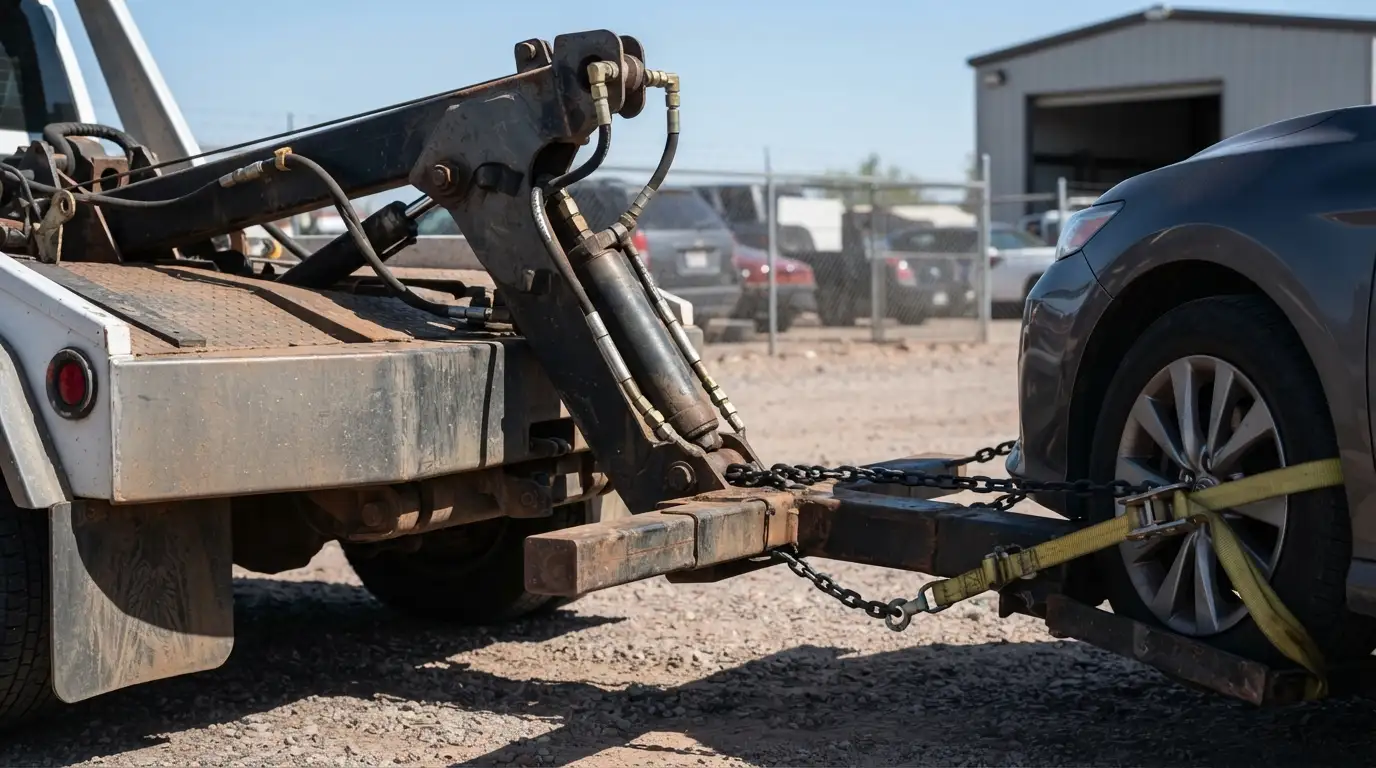
Understanding the main parts makes the wheel lift towing process easier to follow. Each component has a job in supporting and securing the vehicle.
| Part | What it does |
| Underlift | Extends from the rear of the tow truck and supports the lifting assembly. |
| Crossbar or T-bar | Holds the wheel-support attachments across the vehicle’s tires. |
| L-arms or forks | Fit around or beneath the tires, depending on the equipment design. |
| Wheel straps | Hold the tires securely against the wheel supports. |
| Hydraulic cylinders | Provide the force needed to raise and lower the assembly. |
| Hydraulic hoses | Carry hydraulic fluid between system components. |
| Hydraulic controls | Let the trained operator extend, position, raise, and lower the lift. |
| Safety chains | Provide secondary securement where the equipment instructions require them. |
Some systems use a hidden wheel lift that sits beneath the truck when not in use. Others use an exposed underlift. Self-loading models can also reduce the amount of manual positioning needed.
The exact design depends on the tow truck model and equipment manufacturer.
How to Use a Tow Truck Wheel Lift: Step-by-Step Process
The correct wheel lift towing process depends on the truck, lifting equipment, and vehicle being moved. The following steps explain the general procedure used by trained towing professionals.
Important: This is an educational overview, not a substitute for operator training. Always follow the specific wheel-lift manual, vehicle towing instructions, and applicable safety rules. Never operate equipment beyond its rated limits.
1. Inspect the Tow Truck and Wheel-Lift Equipment
Before starting, the operator checks the tow truck and its lifting system. A damaged part can cause the vehicle to shift or fall during transport.
The inspection should include:
- Hydraulic hoses for leaks, cracks, or loose connections.
- Hydraulic cylinders for visible damage or fluid leaks.
- Wheel straps for cuts, worn stitching, and damaged hooks.
- Safety chains and attachment points for wear or damage.
- Crossbar, L-arms, and locking parts for proper condition.
- Hydraulic controls for correct operation.
- Equipment labels and rated lifting capacity.
The operator should also check the truck’s tires, lights, brakes, and other safety systems.
Never use damaged wheel-lift towing equipment. Replace faulty parts before beginning the job.
2. Position the Tow Truck Behind the Disabled Vehicle
The operator positions the tow truck where the underlift can reach the vehicle safely.
The truck should be aligned with the vehicle’s intended lifting direction. The operator also needs enough room to work around the rear of the tow truck.
Before using the hydraulic controls, the operator should:
- Check passing traffic and nearby hazards.
- Use warning lights and traffic control devices as needed.
- Choose a stable working surface.
- Avoid soft ground or unsafe slopes.
- Keep people away from the lifting area.
On a busy road, traffic protection comes first. A safe work area is essential before the lifting process begins.
3. Determine Which Wheels Should Be Lifted
This is one of the most important decisions in wheel-lift towing.
The operator must identify the vehicle’s drivetrain and check its towing instructions. Lifting the wrong end can damage the transmission, transfer case, or electric drive system.
Here are the main drivetrain types:
- Front-wheel drive (FWD): The front wheels provide power to move the vehicle.
- Rear-wheel drive (RWD): The rear wheels provide power.
- All-wheel drive (AWD): Power can reach all four wheels.
- Four-wheel drive (4WD): The system can drive both axles, often through a transfer case.
- Electric vehicles (EVs): Electric motors may generate power when their wheels rotate.
For some FWD and RWD vehicles, lifting the drive wheels may allow a wheel-lift tow. However, the vehicle’s manual determines the approved method.
AWD, 4WD, and electric vehicles often need all four wheels off the ground. This may require a flatbed or an approved wheel-lift and dolly setup.
Never guess based only on the vehicle’s appearance. Check the owner’s manual or manufacturer towing guide first.
4. Deploy the Wheel Lift and Position the Yoke
After confirming the correct lifting arrangement, the operator deploys the underlift.
The hydraulic controls extend or lower the lifting assembly. The operator then positions the crossbar and wheel supports around the selected tires.
Depending on the model, the equipment may use L-arms, forks, or another wheel cradle design.
The operator checks that:
- The crossbar is correctly aligned with the tires.
- Both wheel supports sit in their intended positions.
- The tires are properly centered.
- No brake lines, suspension parts, or body panels are trapped.
- The lifting assembly is correctly locked.
The wheel supports must contact the tires as intended. Incorrect placement can cause the vehicle to shift when raised.
5. Secure the Wheels With Straps and Safety Devices
Once the tires are supported, the operator fits the approved wheel straps.
Wheel straps hold the tires in place and help prevent movement during transport. They must be suitable for the equipment and vehicle.
The operator checks that each strap:
- Fits around the correct part of the tire.
- Has no twists or visible damage.
- Is positioned according to the equipment instructions.
- Is tightened to the manufacturer’s requirements.
- Does not touch sharp edges or damaged parts.
Safety chains or other secondary securement devices must also be fitted when required by the equipment manual.
The operator should never use a random attachment point or assume that a tight strap is automatically safe. Every securement device must be used as designed.
6. Raise the Vehicle and Verify the Setup
With the vehicle secured, the operator uses the hydraulic controls to raise it in a controlled manner.
The operator checks the vehicle’s movement throughout the lift. The tires should remain correctly seated in their supports.
Before transport, the operator confirms:
- The wheel straps remain secure.
- The required safety devices are attached.
- The lifted vehicle has enough ground clearance.
- The steering and remaining wheels can move as intended.
- The lift is within its rated capacity.
- The tow truck’s axle and chassis limits are not exceeded.
The vehicle’s weight is only one part of the calculation. Underlift extension and weight distribution also affect the load on the tow truck.
7. Transport the Vehicle and Monitor the Setup
Once all checks are complete, the operator can begin transport.
The tow truck should be driven at a safe speed for road and traffic conditions. Sudden braking, sharp turns, and fast acceleration can affect the load.
During transport, the operator should watch for:
- Unusual movement from the towed vehicle.
- Changes in steering or vehicle tracking.
- Loose straps or securement devices.
- Reduced ground clearance.
- Unusual noises or signs of equipment trouble.
If anything appears abnormal, the operator should stop in a safe location and inspect the setup before continuing.
8. Lower and Unload the Vehicle
At the destination, the operator parks on a suitable, stable surface.
The vehicle is lowered under control using the hydraulic system. Once its tires are safely supported on the ground, the operator removes the wheel straps and required secondary securement devices.
The underlift can then be retracted according to the equipment manual.
Before leaving, the operator checks the vehicle and equipment for any signs of damage. The tow truck is also prepared for its next job.
Which Vehicles Can Be Towed With a Wheel Lift?
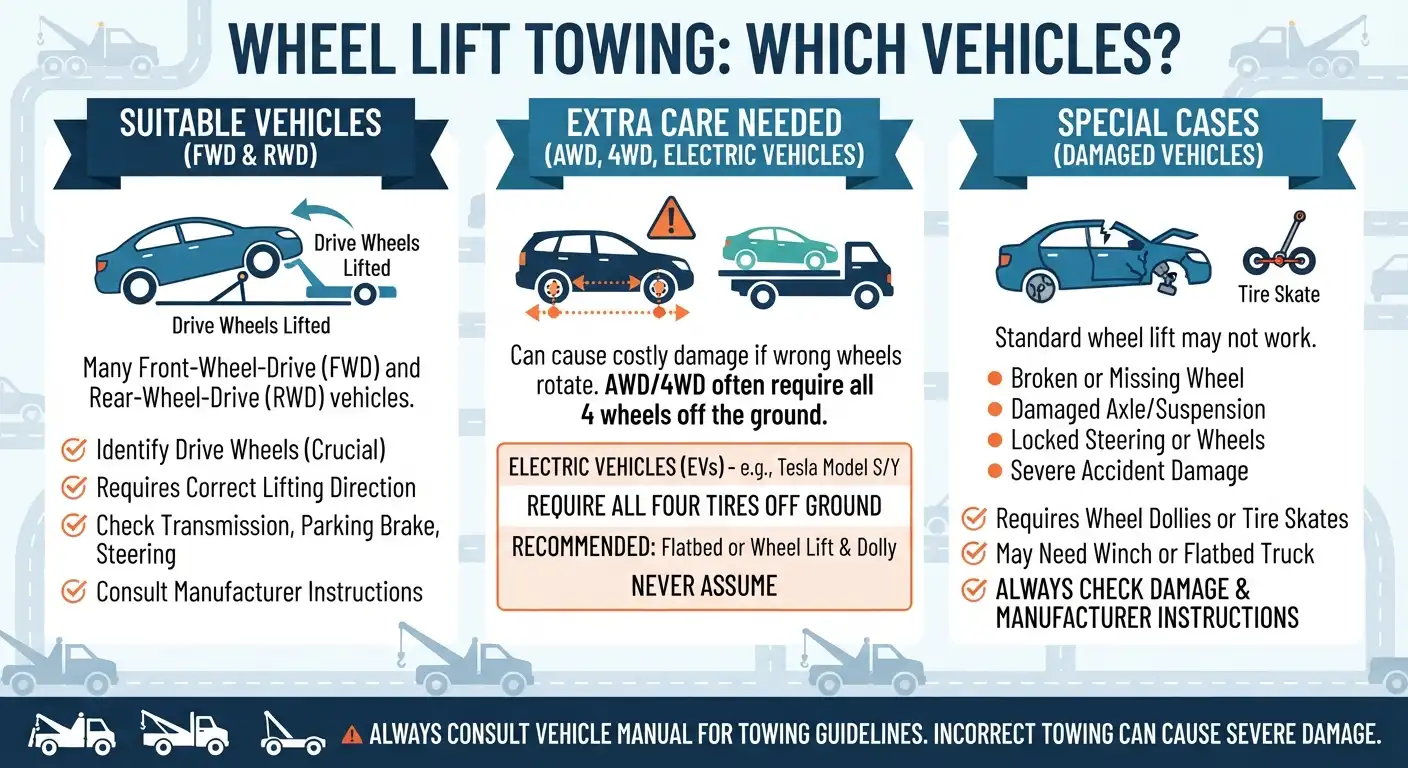
A wheel lift can tow many passenger cars, vans, and light trucks. However, the vehicle’s drivetrain, condition, and towing instructions determine whether this method is suitable.
Front-Wheel-Drive and Rear-Wheel-Drive Vehicles
Many FWD and RWD vehicles can be towed with one axle raised. The operator must identify the drive wheels and use the correct lifting direction.
The transmission, parking brake, and steering condition also matter. Some vehicles need extra equipment even when their drivetrain normally allows wheel-lift towing.
AWD, 4WD, and Electric Vehicles
AWD and 4WD vehicles need extra care because their drivetrain may connect both axles. Letting the wrong wheels rotate during towing can cause costly damage.
Electric vehicles also have model-specific transport rules. For example, Tesla’s Model S and Model Y transport instructions require all four tires to remain off the ground during transport. Tesla recommends a flatbed or an approved wheel-lift and dolly arrangement.
A flatbed is often the simplest choice for these vehicles. Never assume every AWD or EV can be towed with only two wheels raised.
Vehicles With Damaged Wheels or Suspension
A standard wheel lift may not work when a vehicle has:
- A broken or missing wheel.
- A damaged axle or suspension.
- A locked steering system.
- A seized or locked wheel.
- Severe accident damage.
In these cases, the operator may need wheel dollies, tire skates, a winch, or a flatbed tow truck. The right choice depends on the damage and the vehicle manufacturer’s instructions.
Wheel Lift Capacity: What Should You Check Before Towing?
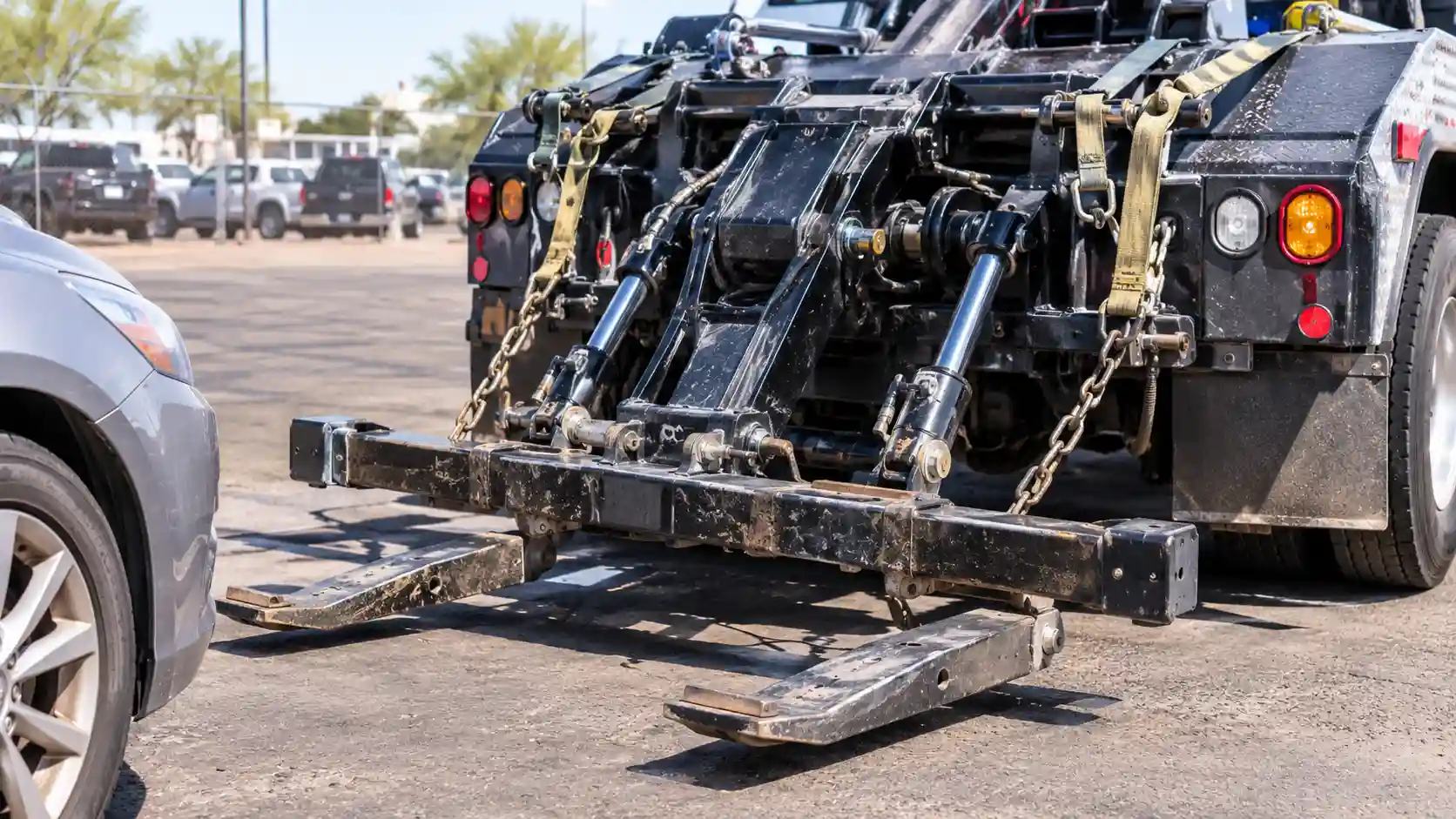
Every wheel lift has rated limits. The operator must check these limits before lifting a vehicle.
Here are the main terms to understand:
| Term | Meaning |
| Lifting capacity | The maximum load the lift can raise under its rated conditions. |
| Towing capacity | The approved load the equipment can support during towing. |
| GVWR | Gross Vehicle Weight Rating. The maximum allowed weight of the tow truck itself when loaded. |
| GAWR | Gross Axle Weight Rating. The maximum allowed weight on a specific axle. |
| WLL | Working Load Limit. The maximum permitted working load of a rated component. |
| Underlift extension | How far the lifting arm extends from the tow truck. |
One important detail is that extending the underlift can change the load placed on the tow truck’s rear axle.
Jerr-Dan’s operating manual warns that a wheel lift can increase rear axle load and reduce front axle load. Overloading can affect steering and braking, damage the truck frame, and create unsafe conditions.
The operator must consider the complete setup, not just the weight of the disabled vehicle.
Common Wheel-Lift Towing Mistakes to Avoid
Even good equipment can cause problems when used incorrectly. These are some common mistakes operators should avoid.
- Exceeding equipment capacity: Going beyond the rated limits can damage the lift and tow truck.
- Choosing the wrong lifting direction: Incorrect wheel selection can damage the drivetrain.
- Positioning the yoke incorrectly: Poor tire placement can cause the vehicle to shift.
- Using damaged straps: Worn straps may fail under load.
- Ignoring AWD and 4WD restrictions: Some vehicles require all four wheels off the ground.
- Towing vehicles with damaged wheels: A standard wheel lift may not support the vehicle safely.
- Skipping the final inspection: Loose securement or poor clearance can create problems during transport.
A careful inspection before moving the vehicle can prevent damage and reduce roadside risks.
How Much Does Wheel-Lift Towing Cost in Phoenix, AZ?
Wheel-lift towing prices depend on distance, vehicle size, pickup location, time of day, and the work required.
A useful way to understand the bill is to separate the initial hookup charge from the mileage charge.
Published Phoenix-area price estimates provide the following example ranges:
| Cost item | Example price |
| Local tow under 5 miles | $75–$125 |
| First 5 miles | Often included in the base price |
| Each additional mile | $3–$5 |
| After-hours or holiday fee | $25–$50 |
These are market examples, not fixed rates or a quote from Redline Roadside & Towing LLC.
Example: Suppose a vehicle needs a 10-mile tow. If the first five miles are included, the remaining five miles could add $15–$25.
That gives an estimated total of $90–$150 before any extra fees.
Actual prices vary between towing companies. A damaged wheel, locked steering, winching, or special equipment can increase the cost.
Before agreeing to a tow, ask the company to confirm:
- The hookup or base charge.
- The mileage rate.
- Any after-hours fees.
- Extra charges for special equipment.
- The total estimated price before loading.
A clear price helps you avoid surprises when the vehicle reaches its destination.
When Should You Call a Professional Tow Truck Operator?
Operating a wheel lift requires proper training, suitable equipment, and knowledge of vehicle towing rules. It is not a job to attempt with improvised tools or an unfamiliar hydraulic system.
If your car breaks down, a trained operator can check its drivetrain, condition, and towing requirements before choosing the right method.
For work trucks and larger commercial vehicles, choosing equipment that matches the vehicle’s weight is especially important. Redline Roadside & Towing LLC provides towing support across Phoenix and the West Valley.
If your work truck needs assistance, our 24/7 Medium Duty Towing in Phoenix AZ service.
Conclusion: Understanding the Wheel-Lift Towing Process
A wheel lift uses hydraulic power and a wheel-support system to raise one end of a vehicle for towing. The operator must inspect the equipment, check the drivetrain, position the yoke, secure the tires, and verify the load before moving.
The correct method always depends on the vehicle and equipment manufacturer’s instructions. Proper training and securement help protect the vehicle, tow truck, and everyone on the road. Need reliable towing for your vehicle or work truck? Contact Redline Roadside & Towing LLC or call at (602) 549-8722. Get professional help and a clear price before the tow begins.
FAQs
How does a tow truck wheel lift work?
A wheel lift uses hydraulic power to raise one end of a vehicle. A metal yoke supports the selected tires, while straps keep them secure during transport.
How do you secure a vehicle to a wheel-lift tow truck?
The operator positions the tires correctly in the wheel supports and fits approved wheel straps. Required safety chains and other securement devices are checked before lifting.
Can a wheel-lift tow truck tow an AWD vehicle?
Yes, some wheel-lift systems can tow AWD vehicles when combined with approved dollies. All four wheels must remain off the ground when the vehicle manufacturer’s instructions require it.
Is wheel-lift towing safe for a car?
Yes, when the vehicle is compatible with the equipment and the operator follows the correct towing procedure. Incorrect wheel placement or poor securement can cause damage.
What is the difference between wheel-lift and flatbed towing?
A wheel lift raises one end of a vehicle while the other wheels may remain on the road. A flatbed carries the entire vehicle with all four wheels off the ground.
Can a wheel lift tow a car with a flat tire or damaged wheel?
It depends on the damage. A flat tire may still be supported with suitable equipment, but a broken wheel or damaged suspension may require dollies, skates, or flatbed towing.