
Redline Roadside & Towing LLC

Jump Start

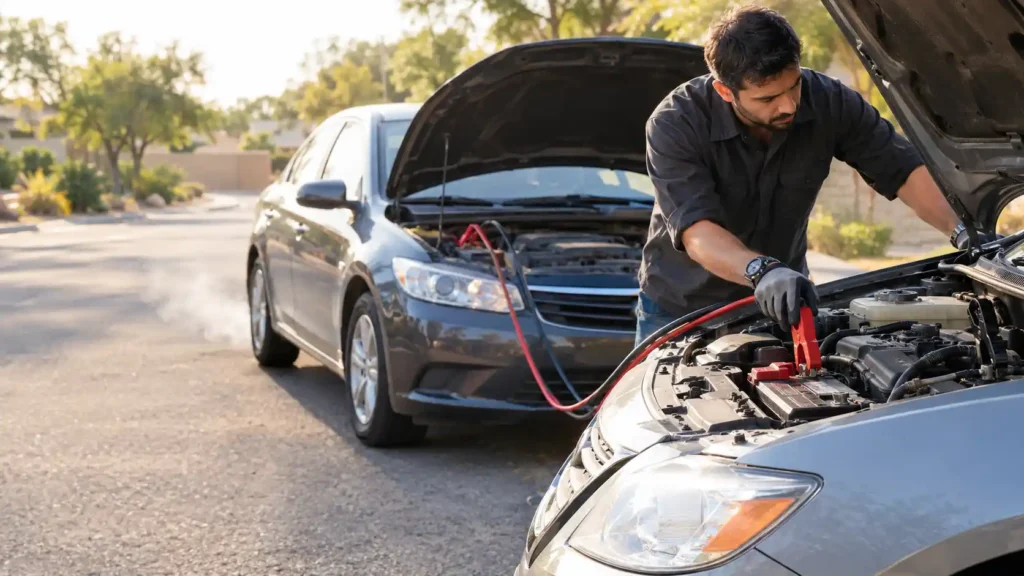
Man connecting jumper cables to learn how long does it take to jump a car battery outdoors.
Jump Start

How Long Does It Take to Jump a Car Battery? A Clear Timeline

How long does it take to jump a car battery? It takes 5 to 15 minutes to jump a car battery once cables are connected. Let the working car run for 3 to 10 minutes to charge the dead battery before cranking the engine. Once started, safely remove the cables and drive your car for 20 to 30 minutes so the alternator can recharge the battery. If you use a portable jump box instead of another vehicle, the process takes under 2 minutes. Below, Redline Roadside & Towing LLC walks you through each step of a jump start. You will see what slows it down and when to stop. A donor vehicle and a good set of cables are all you need. Jump Start Times at a Glance How long does it take to jump a car battery in real life? It depends on how drained the battery is, how old it is, and the weather. A weak battery still cranks the engine, just slowly. A dead battery gives you clicks or silence. Dead ones take longer. Typical times take to jump start, by situation: Situation Time to start What to expect Healthy but drained (lights left on) 5 to 10 minutes Starts after a short wait Older battery (3+ years) 10 to 20 minutes May need a second try Cold morning 15 to 30 minutes Slow charge, longer wait Portable jump starter 2 to 5 minutes No second car needed Failed jump Stop after 2 to 3 tries Look for another cause Those numbers show how long to jump a dead battery in common cases. Your own time may land a little above or below them. The Jump Start Timeline, Minute by Minute How long does it take to jump start a car from start to finish? About 10 to 15 minutes. Here is how the time breaks down. Minutes 0 to 3: Set up. Park the donor vehicle close enough for the cables to reach. Keep the cars from touching. Put both cars in park, or neutral for a stick shift. Set the parking brakes. Turn both engines off and pop both hoods. Find each battery. The owner’s manual shows where it is. Minutes 3 to 5: Clamp on the cables. Cable order matters. Follow it every time. Red clamp on the positive (+) terminal of the dead battery. Other red clamp on the positive (+) terminal of the donor battery. Black clamp on the negative (-) terminal of the donor battery. Last black clamp on unpainted metal on the dead car, away from the battery. A thick bolt or engine bracket works well. This is your ground. Minutes 5 to 10: Wait. Start the donor vehicle and let it idle for 2 to 5 minutes. Then try the dead car. If it starts, leave it running. If not, wait 3 to 5 more minutes and try again. Minutes 10 to 12: Disconnect. Remove the clamps in reverse order. Take off the black ground clamp first, then the black on the donor. Next, remove the red on the donor, then the red on the dead battery. Never let the clamps touch each other. Keep the engine running after you unhook. Why Some Jumps Take 5 Minutes and Others Take 30 Time depends on how much power the dead battery has left and how well power can flow. These are the main causes of a longer jump. Battery age and charge level. A battery that just ran down overnight takes a quick boost. A battery that is old or fully drained needs more time. Most batteries last three to five years, so one near that age may struggle. Weather. Cold slows the chemistry inside a battery. Heat wears it out faster over time. Both can add minutes. Cables. Thin or damaged cables carry less power. Cable gauge tells you how thick they are, and a lower number means thicker. Choose a thick set with firm clamps. The donor vehicle. A small engine and a small battery push less power. A bigger donor helps. Make sure it is running well. Corrosion. White or blue crust on the terminals blocks power. Clean it off if you can do so safely. Weak starting power. A battery has a CCA rating, which means cold cranking amps. Low CCA means a weak start in cold weather. Accessories on. Lights, radio, and heat pull power away from the start. Turn them off first. A car left sitting. A car parked for weeks can lose charge through parasitic drain. That is a small drain that runs even when the car is off. A bad alternator or starter. These make the car hard to start, and no amount of waiting fixes them. How Long to Drive After a Jump (Idling Won’t Cut It) After a jump start, the car must be driven constantly for at least 30 minutes ideally on the highway while all non-essential amenities, such as the air conditioner and audio, are turned off to maximise alternator performance. Since an alternator is meant to keep a battery healthy rather than recharge a severely depleted one, idling or brief city drives provide insufficient power to revive a flat battery. For a permanent solution, the battery should be linked to a specialised smart charger at home or evaluated at a local auto parts store to discover whether it needs replacement.  Jumping With a Portable Starter: Is It Faster? Yes. A portable jump starter usually takes 2 to 5 minutes. You do not need a second car or a wait for a donor engine to idle. Here is how to use a jump pack well: Charge level. A pack that is low on charge will fail. Top it up every few months. Peak amps. Match the amp rating to your engine. Big engines and diesels need more power than small cars. Reverse polarity protection. Good packs beep or block power if you swap the clamps by mistake. Still, always check red and black. The steps. Red clamp
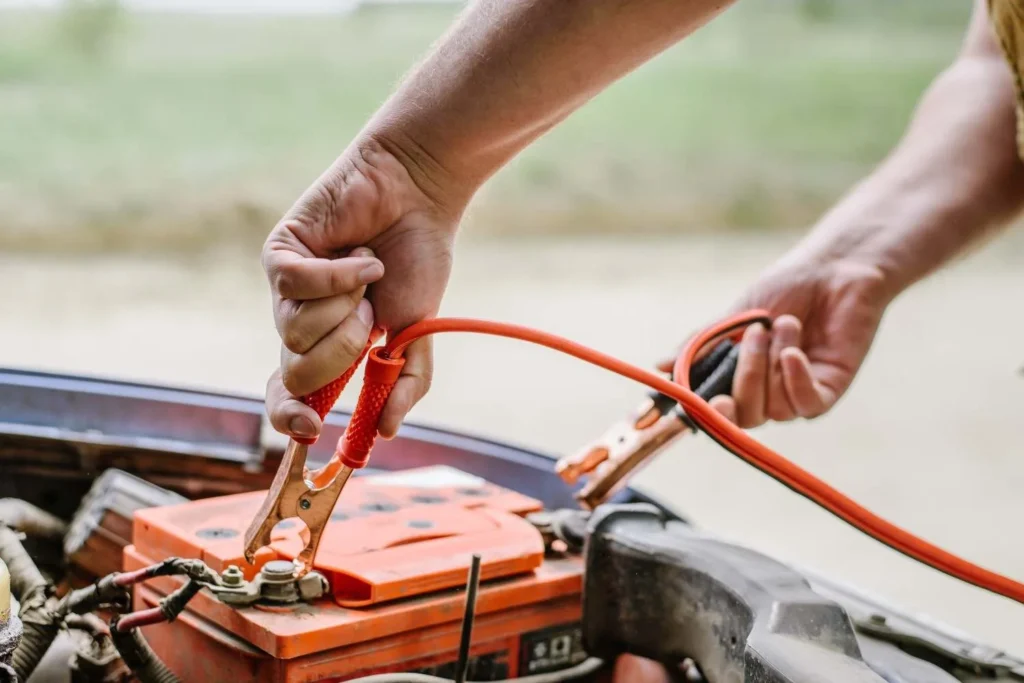
Person connecting jumper cables to a dead car battery under the hood.
Jump Start

What to Do If Car Battery Dies? (Step-by-Step, Every Scenario)

Your car won’t start, the dashboard lights are barely on, and you’re not sure what’s wrong. Knowing what to do if car battery dies to three quick moves: check the warning signs, try a jump-start, and know when to call for help. If your battery dies, check for warning signs first, like dim lights or a clicking sound. Then try a jump-start using jumper cables and a car with a healthy battery, connecting the positive and negative terminals in the right order. If the engine still won’t turn over, call for roadside assistance. Redline Roadside & Towing LLC handles this every day. First: Which Situation Are You In? Not every dead battery looks the same, and the right fix depends on where you are when it happens. If your car is parked and simply won’t start, you’re in the easiest spot. You likely have time, space, and maybe jumper cables or a neighbor nearby. If it died while you were driving, that’s a different problem and a more urgent one. Skip ahead to the safety steps below before you try anything else. You’re stranded with no tools, no other car, and no one nearby, you’ll want the section on calling for help. There’s no shame in that. It’s often the fastest and safest option anyway. Figure out which situation matches yours, then jump to that section. That’s really what do you do when your car battery dies: match your situation to the right response instead of guessing at steps that don’t apply. Is It Actually the Battery? (10-Second Check) If you’re standing in a parking lot thinking car battery died what do I do, the first move is a ten-second check, not the jumper cables. A dead starter or an empty gas tank can look almost identical to a dead battery at first. Turn the key or press the start button and pay attention to what happens. Dashboard lights come on but look dim or flicker: likely a weak battery. You hear a rapid clicking sound: the battery probably doesn’t have enough charge left to turn the starter. Nothing happens at all, no lights and no sound: could still be the battery, but check that the car is actually in park or neutral first. The radio and interior lights work fine, but the engine won’t crank: that points to the starter, not the battery. The engine cranks slowly, like it’s struggling to turn over: the battery has some charge left, just not enough. Dim lights, a slow crank, or that clicking sound all mean the battery is your problem. Move on to the jump-start steps below. If everything else is dead too, including the radio, the issue might be bigger than a dead battery, and a jump-start likely won’t fix it. If It Died While You Were Driving This is the moment that matters most, and it’s the part most guides skip completely. Turn on your hazard lights right away. Ease off the gas and steer toward the shoulder or the nearest safe spot, away from moving traffic. Don’t slam the brakes. Once you’re stopped, shift into park and set the parking brake. Stay inside the car if you’re on a busy road, and get out only once it’s safe to do so. Here’s something worth knowing. If your car actually died while driving, rather than just failing to start in the first place, the battery usually isn’t the real cause. A healthy battery keeps the engine running once it’s already on. When a car stalls mid-drive, the alternator or the charging system is the more likely culprit. A jump-start might get you moving again for a few minutes, but get the charging system checked before you drive very far. How to Jump-Start It Safely (Cables) If your car won’t start and you suspect the battery is dead, a jump-start may get you back on the road. Before starting, make sure you have a set of jumper cables and another vehicle with a working battery. Park the vehicles close enough for the cables to reach, but never let the two vehicles touch. Follow these steps carefully: Park both vehicles safely. Put both cars in Park or Neutral, turn off the engines, and apply the parking brakes. Open both hoods and locate the batteries. Check the positive (+) and negative (–) terminals before connecting anything. Connect the red clamp to the dead battery. Attach the red positive (+) clamp to the positive terminal of the dead battery. Connect the other red clamp. Attach it to the positive (+) terminal of the working battery. Connect the black clamp to the working battery. Attach the black negative (–) clamp to the negative terminal of the good battery. Ground the final black clamp. Attach it to a clean, unpainted metal part of the dead vehicle, such as a suitable engine bolt or bracket. Avoid connecting it directly to the dead battery’s negative terminal when the vehicle manufacturer’s instructions recommend a remote ground. Start the working vehicle. Let it run for a few minutes to allow some charge to reach the dead battery. Try starting the vehicle with the dead battery. If it starts, leave the engine running and follow the vehicle manufacturer’s guidance on how long to keep it running or whether to drive it to recharge the battery. Common Jump-Start Mistakes to Avoid Jump-starting a car is straightforward, but the connections need to be made carefully. Never allow the jumper clamps to touch each other while they are connected to a battery, as this can create sparks. Connecting the cables incorrectly can also damage sensitive electrical components. It’s also important to keep sparks, cigarettes, flames, and other ignition sources away from the battery. Car batteries can release hydrogen gas and contain corrosive acid, so use caution throughout the process. If the vehicle still won’t start after a proper jump-start attempt, the battery may be completely discharged, damaged, or there may be another issue with the starting or charging system. In that situation,

Scroll to Top