
How long does it take to jump a car battery? It takes 5 to 15 minutes to jump a car battery once cables are connected. Let the working car run for 3 to 10 minutes to charge the dead battery before cranking the engine. Once started, safely remove the cables and drive your car for 20 to 30 minutes so the alternator can recharge the battery. If you use a portable jump box instead of another vehicle, the process takes under 2 minutes.
Below, Redline Roadside & Towing LLC walks you through each step of a jump start. You will see what slows it down and when to stop. A donor vehicle and a good set of cables are all you need.
Jump Start Times at a Glance
How long does it take to jump a car battery in real life? It depends on how drained the battery is, how old it is, and the weather. A weak battery still cranks the engine, just slowly. A dead battery gives you clicks or silence. Dead ones take longer.
Typical times take to jump start, by situation:
| Situation | Time to start | What to expect |
| Healthy but drained (lights left on) | 5 to 10 minutes | Starts after a short wait |
| Older battery (3+ years) | 10 to 20 minutes | May need a second try |
| Cold morning | 15 to 30 minutes | Slow charge, longer wait |
| Portable jump starter | 2 to 5 minutes | No second car needed |
| Failed jump | Stop after 2 to 3 tries | Look for another cause |
Those numbers show how long to jump a dead battery in common cases. Your own time may land a little above or below them.
The Jump Start Timeline, Minute by Minute
How long does it take to jump start a car from start to finish? About 10 to 15 minutes. Here is how the time breaks down.
Minutes 0 to 3: Set up.
- Park the donor vehicle close enough for the cables to reach. Keep the cars from touching.
- Put both cars in park, or neutral for a stick shift. Set the parking brakes.
- Turn both engines off and pop both hoods.
- Find each battery. The owner’s manual shows where it is.
Minutes 3 to 5: Clamp on the cables. Cable order matters. Follow it every time.
- Red clamp on the positive (+) terminal of the dead battery.
- Other red clamp on the positive (+) terminal of the donor battery.
- Black clamp on the negative (-) terminal of the donor battery.
- Last black clamp on unpainted metal on the dead car, away from the battery. A thick bolt or engine bracket works well. This is your ground.
Minutes 5 to 10: Wait. Start the donor vehicle and let it idle for 2 to 5 minutes. Then try the dead car. If it starts, leave it running. If not, wait 3 to 5 more minutes and try again.
Minutes 10 to 12: Disconnect. Remove the clamps in reverse order. Take off the black ground clamp first, then the black on the donor. Next, remove the red on the donor, then the red on the dead battery. Never let the clamps touch each other.
Keep the engine running after you unhook.
Why Some Jumps Take 5 Minutes and Others Take 30
Time depends on how much power the dead battery has left and how well power can flow. These are the main causes of a longer jump.
Battery age and charge level. A battery that just ran down overnight takes a quick boost. A battery that is old or fully drained needs more time. Most batteries last three to five years, so one near that age may struggle.
Weather. Cold slows the chemistry inside a battery. Heat wears it out faster over time. Both can add minutes.
Cables. Thin or damaged cables carry less power. Cable gauge tells you how thick they are, and a lower number means thicker. Choose a thick set with firm clamps.
The donor vehicle. A small engine and a small battery push less power. A bigger donor helps. Make sure it is running well.
Corrosion. White or blue crust on the terminals blocks power. Clean it off if you can do so safely.
Weak starting power. A battery has a CCA rating, which means cold cranking amps. Low CCA means a weak start in cold weather.
Accessories on. Lights, radio, and heat pull power away from the start. Turn them off first.
A car left sitting. A car parked for weeks can lose charge through parasitic drain. That is a small drain that runs even when the car is off.
A bad alternator or starter. These make the car hard to start, and no amount of waiting fixes them.
How Long to Drive After a Jump (Idling Won’t Cut It)
After a jump start, the car must be driven constantly for at least 30 minutes ideally on the highway while all non-essential amenities, such as the air conditioner and audio, are turned off to maximise alternator performance.
Since an alternator is meant to keep a battery healthy rather than recharge a severely depleted one, idling or brief city drives provide insufficient power to revive a flat battery. For a permanent solution, the battery should be linked to a specialised smart charger at home or evaluated at a local auto parts store to discover whether it needs replacement.
Jumping With a Portable Starter: Is It Faster?
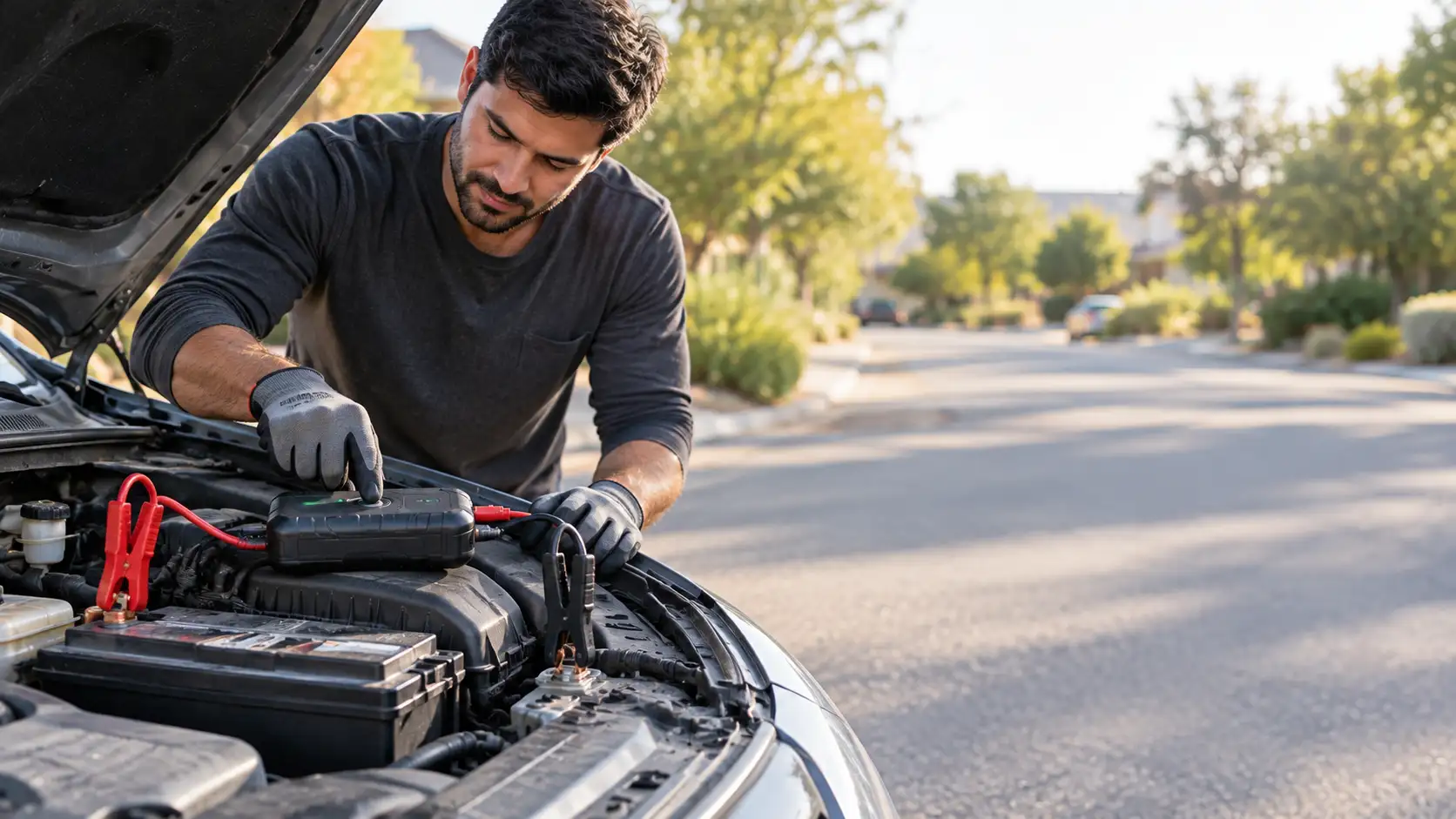
Yes. A portable jump starter usually takes 2 to 5 minutes. You do not need a second car or a wait for a donor engine to idle.
Here is how to use a jump pack well:
- Charge level. A pack that is low on charge will fail. Top it up every few months.
- Peak amps. Match the amp rating to your engine. Big engines and diesels need more power than small cars.
- Reverse polarity protection. Good packs beep or block power if you swap the clamps by mistake. Still, always check red and black.
- The steps. Red clamp on positive, black clamp on negative or bare metal, then turn the pack on and start the car. Follow your pack’s manual.
A stick shift can also be push started. You need a helper and a clear road. Turn the key on, hold the clutch in, and shift into second gear. Once the car rolls, release the clutch. Check your owner’s manual first, since some cars warn against this.
When the Jump Does Not Work: Know When to Stop
Stop after 2 or 3 tries. More tries will not help if the problem is not the battery.
Listen to the sound. Fast clicking means low power, and a jump may still work. One loud click or no sound with bright lights points to a starter or a loose connection. If the engine turns over but never starts, the cause is likely fuel or spark.
Common causes of a failed jump:
- A bad starter
- A failing alternator (the car starts, then dies)
- A dead cell inside the battery
- A loose clamp or corroded terminal
Hybrids and EVs have a small 12V battery for starting. Use the jump point shown in the owner’s manual. Never touch the high voltage parts.
Stuck with a car that will not start? Our guide on What to Do If Car Battery Dies covers your next steps.
Waiting for a Pro: Arrival Time and Real Costs
Calling a pro takes the guesswork out. 10 to 30 minutes of Redline’s real average arrival time is what most customers wait. The jump itself takes about 10 to 15 minutes once we arrive.
Here is what to expect on cost:
- Service call: (602) 549-8722. This covers the visit and the jump.
- Battery test: A quick check shows if your battery is worth keeping.
- New battery: Most replacements cost between $120 and $300, which often includes the battery, installation, a system test, and disposal of the old one.
- Tow: If the jump fails and the car will not run, a tow gets it to a shop.
Many roadside plans include a free jump, so check yours first.
Dead battery right now? We serve 24/7 towing, roadside assistance and Jump Start Service in Phoenix and across the area. We come to you, jump your car, and test your battery on the spot.
Stop the Next Dead Battery Before It Happens
Most dead batteries give signs first. Slow cranking, dim lights, and a warning light mean trouble.
- Test it at 3 years. Then test it every year after that.
- Clean the terminals. Mix baking soda and water, scrub the crust, and wipe dry. Wear gloves.
- Check the hold-down bracket. A loose battery shakes, and shaking harms the plates inside.
- Skip too many short trips. The engine needs time to refill the battery.
- Watch for heat. Summer heat shortens battery life, so test before the hot months.
Final Word: Plan for 15 Minutes, Then Drive
So, how long does it take to jump a car battery? Give it 10 to 15 minutes, then drive for 30. Use the right cable order, stop after 2 or 3 failed tries, and test the battery soon after.
If you want help, Redline Roadside & Towing LLC is ready. Contact us and we will send a tech to jump your car.
FAQs
How long does it take to jump a dead battery?
Most jumps take 10 to 15 minutes. A fully dead or old battery can take up to 30. A portable jump starter can do the job in 2 to 5 minutes.
How long to jump a dead battery before trying to start the car?
Let the donor vehicle idle for 2 to 5 minutes first. Then try the dead car. If it does not start, wait 3 to 5 more minutes and try again.
How long should I leave jumper cables connected?
Leave them on until the car starts, then remove them right away in reverse order. Do not leave cables on longer than needed. Stop after 2 or 3 tries.
How long should I drive after a jump start?
Drive for about 30 minutes, ideally on the highway. Turn off accessories. Idling alone will not charge the battery enough.