Roadside assistance usually changes your flat tire using the spare already in your vehicle. It does not normally provide or pay for a brand-new tire. The technician removes the damaged wheel and installs your spare if it is safe to use. If you have no spare, a damaged rim, or another problem, you may need a tow to a tire shop.
This guide explains what roadside assistance covers, when a tire can be repaired, and what happens when you need a new one. It also covers typical costs, spare tire safety, and what Phoenix drivers should know before calling for help.
The Short Answer: Roadside Help Changes the Tire, It Does Not Replace It
People mix up two words here. Does roadside assistance replace your tire? It does not. It changes your tire, and those are two different jobs. Use this table to see what each flat tire case looks like.
| Situation | What roadside help does |
| Good spare | Swaps the spare on. You drive to a shop. |
| No spare | Adds air for a slow leak, or tows you to a shop |
| Flat spare | Adds air if the spare holds it, or tows you |
| Small puncture | Adds air, seals it with a string plug, or swaps the spare |
| Damaged rim | Cannot fix it. Tows you to a shop. |
Change vs Replace: What Each Word Means
A tire change means the crew takes the flat off and bolts your spare tire on. You still own the same flat tire. It sits in your trunk, and you still have a flat to deal with.
Tire replacement means a shop sells you a new tire and mounts it. Roadside crews do not carry stock for that. If a tow is the only way to reach a shop, the tow truck becomes your bridge to a replacement.
What Roadside Assistance Does for a Flat Tire
The work is simple and quick. The crew arrives with a jack and gear, and they handle the swap so you stay out of traffic.
Does Roadside Assistance Change a Flat Tire?
Yes, with your spare. The technician sets the jack on solid ground and loosens the lug nuts with a lug wrench. Then the flat tire change begins. They lift the car, pull the wheel, mount the spare, and torque the lug nuts in a star pattern. Most swaps take under 30 minutes.
Will Roadside Assistance Put on a Spare Tire?
Yes, if the spare is usable. The technician checks three things first:
- The spare has air. They test the pressure with a gauge.
- The spare is not cracked, dry, or flat.
- You have the locking wheel nut key, if your wheels use locking nuts.
If the spare fails any check, the crew cannot mount it safely.
Does Roadside Assistance Provide a Spare Tire?
No. The technician does not bring one. The spare must be yours, inflated, and in the car. Pop your trunk floor before you call and confirm it is there. That one check saves a lot of waiting.
Air, Tow, or Both
Slow leaks are a different story. A crew can run an inflator and add air to get you moving. That works when the tire holds pressure long enough to reach a shop.
When a swap is not possible, a tow is the fix. Many plans cap the tow distance. A mileage limit of about 5 miles on a basic plan is common, so a long haul can cost extra.
Will Roadside Assistance Plug a Tire?
Sometimes, but rarely. A plug sounds easy, yet the tire industry has strict rules about it.
Why Most Roadside Crews Skip the Plug
The tire industry says a proper repair means taking the tire off the wheel. Experts call that step a dismount. You cannot do it safely on a highway shoulder. The U.S. Tire Manufacturers Association also says a plug alone is not an acceptable repair. A good repair needs a plug-patch combo: a rubber stem fills the hole, and a patch seals the inner liner.
Some crews will push a string plug into a small hole from the outside. Treat that as a short-term seal. It gets you off the road and to a tire shop. It is not a fix to live with.
When a Puncture Can Be Repaired
The industry limit is a hole no bigger than 1/4 inch (6 mm), and only in the tread area. Here is how common damage stacks up.
| Damage type | Repairable? | Why |
| Center tread nail | Yes, at a shop | It sits in the tread and is under 1/4 inch |
| Large hole | No | Over 1/4 inch is past the repair limit |
| Sidewall | No | The sidewall flexes too much to hold a repair |
| Shoulder | No | The edge area is outside the safe repair zone |
| Run-flat driven flat | Usually no | Driving on it can damage the inside walls |
What to Do After a Temporary Fix
Drive straight to a tire shop. Do not wait a week. The shop pulls the tire off for a full inspection and decides on repair vs replace. If the inner liner is chewed up, you need a new tire. If the tire is clean, a plug-patch combo may save it.
When Roadside Help Cannot Change Your Tire
Some flats stop a swap cold. This table shows what happens next.
| Problem | Result |
| No spare | Air for a slow leak, or a tow to a shop |
| Flat spare | Crew inflates it if it holds air, or tows you |
| Bent rim | No swap. Tow to a shop. |
| Locked lug nut with no key | Crew cannot remove the wheel. Tow. |
| Two flats | Only one spare, so one tire is fixed. Tow is likely. |
| No jack or tools | Crew brings tools, so this one is usually fine |
| Run-flat tire | No spare exists. Tow or short drive per the manual. |
| Unsafe spot | Crew may tow you to a safer place first |
A tow brings mileage into play. Many plans include a set number of miles, and a per-mile fee kicks in after that. A flatbed is the best pick for a damaged wheel, since it lifts the whole car. Some newer cars carry a sealant kit instead of a spare. Use it on small tread holes only, then see a shop.
How to Get a New Tire After a Flat
This is the real replace path. It always runs through a shop or a mobile tire service.
Tow to a Shop vs Mobile Tire Service
| Tow to a tire shop | Mobile tire service | |
| Speed | Tow time plus shop wait | A van comes to you |
| Cost | Tow fee plus the tire | Tire plus a trip fee |
| What you get | Mounting, balancing, new valve stem, TPMS check | The same work done at your spot |
| Best for | Damaged rims, rare tire sizes | Easy flats and busy days |
Both paths end with new rubber on your wheel. A good install includes mounting, balancing, a fresh valve stem, and a check of the TPMS sensor.
Find Your Tire Size Before You Call
Look at the sidewall. You will see a code like P225/65R17. That is the width, the shape, and the wheel size. Read it to the shop and they can match it fast.
Next, find the DOT code. The last four digits show the build date. For example, 2423 means week 24 of 2023. Tires age even when the tread looks fine, and many car makers say to replace them around six years old. If you bought a road hazard warranty, dig out that paper. It may cover the new tire.
What a Flat Tire Costs With and Without Roadside Help
Prices shift by shop and by year. These ranges come from official club price pages and 2026 public rate guides. The last column is for Redline’s own prices.
| Item | Typical 2026 range | Redline price |
| Membership fee (yearly) | About $65 for basic plans, $115 to $155 for higher tiers | N/A |
| Pay-per-use tire change | Roughly $50 to $100 | Contact Redline for a quote based on your location and vehicle. |
| Tow per mile | $3 to $7 per mile after a $75 to $150 hookup | Contact Redline for an exact quote based on your pickup location, destination, and vehicle type. |
| Patch repair | About $20 to $60 | N/A |
| New tire installed | $120 to $350 for most cars and SUVs, more for trucks | N/A |
| Mobile tire service | Tire price plus about $45 to $90 per tire to mount and balance | N/A |
Membership vs Pay Per Use
Here is a simple example, not a quote. Say a tire change costs $75 and a 5-mile tow costs $125. One flat plus one tow is $200. A $65 plan pays for itself after one call.
Now say you drive little and never call. Then the plan costs $65 and gives you nothing back. Pay per use wins for low-risk drivers. A plan wins if you drive a lot, drive an older car, or have no spare. Check the call limit too. Many plans allow only four calls a year.
Spare Tire Facts Most Drivers Miss
A spare only helps if it is ready. These are the facts that trip people up.
- Compact spare limits: Many compact spares are rated for about 50 mph and a short distance, often near 50 miles. Your manual and the sidewall have the real numbers.
- Spare pressure: A compact spare often needs more air than your main tires, commonly around 60 PSI. Check the label.
- Spare age: A spare ages even if it never touches the road. Read its DOT date code.
- Locking wheel nut key: Keep it in the car, not at home in a drawer.
- Phoenix heat: Hot pavement and dry air bake rubber. Spares crack and lose air faster here.
A full-size spare works like your normal tires. A compact spare is a short-term tool only.
Quick checklist:
- Spare is in the car and holds air
- Jack and lug wrench are there
- Locking wheel nut key is in the car
- Spare DOT date code is under six years
- Spare pressure checked this month
For more, see the NHTSA tire safety page and the Spare tire page on Wikipedia.
What Happens When You Call for a Flat Tire Change
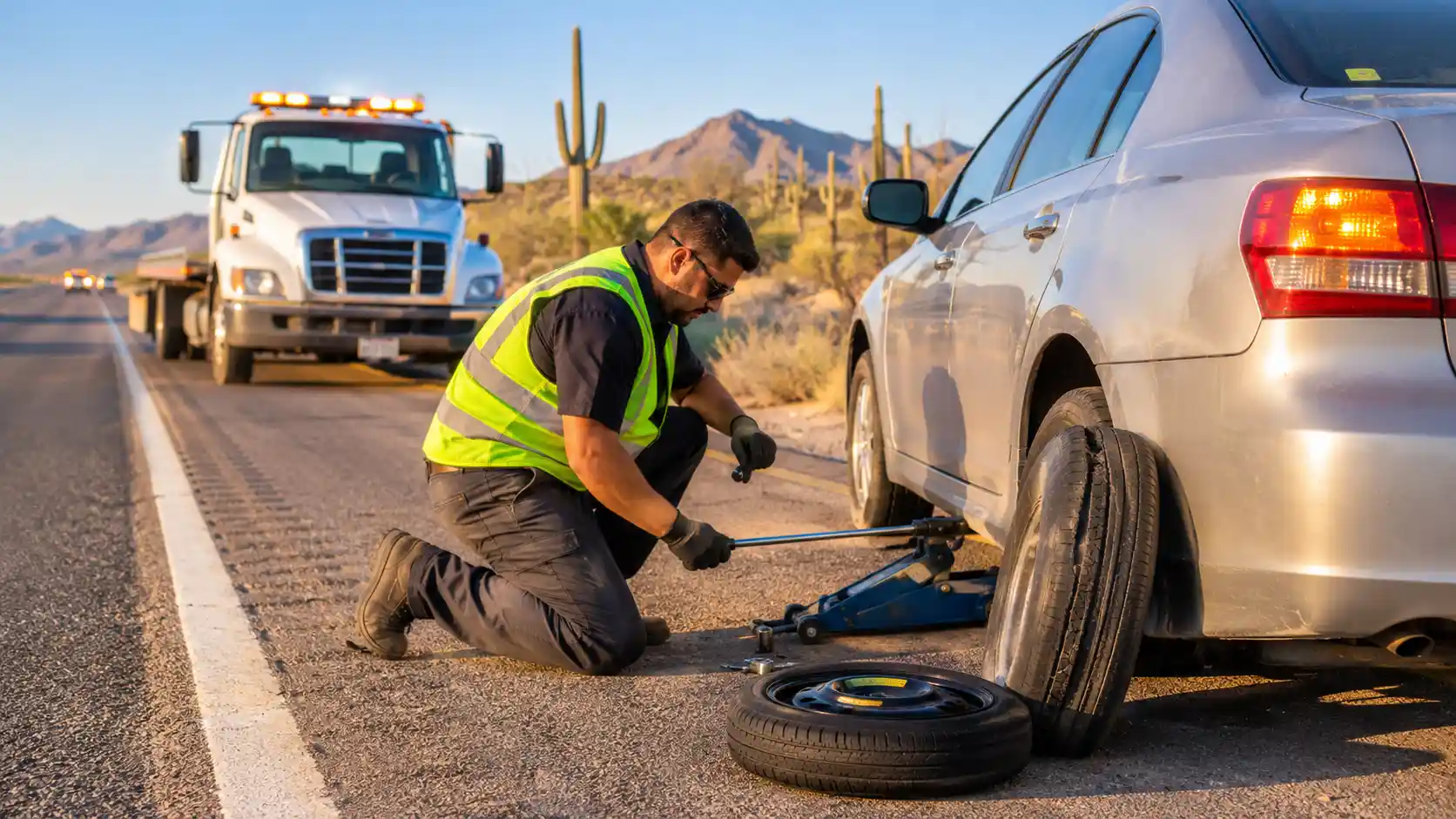
- Get to safety. Pull as far right as you can and stop on a flat, hard spot.
- Share your location. Give a cross street, mile marker, or a pin from your phone.
- Tell the dispatcher your spare and key status. Say if you have a spare, if it holds air, and if you have the locking wheel nut key.
- Confirm the arrival time. Ask for a time window and a phone number for the driver.
- The technician swaps the tire. You wait in a safe spot while they work.
- Drive to a shop. Keep to the spare’s speed limit and get the flat checked fast.
Curious about timing? Read How Long Does It Take to Change a Tire.
Stay Safe on the Shoulder and in Phoenix Heat
Turn on your hazard lights right away. Arizona’s Move Over law, A.R.S. 28-775, tells drivers to change lanes or slow down for a stopped vehicle with warning lights. A first violation carries a $275 penalty, per the state legislature’s fact sheet.
Summer pavement can top 150 degrees. Stay out of your car’s blind side and away from traffic. Stand behind the guardrail if you have one. Keep water with you, and call early so you are not baking in the sun.
Call Redline for a Flat Tire Change in Phoenix
Need a swap now? Our 24/7 Flat Tire Change in Phoenix AZ service sends a Redline Roadside & Towing LLC technician to you. Dispatch runs 24/7, and our arrival time is 10 to 25 minutes. We cover Phoenix, Avondale, Tolleson, Laveen, and the West Valley.
A flat tire change with Redline is priced based on your location and vehicle type. Before starting, our dispatcher confirms your spare tire condition, vehicle details, and exact location so we can send the right help. Call (602) 549-8722 for an upfront quote.
Stuck on the shoulder right now? Call (602) 549-8722. We answer 24/7, and a technician heads your way fast.
Conclusion
Does roadside assistance replace your tire? No. It swaps your flat for your spare and gets you to a shop, where the real replacement happens. Keep a ready spare, know your tire size, Redline Roadside & Towing LLC at (602) 549-8722 for a fast flat tire change in Phoenix.
Before your next trip, check your spare tire, pressure, jack, and lug wrench. If you need help on the road, contact us for assistance across Phoenix and the West Valley.
FAQs
Does roadside assistance replace your tire?
Usually, no. Roadside assistance changes your flat tire using the spare in your vehicle. It does not normally provide a new tire. If your spare is missing or damaged, you may need mobile tire service or towing.
Will roadside assistance put on a spare tire?
Yes. Most roadside providers install a spare if it is in good condition and suitable for your vehicle. The technician may check tire pressure, wheel condition, and the locking wheel nut key before starting.
Does roadside assistance provide a spare tire?
Usually, no. You must have a spare available in your vehicle. Some newer cars have an inflator and sealant kit instead. If you have neither, ask about towing or mobile tire replacement.
Will roadside assistance plug a tire?
Most roadside providers do not plug tires. They usually install your spare, add air when safe, or arrange a tow. A tire shop should inspect punctures and complete repairs using approved methods.
What if I have no spare?
Tell the dispatcher before requesting help. Depending on your location and available services, you may arrange mobile tire replacement or a tow to a nearby tire shop.
Who pays for the new tire?
You normally pay for the replacement tire yourself. Roadside assistance generally covers the service of changing your flat or towing your vehicle, subject to your membership terms. A separate road hazard warranty may help with replacement costs.