Redline Roadside & Towing LLC

Tow

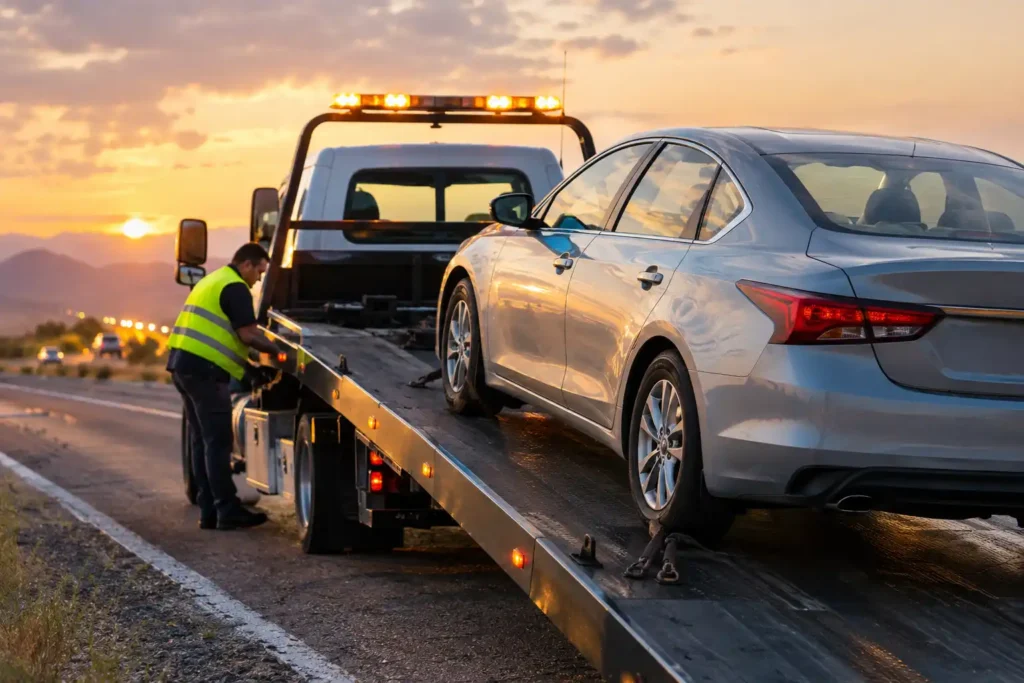
A tow truck driver securing a silver sedan on a flatbed bed towing truck on the highway, illustrating how much does a tow truck cost.
Tow

How Much Does a Tow Truck Cost? (2026 Price Guide)

Most neighborhood tows are $75 to $250. That includes a hook-up cost and a few miles down the road. Long distance tows, large duty trucks or a tow at 2 a.m. might run the charge to $300 or more. So how much does a tow truck cost for your exact situation? Depends on your car, your distance and why you need the tow in the first place. Here’s the whole breakdown, with real numbers you can use. Quick Answer: Tow Truck Cost at a Glance Hook-up fee (national average): $50 to $125 Per-mile rate after hook-up: $2 to $5 per mile Typical local tow (under 10 miles): $75 to $250 Long-distance tow (50+ miles): $200 to $800 or more Heavy-duty tow (truck, van, RV): $125 to $350+ for hook-up alone These are national ranges. Your local tow rate depends on your city, your state’s towing rules, and the type of truck the job needs. What Actually Goes Into Your Tow Bill A tow bill is not one flat number. It is built from three parts stacked together. The hook-up fee. This covers the driver showing up and connecting your car to the truck. Most companies charge $50 to $125 for this, no matter how far you’re going. The per-mile rate. Once your car is hooked up, you pay for the miles it travels. This is usually $2 to $5 per mile for a standard car. Surcharges. These get added on top when your situation isn’t a simple, daytime, easy-access tow. Common ones include: After-hours surcharge (nights, weekends, holidays) Storage fee, if your car sits in a tow yard overnight Winching fee, if the car needs to be pulled from a ditch or tight spot Heavy-duty fee, if your vehicle needs a bigger truck Add these three pieces together and you get your final bill. A simple daytime tow might just be hook-up plus mileage. A midnight tow from a ditch could include all three. How Much Does a Tow Truck Cost Per Mile? Towing costs vary considerably with the length of the trip. Here’s exactly what you will get: Local Tows: You’re looking at $2 to $5 per mile in addition to the base hook-up fee. A five mile tow at $ 3 / mile tacks on $ 15 to your account. Long-Distance Tows (50+ miles): The charge normally reduces to between $1.50 and $3 per mile because of the lengthier single journey. But it adds up fast, 100 mile tow at $2.50/mile adds $250 in mileage alone. Tow Truck Cost by Vehicle Type Bigger and heavier vehicles need bigger trucks, and bigger trucks cost more to run. Here’s what to expect by vehicle type. Vehicle Type Typical Tow Method Estimated Cost Range Sedan or small car Flatbed or wheel-lift $75 – $200 SUV or minivan Flatbed $85 – $225 Pickup truck Flatbed $100 – $250 Motorcycle Flatbed with straps $75 – $150 Electric vehicle (EV) Flatbed only $100 – $275 Heavy-duty (box truck, RV, bus) Heavy-duty wrecker $150 – $500+ Electric vehicles must be towed on a flatbed truck because their motors are permanently linked to the wheels without a true mechanical neutral. Towing an EV with its wheels rolling on the ground generates unmanaged electricity that causes catastrophic battery and inverter failures, resulting in $8,000 to $18,000 in damages. Because EVs are exceptionally heavy, they require specialized flatbed transport, “Transport Mode” activation to unlock the electronic brakes, and secure wheel straps instead of chassis hooks—services that typically add a $20 to $80 premium over standard towing. You may read this What Is Towing Capacity for more about tow. Tow Truck Cost by Situation Your bill also depends on why you’re calling for a tow. Here’s how five common situations compare. Breakdown on The Road This is the simplest and usually cheapest case. Your car is upright, accessible, and just needs a lift onto a flatbed. Expect a standard hook-up fee plus mileage. Accident Recovery If your car was in a crash, it may be damaged, off the road, or blocking traffic. Accident recovery often costs more because it can involve winching, debris cleanup, and coordinating with police on scene. Illegal Parking or Impound If your car gets towed for parking violations, you’re not calling the truck. The city or property owner is. These impound tows come with their own fee schedule, plus a daily storage fee that adds up fast if you don’t retrieve the car quickly. This category also covers repossession tows, where a lender arranges pickup of an abandoned vehicle or one behind on payments. Ditch or Off-road Recovery A car stuck in a ditch, mud, or snowbank needs winching before it can even be hooked up. This adds time and equipment, which adds cost. Off-road recovery is one of the more expensive standard calls because of the extra labor involved. Long Distance Relocation Moving a car across the state or across the country is priced differently than an emergency tow. Companies that do long hauls often quote a flat rate based on total mileage rather than the standard hook-up-plus-per-mile formula. What Makes a Tow More Expensive A few factors push any tow toward the high end of its price range. Time of day. Calling at 2 a.m. costs more than calling at 2 p.m. Most companies add a night, weekend, or holiday surcharge, sometimes called peak-hour pricing. Distance to your location. If the tow company has to drive 30 minutes just to reach you, some charge for that travel time separately. This matters more in rural pricing areas, where the nearest available truck might be far away. Hookup difficulty. A car parked in a tight garage, wedged against a curb, or stuck in mud takes longer to hook up safely. Harder hookups mean more time on the clock. Weather and terrain. Ice, snow, steep grades, and off-road conditions slow everything down and raise the risk for the driver and the truck. Companies factor that risk into the price. Will Insurance or Roadside Assistance Cover It? Often,
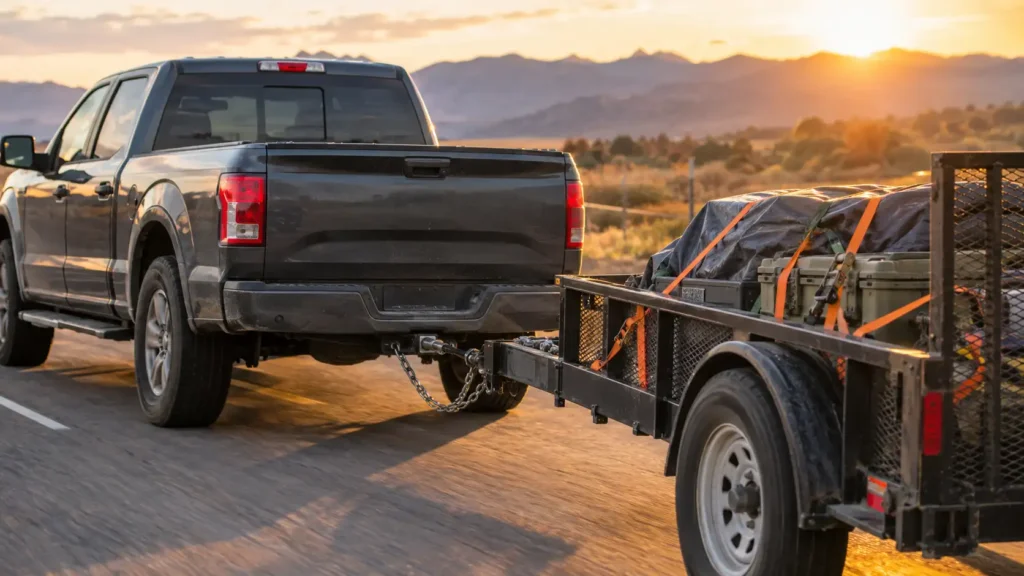
Dark pickup truck learned how to tow a trailer safely for beginners on an open road during sunset.
Tow

How to Tow a Trailer Safely for Beginners: A Step-by-Step Guide

The short answer to how to tow a trailer safely for beginners is simple. Know your weight limits, hook up the trailer the right way, load heavy items up front, and drive slow. Do these four things and most towing trouble never starts. This guide gives you each step, a pre-trip checklist, and a plan for when things go wrong. If your trailer breaks down in the Valley, Redline Roadside & Towing LLC answers 24/7. The Quick Answer: 6 Steps to Tow Safely Find your vehicle’s towing capacity in the owner’s manual. Match the hitch, ball, and trailer coupler. Hook up the trailer, chains, and wiring. Load about 60% of the cargo weight toward the front. Run the pre-drive checklist. Drive slow, brake early, and leave extra space. Know Your Weight Limits First Weight is the most important part of towing. Get this wrong and nothing else will save you. Learn these terms first: Towing capacity: the most trailer weight your vehicle can pull, set by the maker. GVWR: the most your vehicle can weigh, including people and cargo. GCWR: the most your vehicle and trailer can weigh together. Payload: the weight your vehicle can carry inside and on top of it. Tongue weight: the downward push of the trailer on your hitch ball. Your owner’s manual or the maker’s towing guide lists towing capacity and GCWR for your exact engine and trim. The sticker inside the driver’s door jamb shows GVWR and payload. It does not usually show towing capacity. If you lost the manual, call a dealer with your VIN. Never guess from a similar truck. A small change in engine or axle ratio can shift the limit by thousands of pounds. Read more What Is Towing Capacity Find Your Real Trailer Weight The label on the trailer shows its maximum weight. It does not show what your load weighs. Take the loaded trailer to a public truck scale for the real number. A tongue weight scale gives a quick reading for the hitch. Watch Your Payload Tongue weight counts against your payload. Say your trailer weighs 7,000 pounds. Ten to 15 percent tongue weight puts 700 to 1,050 pounds on your hitch. Add people and gear, and you can hit your payload limit before your towing limit. Keep a 20% Buffer Stay about 20% under your maximum. If your vehicle can pull 8,000 pounds, keep the trailer near 6,400. Heat, hills, and wind all cut into your limit. Many drivers call this the 80% rule. Read more in our guide to the 80/20 rule for towing. Pick the Right Hitch, Ball, and Gear Hitches come in classes. Each class has a typical weight limit. Hitch Class Typical Max Trailer Weight Common Use Class I Up to 2,000 lbs Small utility trailers, bike racks Class II Up to 3,500 lbs Light campers, small boats Class III Up to 5,000 lbs (up to 8,000 with a weight distribution hitch) Mid-size boats, travel trailers Class IV Up to 10,000 lbs (up to 12,000 with a weight distribution hitch) Larger campers, car trailers Class V 12,000 lbs or more Heavy equipment, large RVs Always follow the rating stamped on your own hitch. Your safe limit is the lowest rating among the vehicle, hitch, ball mount, ball, and coupler. One weak part sets the limit for the whole setup. The ball must match the coupler. Common sizes are 1 7/8 inch, 2 inch, and 2 5/16 inch. The size is stamped on both parts. A mismatch can pop apart on the road, even if it looks connected. The trailer should ride level. Pick a ball mount with the right drop or rise to get there. A nose-up or nose-down trailer sways more. For heavier loads, use a weight distribution hitch. It spreads tongue weight across both vehicle and trailer axles. This keeps the rear from sagging and helps steering. How to Hook Up a Trailer Step by Step Back up slowly toward the trailer. A spotter helps. Stop with the ball just in front of the coupler. Set the parking brake. Lower the coupler onto the ball with the tongue jack. Latch the coupler and insert the pin or lock. Tug up on the tongue to confirm it holds. Cross the safety chains under the tongue in an X. Hook them to the hitch chain loops, not the ball mount or bumper. Leave slack for turns, but keep them off the ground. Clip the breakaway cable to a solid point on the vehicle if your trailer has brakes. Do not clip it to the chains. Plug in the wiring. Raise the tongue jack all the way and remove the wheel chocks. Test the brake lights, turn signals, and running lights. The X pattern matters. If the hitch fails, the chains catch the tongue and keep it off the road. To unhook, reverse the steps. Chock the trailer wheels first, then lower the jack and release the coupler. Trailer Brakes and Wiring Basics Most trailers use a 4-pin flat plug for lights. A 7-pin round plug adds brake power and reverse lights. Adapters connect the two. Electric brakes need a brake controller in your cab. Surge brakes are hydraulic and work on their own when you slow down. If you have a controller, follow the maker’s steps to set the gain. Then test it at low speed in an empty lot. The breakaway system is a safety backup. If the trailer comes loose, the cable pulls a pin and applies the trailer brakes. Rules on trailer brakes vary by state and trailer weight. Check the Arizona MVD for the current rules. How to Load a Trailer the Right Way Poor loading is a top cause of sway. Follow these rules: Put about 60% of the cargo weight ahead of the trailer axle and 40% behind. Aim for tongue weight of 10 to 15 percent of total trailer weight on a standard bumper-pull trailer. Keep heavy items low and centered. Spread weight evenly

What Is Towing Capacity
Tow

What Is Towing Capacity? A Clear, Simple Guide

Towing capacity is the maximum weight your vehicle can safely pull behind it. That number covers your trailer, plus everything loaded inside it. So what is towing capacity in real terms? It’s the line between a safe tow and a strained engine, worn brakes, or a dangerous trailer sway. If you’ve ever hooked up a trailer and wondered can my truck actually handle this, you’re asking the right question. This guide breaks it down in plain language, with a real example, a comparison chart, and the safety numbers most guides skip. What Is Maximum Towing Capacity? (Is It Different From Towing Capacity?) Here’s the short answer. Maximum towing capacity and towing capacity are the same thing. Manufacturers use both terms to describe the heaviest trailer weight your vehicle can pull when it’s set up correctly, with the right engine, axle, and towing package. So if you’ve searched what is the maximum towing capacity, you’re not missing a separate number. You’re looking for the same rating, usually tested against the SAE J2807 standard, which sets consistent rules for how automakers measure and report that figure. That standard is why a 2026 half-ton truck rated for 13,000 pounds can be compared fairly against a rival brand’s truck rated for 12,500 pounds. How Towing Capacity Is Calculated (With a Real Example) Every automaker starts with three numbers: Gross Combined Weight Rating (GCWR), curb weight, and payload. The formula is simple. Towing Capacity = GCWR − (Curb Weight + Payload) Let’s walk through a real example. Say a mid-size truck has a GCWR of 16,000 pounds. Its curb weight, meaning the truck alone with fuel and fluids but no people or cargo, is 4,900 pounds. You’re loading 500 pounds of gear, tools, and passengers into the cab and bed. Here’s the math: 16,000 minus (4,900 plus 500) equals 10,600 pounds. That’s your usable towing capacity for this trip, once passengers and cargo are already accounted for. This is exactly what is towing capacity in practice. It’s not a fixed sticker number you can ignore once you load the truck. Every bag, tool, and passenger you add reduces the trailer weight you can safely pull. Two identical trucks with different cargo loads will have two different real-world towing numbers, even though the factory rating stays the same. Towing Capacity vs. GVWR vs. Payload: Know the Difference These terms get mixed up constantly, so here’s a quick side-by-side reference. Term What It Means Applies To Towing Capacity Max weight the vehicle can pull behind it The trailer and its cargo GVWR (Gross Vehicle Weight Rating) Max weight the vehicle itself can carry, including passengers, cargo, and tongue weight The tow vehicle only GAWR (Gross Axle Weight Rating) Max weight one axle can support, front and rear rated separately Each individual axle GTW (Gross Trailer Weight) Total weight of the loaded trailer, fuel and cargo included The trailer only Payload Weight of people, gear, and cargo the vehicle carries inside it Cab and bed, not the trailer Tongue Weight Downward force the trailer places on the hitch Should sit between 10 and 15 percent of loaded trailer weight The easiest way to remember it: GVWR is about what your truck carries. Towing capacity is about what your truck pulls. Mixing these two up is the single most common mistake first-time tow buyers make. What Affects Your Vehicle’s Towing Capacity A few mechanical factors set the ceiling on how much a vehicle can pull. None of these factors work alone. A powerful engine paired with weak brakes still limits your safe capacity, since the whole system has to work together under load. How to Find Your Vehicle’s Exact Towing Capacity Don’t guess based on what a similar model can tow. Check your own vehicle these ways. Two trucks with the same badge can have very different numbers depending on engine choice, cab size, and factory options. Always check your specific build. What Happens If You Tow at Max Capacity? Towing at max capacity is legal, but it leaves you with zero margin for error. A common rule among experienced tow operators is to stay around 80 percent of your rated capacity, not the full number on the sticker. Here’s why that margin matters. When you’re towing at max capacity, your brakes work harder to stop the added weight, which raises stopping distance and heat buildup. Trailer sway becomes more likely, especially in wind or on uneven pavement. Hills strain the engine and transmission more, since there’s no reserve power left. Tongue weight has to sit right in that 10 to 15 percent range, or the whole rig becomes unstable at speed. A properly installed weight-distribution hitch helps spread the load across both axles and reduces sway, but it doesn’t raise your actual towing capacity. It just makes towing closer to that limit safer. If your trip regularly pushes you near the max, it’s worth stepping up to a vehicle with a higher rating instead of living at the edge every time. Towing Capacity by Vehicle Type Here’s a quick-reference chart by vehicle class, using FHWA weight categories as the baseline. Vehicle Type Typical Towing Range Hitch Class Subcompact/Compact SUV 1,500 to 3,500 lbs Class I–II Midsize SUV 3,500 to 6,000 lbs Class III Full-Size SUV 6,000 to 9,600 lbs Class III–IV Half-Ton Truck 8,000 to 13,500 lbs Class IV–V Heavy-Duty Truck 15,000 lbs and up (often 20,000+ with a gooseneck) Class V Light Duty Towing generally covers vehicles under 10,000 pounds GVWR, like SUVs and half-ton trucks. Medium Duty Towing covers the 10,001 to 26,000 pound range, common for box trucks and larger work vehicles. Heavy-Duty Towing applies above that, where semis, RVs, and construction equipment live. You can see the full federal breakdown on the Department of Energy’s Alternative Fuels Data Center. If your load falls outside your vehicle’s rated range, or you’re not sure which category your rig lands in, don’t guess on the highway. Redline Roadside & Towing LLC handles Light Duty Towing, Medium

Scroll to Top