Redline Roadside & Towing LLC

Tow

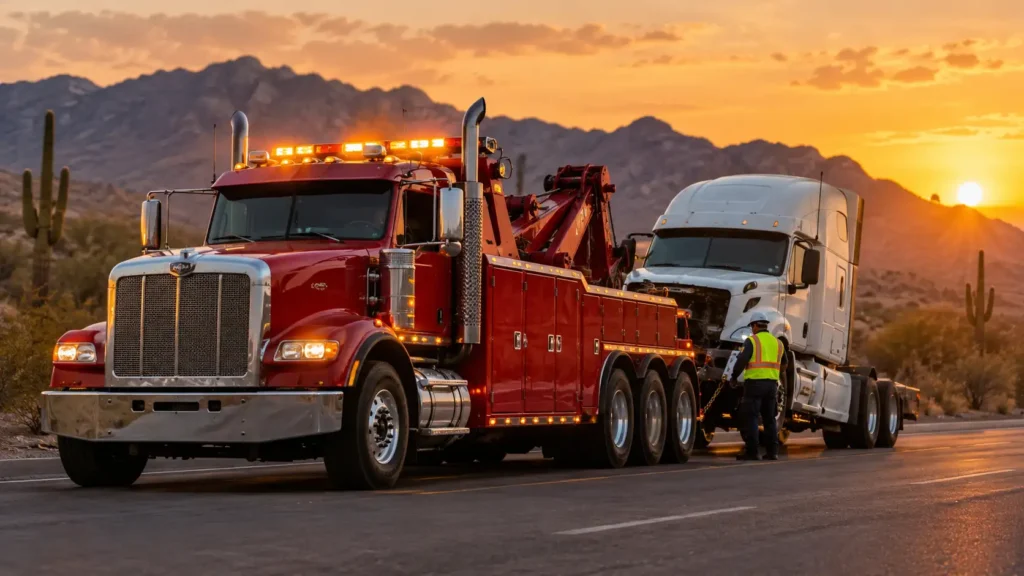
Heavy duty tow truck towing a semi-truck on a Phoenix highway
Tow

What Is Heavy Duty Towing? Weight Classes, Trucks, and Costs Explained

What is heavy duty towing? It’s the towing and recovery of vehicles above 26,000 pounds, such as semis, buses, dump trucks and huge equipment. It takes enormous wreckers, rotators and hefty rollbacks that are made to handle loads a regular tow truck can’t lift. Redline Roadside & Towing LLC performs these jobs all around Phoenix and the West Valley. This article will explain weight classifications, trucks, how a tow works, and what it costs in Arizona. Heavy Duty Towing Weight Classes Tow companies sort jobs by GVWR, the gross vehicle weight rating set by the maker. The U.S. Department of Energy and Wikipedia list the same truck classes. Class GVWR Common Vehicles Truck Type Light duty Up to 10,000 lb Cars, SUVs, pickups, small vans Flatbed, wheel lift Medium duty 10,001 to 26,000 lb Box trucks, large vans, small buses Medium wrecker or rollback Heavy duty 26,001 lb and up Semis, city buses, dump trucks Heavy wrecker, rotator, heavy rollback Class 7 runs from 26,001 to 33,000 lb. Class 8 starts above 33,000 lb. Some companies set the light duty line at 14,000 lb, so ask how yours sorts your vehicle. Our guide to What Is Medium Duty Towing covers the middle class. A tractor and a trailer each have their own rating, and a loaded rig can reach 80,000 lb. That combined limit is the GCWR. Tell dispatch the tractor rating, the trailer rating, and the cargo. Which Vehicles Need a Heavy Duty Tow Truck? Heavy duty truck towing covers more than semis: Tractor-trailers and dump trucks Cement mixers and garbage trucks City buses and motor coaches Diesel Class A motorhomes, which often pass 26,000 lb Excavators and bulldozers, hauled on a lowboy Some vehicles look smaller than they are. A loaded RV or a dually pulling a gooseneck trailer can pass the line fast. If your total weight nears 26,000 lb, tell dispatch. Types of Heavy Duty Tow Trucks Heavy wrecker. An underlift grabs the axle or frame, and a boom raises one end. Air brakes hold the load, and a winch pulls vehicles from ditches. Most semi tows start here. Rotator. Its crane spins a full circle, so it can lift and turn a rolled truck without moving. It helps after a rollover or jackknife. Heavy rollback and lowboy. A rollback carries a vehicle on its bed. A lowboy sits closer to the ground for equipment. Wreckers and rotators carry a tonnage rating, and the crew matches it to the real weight of the load. Crews also bring air cushions, dollies, driveline tools, and rated chains. When You Need a Heavy Duty Tow in Phoenix A semi breaks down on I-10 or I-17 and blocks a lane A rollover or jackknife on Loop 101 shuts down lanes A truck slides into a wash during a monsoon storm A load spills and must move to another trailer How a Heavy Duty Tow Works Call dispatch. Share the make, model, GVWR, cargo, trailer, axle count, air brakes, exact location, and blocked lanes. Our guide on How to Call a Tow Truck shows what to say. Secure the scene. The crew sets cones and lights. Rig the load. The team checks the weight and sets up the rigging. Recover the truck. For a rollover, the crew disconnects the driveline, then lifts or winches the truck upright. Tow it. Spilled cargo moves to another trailer, and the truck goes to a yard or shop. Turn on your warning lights and wait behind the guardrail if it is safe to do so. If anyone is wounded call 911. Arizona’s Move Over legislation requires drivers to move over a lane, or slow down if it is not safe, when they are approaching a stopped vehicle with flashing or warning lights. In 110 degree weather, stay in the shade and drink water. How Much Does Heavy Duty Towing Cost in Arizona? Price depends on weight, time, and equipment. Public rate sheets give a fair starting point. The City of Phoenix police towing contract, effective January 1, 2025, lists $530.98 for vehicles of 26,000 lb or more, plus a $75 after-hours charge per occurrence. Those are police-ordered tow rates, so a private call can differ. Rotators bill by the hour and cost far more than a standard tow. One state regulator’s 2024 rate sheet lists a heavy rotator of 60 tons or more at $780.68 an hour. These things raise the bill: A second truck A rotator Cargo cleanup Night, weekend, or holiday calls Long loaded miles Storage days A minimum billing time, which some companies set at two hours Every job is different, so call Redline for a quote on yours. How to Choose a Heavy Duty Tow Company Ask these five questions before you say yes: Is your equipment rated for my weight? Are your drivers trained for heavy recovery? Do you hold the right license and commercial coverage? Ask for proof. Have you moved cargo like mine? When will you arrive, and what will it cost in writing? Walk away if no one asks your weight, a light truck is sent to a heavy job, or new fees show up at the yard. Call Redline Roadside & Towing LLC for 24/7 Heavy Duty Towing in Phoenix When a big truck goes down, the right equipment matters. Redline Roadside & Towing LLC offers 24/7 Heavy Duty Towing in Phoenix for rollovers, breakdowns, accident recovery, and equipment moves. Dispatch answers day and night, and our arrival time is 10 to 25 minutes across Phoenix. We also cover Avondale, Tolleson, Laveen, and the West Valley. Don’t wait on the shoulder. Call (602) 549-8722 now, give dispatch your location and GVWR, and ask for a price on your job. Conclusion Now you know what is heavy duty towing and why the truck, the crew, and the price all depend on weight. Know your GVWR, ask the right questions, and call Redline Roadside & Towing LLC at any hour when a big job lands on your
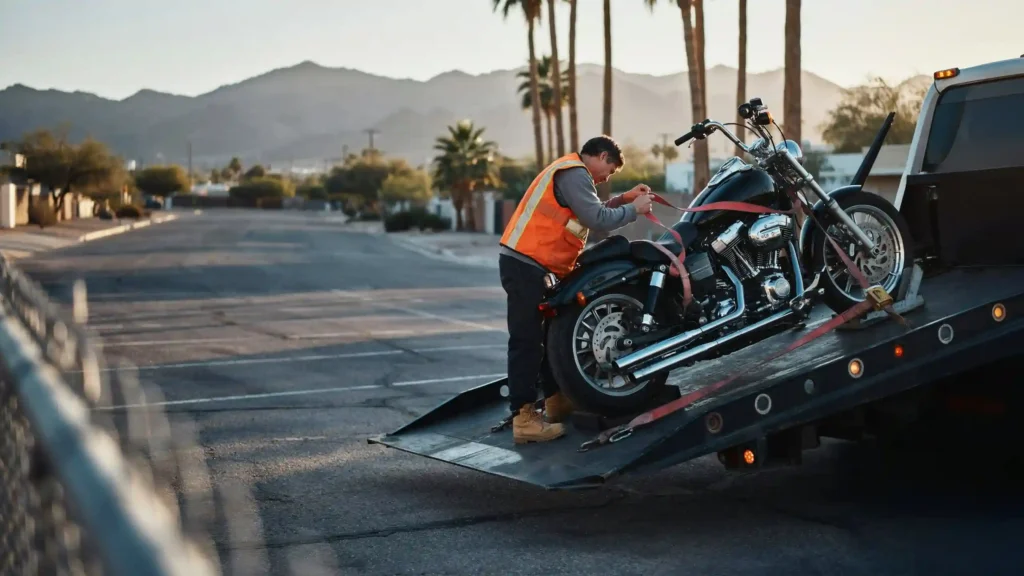
Man strapping down a black cruiser motorcycle on a flatbed tow truck using red tie-down straps.
Tow

How Much Does It Cost to Tow a Motorcycle?

A short motorcycle tow in 2026 costs about $85 to $150, plus $3 to $6 for each extra mile. That is the direct answer to how much does it cost to tow a motorcycle. Most bills have two parts: a hook-up fee and a per-mile rate. Redline Roadside & Towing LLC prices every local tow in Phoenix the same way. Distance, time of day, bike size, and the gear on the truck all change the total. This guide gives real ranges, a simple formula, and the fees riders often miss, so you can check any quote before you say yes. Motorcycle Towing Price at a Glance Here is the motorcycle towing price most riders see in 2026. These ranges come from published tow company rate sheets. Treat them as estimates, not quotes. Scenario Typical Cost What Drives It Local tow under 10 miles $85 to $150 Hook-up fee and minimum charge 10 to 30 miles $120 to $250 Loaded miles at the per-mile rate 50 miles or more $250 to $450 Distance and the drive back After-hours tow $25 to $100 extra Night, weekend, or holiday surcharge Off-road or crash recovery $150 to $350 per hour Winching, labor, and extra gear Long-distance transport $300 to $800 for 100 miles Lower per-mile rate and trailer type How Motorcycle Towing Rates Are Built Most motorcycle towing rates follow one pattern. You pay a flat starting fee, then a charge for each mile. The Hook-Up Fee This fee pays for dispatch, driver time, and loading your bike. Expect $50 to $150 for a motorcycle. Some companies add $25 to $150 for special strapping gear. Most also set a minimum charge, so a one-mile tow costs the same as a short drive across town. The Per-Mile Rate and Loaded Miles Per-mile rates run about $3 to $6. Loaded miles are the miles your bike rides on the truck. Deadhead miles are the empty miles the driver travels to reach you. Some companies bill both. Ask which ones count. A Simple Formula With Three Examples Total = hook-up fee + (loaded miles × per-mile rate). Take an $85 hook-up fee and a $4 rate. A 5-mile tow comes to $105. A 20-mile tow comes to $165. A 50-mile tow comes to $285. These are sample numbers, not a quote. Published motorcycle tow rates differ because each company sets its own fee, rate, and minimum. What Changes the Price of a Motorcycle Tow The motorcycle tow cost shifts with four things you can often see before you call. Distance and Location City tows are short. Rural pickups cost more per mile and take longer to reach. Freeway pickups need extra care from the driver. A bike that quits on the far west side may need a 30-mile ride on I-10 or Loop 101 to reach a good shop, and those miles add up fast. Time of Day Nights, weekends, and holidays often cost more. Some companies add a flat after-hours surcharge. Others add a percentage of the bill. Ask which one you will pay. Bike Type and Weight Touring bikes can top 800 pounds. Trikes and sidecar rigs need more loading room and extra tie-down points. An electric motorcycle usually needs a flatbed. Big or odd-shaped bikes can raise the price. Bike Condition A rolling bike loads fast. A crashed or stuck bike takes a winch and extra hands. Many companies bill a winching fee and recovery labor by the hour. Flatbed vs Wheel-Lift Towing for Motorcycles Ask for a flatbed. It costs a little more, but it protects the bike. You can read how each tow truck type works if you want the basics. Method Risk to the Bike Cost Difference Best Use Flatbed with wheel chock Lowest $0 to $50 more Almost every bike Wheel-lift Medium to high Base price Short moves with a trained driver Hook-and-chain Very high Not worth any savings Never Why Flatbed Costs a Little More A flatbed carries the whole bike. The driver sets the front wheel in a wheel chock and ties the bike down with soft loop straps. Nothing pulls on the frame or the forks. When a Wheel-Lift Can Cause Damage A wheel-lift grabs one wheel and lifts it. Forks, fairings, and the frame can take stress they were not built for. A hook-and-chain rig can crack plastic and bend metal. Never agree to one. Chain, Belt, and Shaft Drive Bikes Drive type matters because of the transmission. Rolling a bike on one wheel can spin gears without oil flowing. That wears parts on chain, belt, and shaft drive bikes alike. A flatbed avoids the problem. Motorcycle Tow Cost by Situation How much does it cost to tow a motorcycle? It depends on why you need the tow. Roadside Breakdown A dead battery, a flat tire, or a mechanical failure all start with the local range above. A jump or quick fix on the spot can cost less than a tow. Accident Tows and Impound After a crash, police may direct the tow. Those tows follow set rates. Phoenix says storage for impounds under A.R.S. 28-3511 is capped at $25 a day, and the owner also pays a $150 city fee. Impounds under Phoenix City Code 23-55 are capped at $15 a day, according to the Phoenix Police towing page. If police did not order the tow, you can usually pick your own company. Ask the officer on scene. Non-Running or Off-Road Bikes A bike stuck in sand or down a bank needs recovery labor and extra gear. Plan on $150 to $350 per hour, plus the tow itself. Long-Distance Hauls Per-mile rates drop on long hauls, and some companies quote a flat price. An open trailer costs less. An enclosed trailer costs more but shields the bike from rain and road debris. Hidden Fees and What to Ask Before You Say Yes Know which extra charges to watch for and what to ask before approving the tow. Fees That Surprise Riders Watch for a

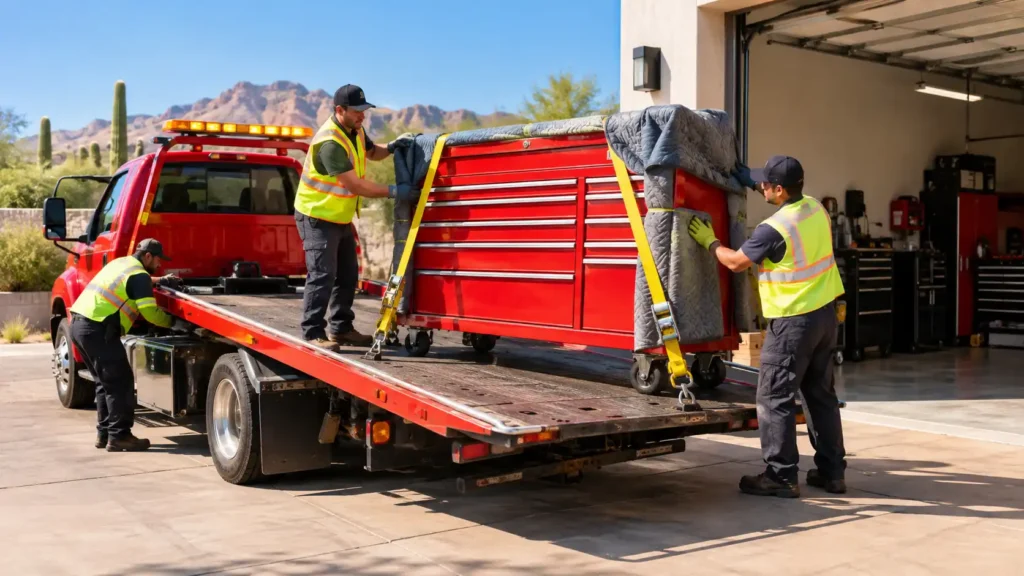
Workers securing a heavy red tool box with yellow ratchet straps on a red flatbed tow truck in Phoenix, Arizona.
Tow

How to Transport a Heavy Tool Box Safely Without Damage or Injury

Knowing how to transport a heavy tool box starts with one rule. Empty it first, then move it on a ramp, a flatbed, or a trailer. Never carry it by hand. Redline Roadside & Towing LLC moves loaded cabinets across Phoenix every week, and the same rules apply to every job. This guide gives you a method for every size. You will find a tool box, tool chest, or roller cabinet fix in the sections below. Use the table first, then read the steps that match your box. Before You Move It: Prep Checklist This is how to move a heavy toolbox without hurting your back or your floor. Work through each step in order. Find the Real Weight and Measurements Look up the empty weight in the maker’s spec sheet. Then estimate the loaded weight. Tools add up fast. A full bottom drawer can hold over 100 lbs. Measure the box width, depth, and height. Measure every doorway and gate on your path. Check the payload capacity of the truck or trailer you plan to use. Empty the Tools First (and Why) Never move a loaded box. Tools shift, drawers slam, and the whole load becomes a shock load on the casters. One bump can crack a caster plate or tip the cabinet. Weight is a safety issue too. The OSHA ergonomics guidance lists heavy lifting as a top cause of back injury. Put tools in plastic crates and carry them in your own vehicle. Remove or Lock the Drawers Use the built-in drawer locks. Drawer slides can open on a bump and pull the box over. If the locks are weak, pull the drawers out. Wrap each one in a moving blanket. Wrap the empty frame in stretch wrap so doors and drawers stay shut. Separate the Top Chest and Secure Loose Parts Lift the top chest off the base. Most chests sit on the base by weight alone, and some have bolts. Remove any side cabinet too. Turn on the caster locks once the box is in place. Remove loose shelves, trays, and keys. Tape keys to the lid. Protect the Finish Wrap the box in moving blankets or furniture pads. Add corner protectors on the sharp edges. Paint chips fast on a ramp or strap line, and a scratched cabinet loses resale value. Equipment You’ll Need Gather this before the move: Loading ramp rated for the box weight Ratchet straps with a clear WLL (working load limit) Wheel chocks for the trailer or truck 2×4 blocking to stop the box from sliding Floor jack for lifting one end Winch or come-along for pulling up a ramp Moving blankets and furniture pads Work gloves with a good grip How to Transport a Large Tool Chest: 6 Methods Compared Here is how to transport a heavy tool chest, ranked by how often shops use each option. This section also covers how to move a large toolbox when the box is too tall for a van. Flatbed or Rollback Tow Truck Best for: Heavy loaded boxes and multi-bank cabinets. Skip it when: The box is small enough for your own truck. Key tip: Ask the tow truck operator three things. Do you carry insurance for cargo? Do you use a winch? How do you strap the box? A good company will say yes and explain the plan. Ask how a damage claim works before the truck arrives. Heavy tool box towing is a real service, and it works well. The truck tilts its bed, a winch pulls the box on, and chains or straps hold it down. A rollback does this without anyone pushing the cabinet up a ramp. Redline Roadside & Towing LLC offers 24/7 Tool Box Towing in Phoenix for cabinets that are too heavy or too risky to move yourself. Our drivers use winches, rated straps, and padding on every job. We reach most spots across Phoenix and the West Valley in 10 to 25 minutes. Call Redline now for a fast quote, and we will send a flatbed to your shop or garage today. Utility or Drop-Deck Trailer With a Ramp Best for: Low-cost DIY moves with empty boxes. Skip it when: The box is over the trailer capacity. Key tip: A drop-deck trailer has a low deck height. That makes ramp length shorter and the push easier. A rental U-Haul trailer is the cheapest way in most cities. Check the trailer capacity on its sticker, and subtract the trailer’s own weight. Box Truck or Van With a Liftgate Best for: Smaller boxes that fit through the door. Skip it when: The ground is soft or sloped. Key tip: A liftgate needs a level surface and a rated weight limit. Use furniture pads, and strap the box to the tie-down points on the wall. An enclosed trailer works the same way. Pickup Truck Best for: Small, empty, or light boxes only. Skip it when: The box is tall, since it can tip over. Key tip: Tailgate height is a big lift. Check the payload capacity in the door jamb first. Never push a roller cabinet up a steep tailgate ramp. Forklift, Engine Hoist, or Skid Steer Best for: Warehouse or shop loading, rough ground, and very heavy boxes. Skip it when: Nobody trained is on site. Key tip: Set the box on a pallet first. Slide the pallet forks all the way under. A pallet jack works on smooth concrete. An engine hoist can lift one end of a box when no forklift is around. Professional Movers or Freight Best for: Long distance and very large boxes. Skip it when: The move is across town. A flatbed costs less. Key tip: A rigging company can handle the biggest cabinets. For LTL freight, crate the box and buy cargo insurance. A tool truck dealer can often arrange pickup when you buy a new unit. Step-by-Step: Loading a Heavy Tool Box Onto a Trailer or Truck Set Up the Vehicle and Ramp Park on level ground.

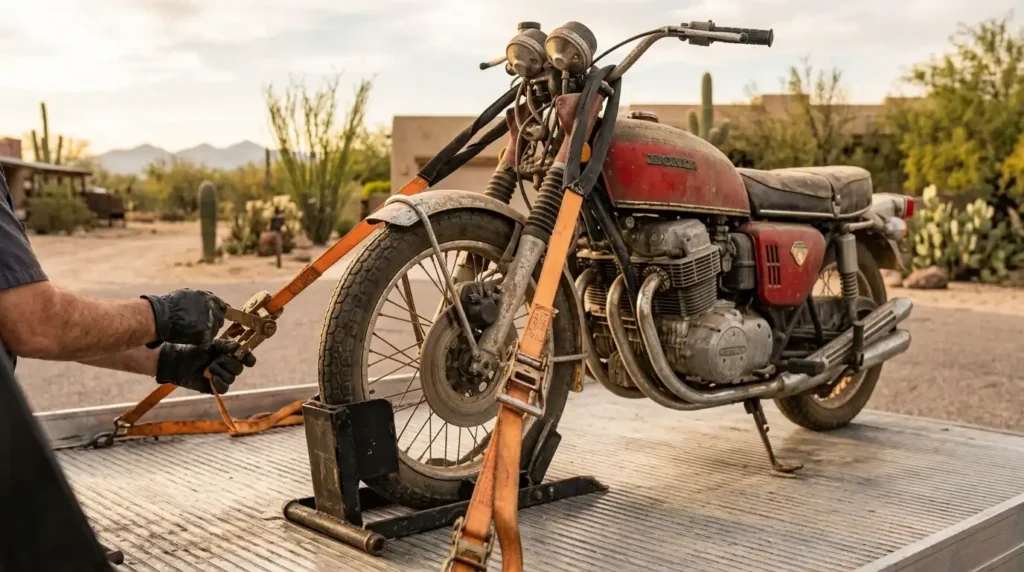
Old red vintage motorcycle strapped down on a trailer for towing, illustrating how to junk a motorcycle.
Tow

How to Junk a Motorcycle: Paperwork, Payout and Towing Explained

Here is how to junk a motorcycle in five steps. Get the title in order, prepare the bike, pick a junkyard or buyer, move the bike, and finish the paperwork. A non-running motorcycle can still go to the yard. Redline Roadside & Towing LLC tows dead bikes every day, so the towing part is covered in full below. This guide is for anyone with a wrecked, old, or inherited bike that no longer runs. You will get clear steps, real costs, and a plan for towing. Use the tables to compare your options fast. Junk It or Sell It? Run This Check First Get a repair quote. Then look up what the same bike sells for in good shape. That number is its market value. If the repair cost is more than about 70 percent of the market value, junking usually wins. Condition changes the answer. A wrecked bike with a bent frame rarely makes sense to fix. An older bike that only needs a carb clean may sell as a project bike for a few hundred dollars. Check local listings to see what similar bikes bring. A salvage title lowers the price, but buyers still want the bike. Selling for parts often pays more than scrap, because engines, wheels, and clean body panels sell on their own. If you don’t need cash, donation is another path. Many charities take non-running bikes and give you a receipt. Paperwork to Gather Before You Junk a Motorcycle Most yards want proof of ownership before they hand over a dime. Have these ready: Title: The main proof that the bike is yours. Sign it over when you sell. Registration: An old registration can back up your claim if the title is missing. Lien check: If a bank still has a lien, you can’t junk the bike until the loan is paid and the lender releases it. VIN: The vehicle identification number is stamped on the frame near the steering neck. Make sure it matches your papers. You can check the bike’s history at vehiclehistory.gov, the federal NMVTIS site. Bill of sale: Write the date, price, VIN, and both names. Add “sold as is” and sign it. Lost title? Apply for a duplicate title at your state DMV. Fees and wait times differ by state. Inherited bike? Bring the death certificate, your ID, and the title. Some states also ask for a court letter or a signed form. Salvage title? You can still junk the bike. Sign the title over like normal. Very old bike? Some states don’t title older bikes. You may only need a bill of sale. Rules differ, so check your state DMV page before you call a buyer. Get the Bike Ready: Fluids, Battery, Plates and Parts Take the license plates off first. Keep them or turn them in, based on your state’s rules. Check the saddlebags and under the seat for helmets, tools, and papers. Pull the battery next. It holds lead and acid, so it counts as hazardous waste. Most auto parts stores take old batteries for free. Drain the fuel with a hand pump into an approved gas can. Never pour gas on the ground or down a drain. Oil, coolant, and brake fluid are also hazardous waste. The EPA has a good guide on recycling used oil, and many shops take it free. Last, look for salvageable parts. Seats, mirrors, levers, saddlebags, lights, and aftermarket exhausts sell well on their own. Pulling them takes under an hour with basic tools. Where Can You Junk a Motorcycle? Compare Your Options Each buyer fits a different need. Payouts below are typical ranges, so call a few places for a real number. Option Payout Effort Title needed Best for Junkyard (licensed scrap yard) About $100 to $300 Medium Usually yes Whole bikes that don’t run Scrap metal dealer About $25 to $100, paid by weight Medium Sometimes Stripped or rusted frames Salvage dealer Often more than scrap Medium Yes Newer or wrecked bikes with good parts Sell for parts Varies by bike High No for loose parts Popular models with clean parts Donation $0, possible tax deduction Low Yes Owners who want a receipt, not cash Junk removal service You pay, from about $359 Low Not always People who can’t move the bike Towing company You pay a tow fee Low Needed at the yard Bikes that need a ride to any option above Junk motorcycle removal crews can pick up from your garage or from the curb. Many offer same-day pickup if you book early. The in-home option costs the same in most cases, but check when you book. What Junking a Motorcycle Costs, or Pays Scrap steel is the floor price. In September 2026, yards were paying about 7 to 13 cents a pound for prepared heavy steel. Most grades landed between $165 and $215 per ton. Many bikes weigh between 350 and 800 pounds. That puts the steel alone at roughly $25 to $100. Engines, aluminum, and good parts push the offer higher. Item Typical figure Scrap price per ton $165 to $215 for most prepared steel Curb weight About 350 to 800 lb Upfront price from a junkyard About $100 to $300 Parts value Often beats scrap if the parts are clean Removal fee From about $359 Towing fee $40 to $90 hook-up fee, plus $2.50 to $7 per mile Knowing how to junk a motorcycle for the best price comes down to one habit. Call three buyers and ask for the price in writing. Towing a Non-Running Motorcycle to the Yard Without Damage A flatbed is the safest ride for a dead bike. The bike sits flat, strapped down, with all wheels off the road. A wheel-lift truck lifts one end and can hurt forks or frames. A motorcycle trailer works well if you own one and have a truck to pull it. Never tow a bike on its own two wheels behind a car. It can’t steer or brake right, and a

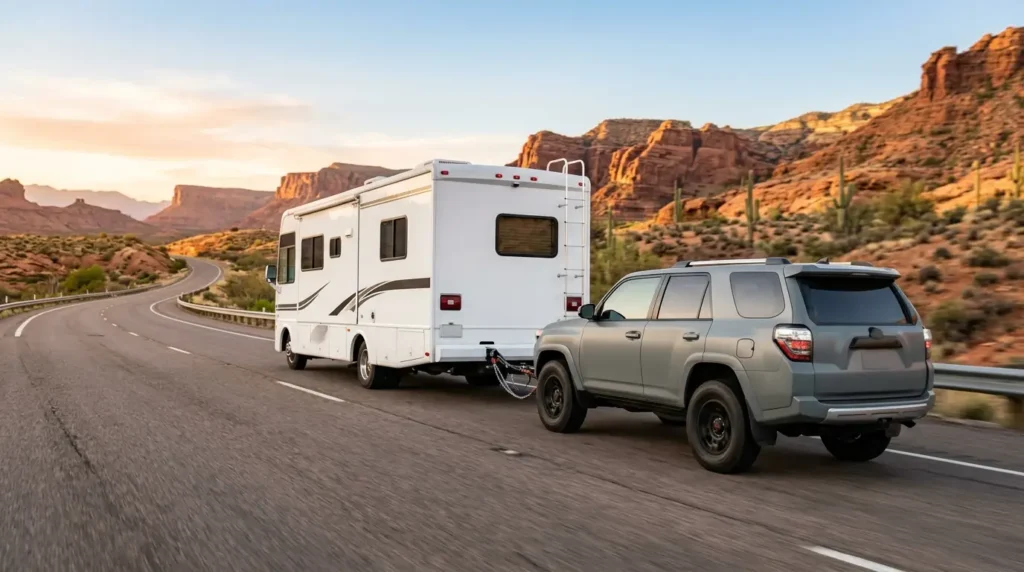
White motorhome towing a grey SUV on a scenic highway, illustrating what vehicles can be flat towed behind an RV.
Tow

What Vehicles Can Be Flat Towed? Check Yours in 2 Minutes

Only vehicles the maker approves for four-down towing can be flat towed. That is the short answer to what vehicles can be flat towed. Your owner’s manual and your model year decide it, not the brand. Some Jeeps, Chevy trucks, and small cars pass. Most front-wheel-drive automatics and most EVs do not. The wrong pick can ruin a transmission fast. Redline Roadside & Towing LLC put this guide together for motorhome owners. You get a quick list, four rules, a 2-minute check, real costs, and a backup plan if your vehicle fails the test. Quick List of Vehicles People Flat Tow Most These names show up often on approved lists. Model year changes the answer, so treat this as a starting point. Each year’s list is different, and many people wrongly assume a vehicle can be towed because a similar model was approved before. The yearly RV Life guide lists verified maker-approved vehicles with drivetrain rules and special limits. Cars: People ask what cars can be flat towed, and the short list is small. Select trims of the Chevy Trax and Nissan Versa have appeared on recent lists. Older small cars like the Chevy Sonic and Ford Fiesta show up on past lists. SUVs and 4x4s: The Jeep Wrangler, Jeep Grand Cherokee, and Ford Bronco are common picks. Trucks: Many people tow the Ford F-150, Chevy Colorado, and Ram 1500. Check the exact year, engine, and drive type. If you wonder which vehicles can be flat towed in 2026, the list is shorter than it used to be. The 2026 RV Life guide lists only specific approved vehicles, such as the Chevrolet Blazer AWD, with a 65 mph limit. The 4 Rules That Decide If a Vehicle Can Be Flat Towed Transmission Disconnect or Neutral Transfer Case A car in neutral is not enough. The transmission must truly disconnect, or fluid keeps moving without the engine running. Many 4x4s use a transfer case that shifts to neutral. A rear-wheel-drive or 4×4 vehicle with a manual transmission often works. Steering That Unlocks Most cars lock the wheel when the key is out. A vehicle cannot tow safely if the front wheels cannot turn. Many cars need the key in accessory mode. Some need a fuse pulled or the battery disconnected. Model Year, Not Just Model A Honda CR-V from 2015 may pass. A new one may not. Older CR-Vs can still be flat towed, but newer ones are no longer offered that way. Maker Approval in Writing If the manual does not say yes, the answer is no. A CVT is the most common reason for a no. A CVT can be damaged when towed with all four wheels down. How to Check Your Own Vehicle in 2 Minutes This is the fastest way to learn what vehicles can be flat towed in your own driveway. You only need your manual. Find the right page. Open the index and look under “R” for Recreational Towing. Some manuals say “Dinghy Towing” or “Flat Towing.” RV Life says to look for those same labels. Read the steps. Look for the words “four-down” or “all four wheels on the ground.” The manual lists the exact steps, speed limit, and any fuse or battery rule. No section means no. If the manual has no Recreational Towing section, the vehicle cannot be flat towed. Call the dealer if unsure. Give them your VIN. Ask for the answer in writing. Cars That Can Be Flat Towed Compact and subcompact cars are the lightest option. They are easy on your motorhome’s tow rating. Past picks include the Chevy Sonic, Ford Fiesta, and Ford Focus. Front-wheel-drive cars with a manual transmission often pass. A small used car usually costs less to buy than an SUV or truck. The setup costs about the same either way, so choose by what you need on the road. SUVs That Can Be Flat Towed Behind an RV Only a short list of vehicles can be flat towed behind an RV, but SUVs fill a good part of it. Pick an SUV if you carry gear or bring the family. Mid-size SUVs: The Chevy Equinox and Jeep Grand Cherokee are common choices. The Ford Explorer appears on past lists. Check your year. Full-size SUVs: The Chevy Tahoe and Suburban, GMC Yukon, and Ford Expedition offer lots of cargo space. They also weigh more, so check your motorhome’s limit first. Many of these SUVs can be flat towed only in 4×4 or AWD trim. Trucks and 4x4s That Can Be Flat Towed Jeep Wrangler and Gladiator These are the favorites for off-road use. A 4×4 with a transfer case that shifts to neutral is easy to set up. You can head onto trails once you park. Pickups The F-150, Colorado, Sierra, and Ram 1500 give you a bed for bikes and gear. Pickups weigh more than cars. Check the tow bar rating before you buy. The bar must handle your vehicle’s full weight. Can Hybrids and Electric Vehicles Be Flat Towed? Some hybrids can. Recent approved lists include hybrids like the Ford Maverick Hybrid. Hybrids and EVs drain the battery faster while towed. Almost all of them need a battery charger, and some brake systems need a special setting for them. Read the brake system’s guide before you tow. Most pure EVs cannot be flat towed. Ford, for example, says no flat towing for the Mustang Mach-E and F-150 Lightning, except for short emergency moves. Use a flatbed or trailer for an EV. Equipment and Real Costs to Flat Tow You need more than a bar. You also need a baseplate, a brake system, and lights. Prices below come from owner reports and retailer pages, so treat them as ranges. Tow bar and baseplate: Owners report about $800 for a tow bar and $500 for a baseplate. A premium bar costs only a little more overall. One maker says the gap between entry-level and premium bars may move the full installed price by just

Tow

What Is a Rollback Tow Truck? How It Works

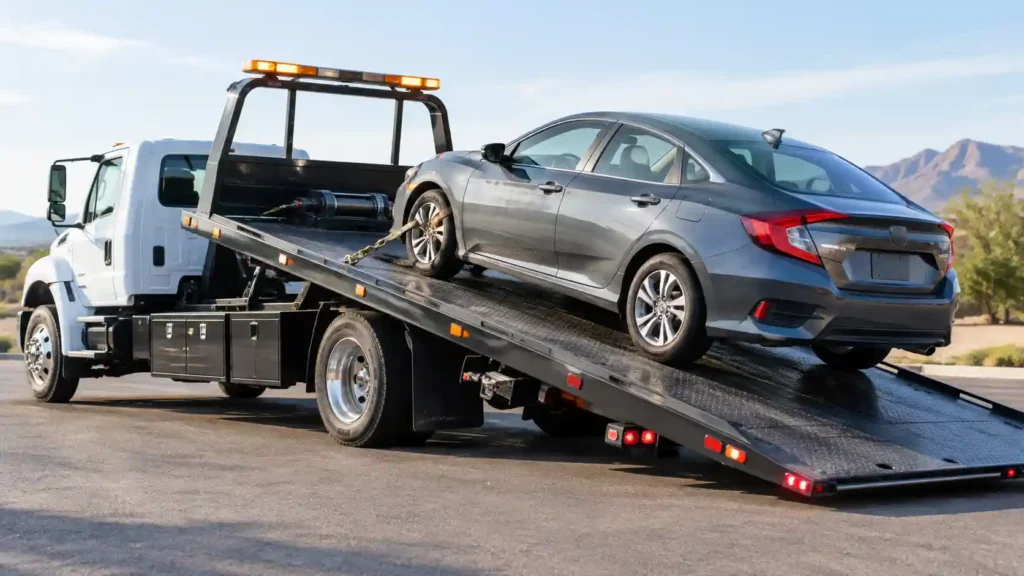
What is a rollback tow truck? A rollback tow truck creates a soft ramp by using a hydraulically powered flatbed that rolls backward and tilts lower to meet the ground. In order to fully shield the vehicle’s body and powertrain from road degradation, vehicles are pushed or winched onto the platform so that all four wheels ride off the surface. All-wheel-drive (AWD) vehicles, low-clearance sports cars, and seriously damaged automobiles need it because of its ultra-low loading angle, which makes it better to normal fixed-pivot flatbeds. Redline Roadside & Towing LLC runs these trucks, so every tip comes from real tow calls. What Is a Rollback Truck and Why Is It Called That? A rollback tow truck has a flatbed that hydraulically glides back and down to meet the ground, producing a gentle slope. The vehicles are driven or winched onto the platform so that all four wheels lift off the tarmac, fully preserving the vehicle’s powertrain and body from wear and tear of the road. This ultra-low loading angle puts it above typical fixed-pivot flatbeds and a must for all-wheel-drive (AWD) automobiles, low clearance sports cars, and seriously damaged autos. This setup makes vehicle recovery fast and safe. Your car does not hang from chains or hooks. It rides on top of the truck. Want to know where the word comes from? Read What Is the Meaning of Tow. How Does a Rollback Tow Truck Work? Step by Step A rollback tow truck works with hydraulics. The truck engine turns a power take-off, or PTO. The PTO runs a pump. The pump sends fluid into hydraulic cylinders, and those cylinders tilt and slide the deck. The driver runs it all from a remote or a side control station. Here is the order of a normal load: Position the truck. The driver parks in line with your car and sets warning lights. Tilt and slide the deck back. The deck lowers until it touches the ground. Run the winch cable out. The driver pulls the wire rope down the deck and sets the hook on a tow point. Pull the car up. The car goes in neutral with the parking brake off. The winch pulls it onto the deck. A car that runs can drive up. Level the deck. The deck slides forward and tilts flat. Secure with tie-downs. Wheel tie-down straps and ratchet straps hold each wheel. Safety chains add backup, and wheel chocks stop any roll. Drive. The driver checks the load one more time, then pulls out. Main Parts of a Rollback Tow Truck Each part has a job. Here are the main ones: Deck: The bed that carries your car. It tilts and slides. Headache rack: The wall behind the cab. It guards the cab from a shifting load. Winch: A powered drum with a cable and hook. It pulls a car up. Control station: Levers or a remote that move the deck and winch. Tie-down points: Rings and slots along the deck for straps and chains. Toolboxes: Steel or aluminum boxes that hold straps, chains, and gear. Deck lights: Lights that help the driver work at night. Bodies come in steel or aluminum. Steel is tough but heavy, and it can rust. Aluminum is lighter and fights rust, but it can crack under stress. Most decks run 19 to 22 feet long. The truck needs a strong chassis, often medium or heavy-duty, with a diesel or gas engine. What Is a Rollback Tow Truck Used For? A rollback can carry almost any car. Some cars need one. Here is who benefits most: Cars that do not run. A dead engine, a flat tire, or locked wheels will not stop a load. The winch does the pulling. AWD and 4WD cars. Dragging wheels can harm the drivetrain and transmission. All four wheels should stay off the road. EVs. Many makers say to use a flatbed. Check your owner’s manual. Low or luxury cars. The gentle angle protects the bumper and the undercarriage. Motorcycles. The driver straps the bike upright on the deck. Wrecked or stuck vehicles. Accident recovery and off-road recovery often start with a winch pull. Dealership, auction, and repossession moves. Cars arrive with no scrapes and no miles on the tires. Small equipment. Mowers, carts, and light machines ride the deck too. A rollback also works for roadside assistance calls, like a car with no keys or a bad tire. Need a rollback now? Redline Roadside & Towing LLC sends the right truck for your car. We also offer Medium Duty Towing Service for larger vehicles. Call us today. We give you a clear price and an arrival time before we roll. Rollback Tow Truck vs Flatbed: Is There a Difference? In towing, people use the two words for the same truck. A rollback has a deck that tilts and slides. A plain flatbed has a fixed deck with no tilt. You load a plain flatbed with ramps or a forklift. That works for cargo, but not for a dead car. When a tow company says flatbed, it almost always means a rollback. Here is how the main tow trucks stack up: Truck Deck How it loads Best for Rollback Tilts and slides Winch or drive up Most cars, AWD, EVs, low cars Plain flatbed Fixed, no tilt Ramps or forklift Cargo and drivable loads Wheel-lift No deck Lifts two wheels Short tows of simple cars Hook-and-chain No deck Chains lift one end Junk cars and scrap moves A wrecker is the older truck with a boom. An integrated tow truck is a heavy wrecker built for big rigs. A rotator is a heavy wrecker with a boom that turns in a full circle. Why a Rollback Is Gentler on Your Car Than Other Tow Trucks A rollback lifts the whole car. All four wheels stay off the road. Nothing drags and nothing swings behind the truck. Wheel-lift and hook-and-chain trucks keep two wheels on the road. That adds wear to tires, the

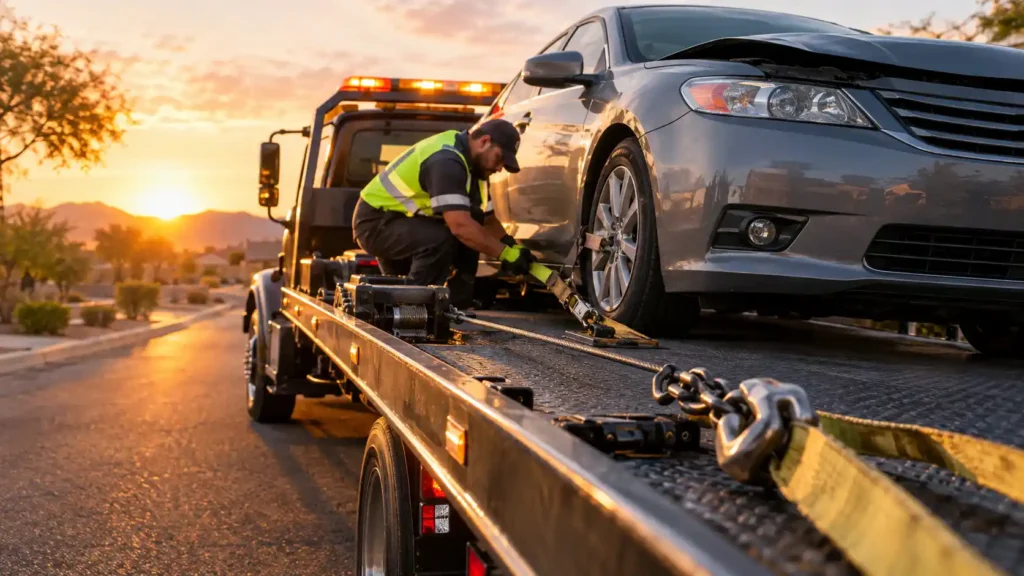
Tow truck operator securing a damaged sedan on a flatbed bed at sunset – what is the meaning of tow
Tow

What Is the Meaning of Tow? Plain Answer, Real Examples

What is the meaning of tow? To tow means to pull a vehicle or object behind another one with a hitch, tow bar, chain, or tow truck. As a noun, a tow is the pull itself, or the truck that does the pulling. At Redline Roadside & Towing LLC, our drivers run tows across Phoenix and the West Valley 24/7, so the examples below come from real calls. You will also learn what towed and towing mean, how “in tow” works, and what a tow costs in Phoenix. If your car was just towed, go straight to the section on towed cars. Tow Meaning in a Minute Tow has three common uses: Verb: to pull something behind you. “ He towed the boat to the lake.” Noun: a pull, or a tow truck. “ I need a tow. ” Phrase: “ in tow ” means following close behind. “ She walked in with two kids in tow. ” Every use come back to one idea. One thing pulls, and another thing follow. The rest of this page shows how that idea plays out on the road. Tow as a Verb: Pulling Something Behind You As a verb, to tow mean to pull something that cannot move well on its own. The thing being pulled rolls on its own wheels, floats, or slides along behind. A pickup tows a camper trailer. A tow truck tows a stalled sedan. A boat tows a water skier. In each case, a link joins the two. That link can be a hitch ball, a tow bar, a tow strap, a chain, or a rope. The verb has four forms: Form Example tow I tow my trailer on weekends. tows The truck tows cars all night. towed Our driver towed the van on Tuesday. towing They are towing a boat right now. When drivers search for towing meaning, they usually mean this road use. A vehicle cannot move, so another vehicle moves it. Tow as a Noun: A Tow, a Tow Truck, and a Tow Rope As a noun, tow has a few common uses: A tow: the act of being pulled. “My car needed a tow after the battery died.” Tow truck: the truck that does the work. Some people call it a wrecker. Tow rope, tow strap, tow bar: the gear that links the two vehicles. Tow hitch: the mount on the back of a vehicle that holds the hitch ball. Tow package: a factory upgrade with a stronger cooling system and trailer wiring. In British English, you may also hear “on tow.” A car on tow is a car being towed. What Does “In Tow” Mean? “In tow” means following close behind. It often describes a person who has others trailing along. “He arrived at the lake with his dog and three cousins in tow.” The phrase started at sea. A ship pulled by another ship by rope was “in tow.” Today the idea covers people, pets, and even problems. “She left the meeting with a long to-do list in tow.” One common mix-up is worth a note. The saying is “toe the line,” not “tow the line.” It comes from runners placing their toes on a start line. Tow is about pulling. Toe is about feet. Towing Vehicle vs. Towed Vehicle Many people search for the meaning of “towing vehicle” and “towed vehicle.” The terms are simple. Towing vehicle Towed vehicle What it does Pulls or carries the other vehicle Gets pulled or carried Common examples Tow truck, pickup, SUV, RV Stalled car, trailer, boat, camper Who is in it The tow driver Nobody, in most roadside tows Tow trucks move vehicles in two main ways. A wheel-lift truck raises the front or back wheels and pulls the car on its other two wheels. A flatbed carries the whole car on its bed. A flatbed is also called a rollback. Both count as towing, though the car rides differently. Tow as a Verb: Pulling Something Behind You To tow is to pull something that cannot move well on its own. A trailer has no engine. A stalled sedan has an engine that will not run. Both need a puller. A link joins the two. It can be a hitch ball, a tow bar, a strap, a chain, or a rope. A pickup tows a camper with a hitch. A boat tows a water skier with a rope. The verb has four forms: tow, tows, towed, and towing. “I tow a trailer.” “She tows boats.” “He towed the van on Tuesday.” “They are towing a camper.” Tow and haul are not the same. To tow is to pull. To haul is often to carry a load. A flatbed carries a car on its bed, yet the trade still calls that a tow. How a car rides changes how it should be towed. A flatbed lifts the whole car. A wheel-lift pulls it on two wheels. Many all-wheel-drive cars do best on a flatbed. Check your owner’s manual for your car’s rule. Tow as a Noun: A Tow, a Tow Truck, and Tow Gear Tow as noun short list of terms: A tow: the act of being pulled. “My car needed a tow after the battery died.” Tow truck: the truck that does the work. Some people say wrecker. Tow strap, tow rope, tow bar: the gear that links two vehicles. Tow hitch: the mount on the back of a vehicle that holds a hitch ball. Tow package: a factory option, often with extra cooling and trailer wiring. In British English, you may hear “on tow.” A car on tow is a car being towed. What Does Towed Mean? Towed means pulled or carried by another vehicle. It is the past tense of tow. It also names the thing that was pulled, such as a towed car or a towed trailer. Towed Vehicle vs. Towing Vehicle Towing Vehicle Towed Vehicle Job pulls or carries the other one gets pulled or carried Examples tow

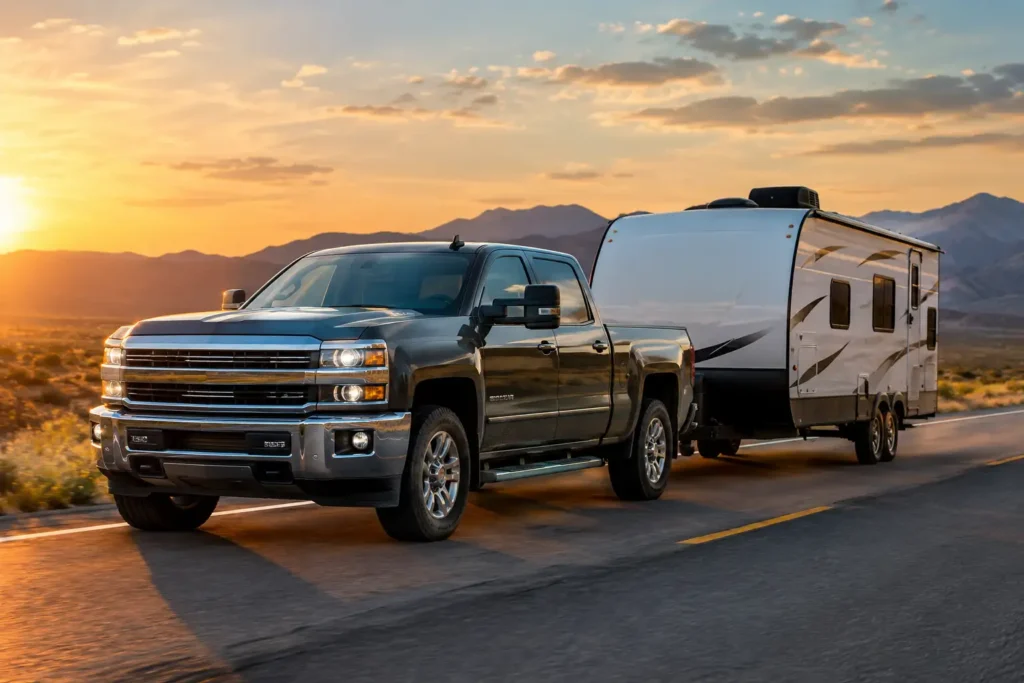
Pickup truck towing a travel trailer camper on the highway explaining what is the 80/20 rule for towing.
Tow

What Is the 80/20 Rule for Towing? A Straight Answer With Real Numbers

What is the 80/20 rule for towing? It’s a simple safety habit. You keep your loaded trailer at or below 80% of your vehicle’s max towing capacity. The other 20% is your cushion. If your truck is rated to tow 10,000 pounds, you plan for 8,000. That gap gives you more room to brake, climb hills, and stay in control. Redline Roadside & Towing LLC pulls heavy loads across Phoenix around the clock, so we know what an overloaded rig looks like on the shoulder. This guide shows the math, the weights that count, and what to do if your trailer is too heavy. What Is the 80% Rule for Towing? The 80% rule is a rule of thumb. Drivers, RV clubs, and tow pros have passed it around for years because it works. Your vehicle has a maximum towing rating from its maker. The rule says to stay well under that number and never sit right on it. Think of the rating as the most the truck can do on a good day, with fresh brakes, cool air, and a flat road. Real trips rarely look like that. A 20% buffer covers wind, hills, heat, and a trailer that weighs a bit more than the sticker says. Here are two quick cases. A truck rated for 7,000 pounds should tow no more than 5,600. A small SUV rated for 3,500 should stop at 2,800. Is the 80/20 Rule for Towing the Same Thing? Yes. The names 80/20 and 80% describe one idea. You use 80% of your rating and leave 20% unused. Some drivers call it the 20% safety margin. The math and the result are the same. The 80/20 rule in business and other fields is a different idea. Here, the numbers only compare your trailer’s weight to your vehicle’s tow rating. How to Calculate Your 80% Towing Limit You need two things: a rating you can trust, and a calculator. Find Your Vehicle’s Max Towing Capacity Start with the owner’s manual. The maker’s website works too, if you pick the exact year, engine, axle ratio, and cab style. Ratings can jump by thousands of pounds between trims of the same truck. The sticker on the driver’s door jamb lists weight ratings like GVWR and payload, but the tow rating itself usually lives in the manual. Skip dealer guesses and forum posts. Do the Math Multiply your max towing capacity by 0.8. The answer is your working limit. Max Towing Capacity 80% Limit 3,500 lb 2,800 lb 5,000 lb 4,000 lb 7,500 lb 6,000 lb 10,000 lb 8,000 lb 12,000 lb 9,600 lb Compare that number to your trailer’s real weight, not the brochure weight. The next section shows which weight to use. Which Weight Counts: Dry, GVWR, or Loaded? Trailer makers advertise dry weight. That’s the trailer empty, with no water, propane, battery, or gear. Nobody tows a trailer like that. Your check needs the loaded weight, or at least the trailer’s GVWR, which is the most it’s built to weigh when full. Trailer GVWR vs. Actual Loaded Weight GVWR gives you a safe worst case. If it fits under your 80% limit, you’re covered no matter how you pack. For a tighter answer, weigh the loaded rig on a truck scale. Many truck stops have one, and the fee is small. Water adds up fast too. A 40 gallon fresh water tank holds about 330 pounds before you pack a single bag. Tongue Weight, Payload, and GCWR in Plain Words Three more numbers matter, and the 80% rule doesn’t replace any of them. Tongue weight is the downward push the trailer puts on your hitch. For most travel trailers it runs about 10 to 15% of the trailer’s weight. Payload is how much your truck can carry in the cab and bed, and tongue weight counts against it. GCWR is the most your truck, trailer, people, and cargo can weigh all together. Many pickups run out of payload before they run out of tow rating, so check all three. Wikipedia explains these weight ratings well if you want the full picture. Buying a Trailer? Run the Numbers First Shopping for a camper? Use the trailer’s GVWR, not the dry weight on the listing, and check it against your 80% limit before you fall for a floor plan. A trailer that looks light on paper can land well over your limit once you add water, bikes, and a week of food. Used trailers carry a certification label with the real GVWR. Find it before you buy. For a deeper look at ratings, read what towing capacity means. Why Towing at 80% Is Safer Weight changes how your truck behaves. A heavier trailer takes longer to stop, and your brakes get hot on long downhills. The engine and transmission also work harder on climbs, which builds heat fast. Close to the limit, a gust of wind or a quick lane change can start trailer sway, and a swaying trailer is hard to bring back under control. Leave room and most of that goes away. Brakes last longer, the truck climbs without struggling, and you have space to react when traffic stops short. Is the 80% Rule a Law or a Guideline? No law sets 80% as the cutoff. It’s a guideline. The maker’s rating is the real ceiling, and you should never go over it. The 80% habit just keeps you far from that line. For the basics of hitching, braking, and loading, NHTSA publishes a free guide called Towing a Trailer: Being Equipped for Safety. When to Tow Even Less Than 80% Some trips call for more cushion than the rule gives you. Steep Grades and Long Downhills Mountain roads push your brakes and cooling system hard. Shift down before the descent starts, not halfway down it. On a long climb, a trailer near your limit can be too much for a truck with a small engine. Phoenix Summer Heat When it’s 110 degrees outside, your

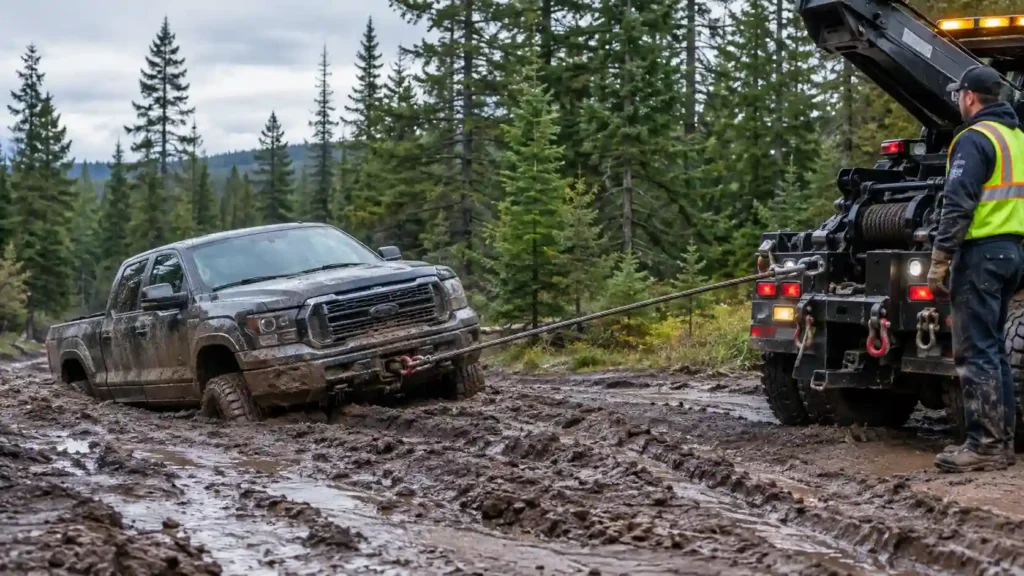
A tow truck winching a pickup truck out of deep mud to demonstrate what does off-road recovery mean.
Tow

What Does Off-Road Recovery Mean? Straight Answer

Off-road recovery utilizes heavy-duty winches, kinetic straps, and traction boards to safely extract stuck vehicles from mud, sand, snow, or rocks, whereas traditional towing simply transports disabled vehicles on stable pavement. At Redline Roadside & Towing LLC, we specialize in both services, deploying advanced rigging techniques and mechanical leverage to rescue stranded drivers from challenging terrain without causing frame or structural damage. If you have ever asked what does off-road recovery mean while staring at a truck buried past its axles, this guide covers it all. You will learn the techniques, the gear, the real costs, and when to call a professional instead of digging yourself in deeper. What Does Off-Road Recovery Mean, Exactly? Off-road recovery frees vehicles physically trapped in rugged terrain like mud, sand, snow, or loose rocks. While standard towing simply transports a disabled vehicle along paved roads, recovery focuses on extricating a sunken or wedged vehicle and safely returning it to stable ground. This complex process requires specialized tools including winches, kinetic straps, snatch blocks, and traction boards to pull vehicles free without causing structural damage. Because of the unique environmental challenges and advanced rigging techniques required, off-road recovery is more resource-intensive and costly than traditional towing. Off-Road Recovery vs. Towing: What’s the Real Difference? Towing vs recovery comes down to one question: can the vehicle move under its own power, or is it stuck? A standard tow uses a flatbed tow truck or a wheel-lift tow truck to move a car that has a dead battery, a flat tire, or engine trouble. The truck lifts or loads the vehicle and drives it somewhere else. It is a routine job with predictable steps. Off-road recovery is a different kind of work. The vehicle is not broken. It is buried, wedged, or trapped by terrain. A crew may need a winch, recovery straps, or even a second vehicle to pull it free before any towing can happen. Recovery jobs also carry more safety risk, since a strap or cable under heavy load can snap and cause serious injury if it is rigged wrong. In short, towing is about transport. Off-road recovery is about extraction. Many stuck-vehicle calls need both: recovery first to get the vehicle unstuck, then a tow if it cannot be driven out afterward. Why Vehicles Get Stuck Off-Road Most off-road recovery calls come down to a handful of common causes. Mud: Tires spin and dig deeper instead of gripping, especially after rain. Sand: Loose, shifting ground swallows tires and drops the frame onto the surface. Snow: Deep or drifted snow packs under the vehicle and kills traction. Rocks: Uneven rock beds can trap a wheel or scrape the undercarriage. Water crossings: What looks like a shallow creek can hide a deep rut or soft bottom. Ditches and steep inclines: A wrong turn off the shoulder can drop a vehicle into a ditch or leave it stuck nose-down on a grade. Loose gravel: Gravel shifts under tire weight the same way sand does, especially on a slope. Knowing the cause matters because each one calls for a different fix. Pulling a truck out of deep mud takes different gear than lifting a car off a rock. Off-Road Recovery Techniques Used by Professionals Off-road recovery techniques vary by how stuck the vehicle is and what caused it. Single-Line Winching Single-line winching is the most basic method. A winch cable runs from the stuck vehicle to a solid anchor, like a tree or another truck, and pulls the vehicle straight out. Double-Line Winching Double-line winching adds a snatch block, a type of pulley, to double the pulling force. Crews use this when a single line does not have enough power or a solid anchor point sits too close. Snatch Strap Recovery Snatch strap recovery uses a stretchy nylon strap between a moving vehicle and the stuck one. The strap stores energy as it stretches, then releases it in a controlled pull. This works well for lighter, less severe stuck situations. Kinetic Recovery Rope Kinetic recovery rope works on the same idea as a snatch strap but stretches further and absorbs more shock, making it a safer choice for tougher pulls. Recovery Boards Recovery boards are ramps placed under the tires to rebuild traction in sand, mud, or snow. They are often the fastest fix, since no second vehicle is needed. Air Cushions Air cushions lift a vehicle that has rolled or is stuck at an odd angle, without adding more stress to the frame. Crane Recovery Crane recovery comes into play for heavy trucks, RVs, or equipment that is too large or too unstable for a standard winch pull. Professionals choose the right technique based on the terrain, the vehicle’s weight, and how deeply it is stuck. Using the wrong method, like a snatch strap on a vehicle buried in deep mud, can waste time or damage the vehicle further. Off-Road Recovery Equipment, Explained Simply You do not need to be an expert to understand off-road recovery equipment. Here is what each tool actually does. Winch: A motorized spool that pulls the vehicle using a steel cable or synthetic rope. D-ring: A metal loop used to connect a strap or rope to a rated recovery point on the vehicle. Bow shackle: A U-shaped connector that links a winch cable to a strap, rope, or anchor. Hi-lift jack: A tall manual jack that lifts a vehicle out of a rut or holds it steady during repairs. Ground anchor: A device buried in soil to create a pull point when no tree or vehicle is nearby. Recovery boards: Traction ramps placed under tires to help a vehicle climb out of soft ground. Tree strap: A wide strap wrapped around a tree trunk to protect it while anchoring a winch cable. Each piece of gear plays a specific role. A winch provides the pulling power, while D-rings, shackles, and straps make sure that power connects safely to the vehicle. Should You Try Self-Recovery or Call a Professional? Some stuck

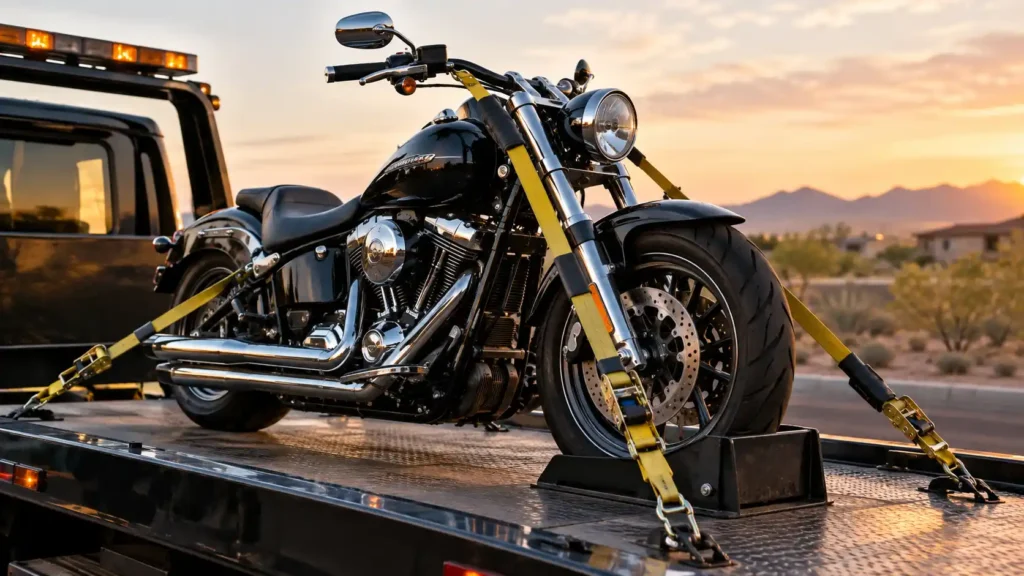
A cruiser motorcycle secured with yellow tie-down straps on a flatbed tow truck, demonstrating how to tow a motorcycle safely.
Tow

How to Tow a Motorcycle: Pick the Right Method

How to tow a motorcycle safely, load it onto a trailer, flatbed, or hitch carrier, and secure it at four separate points using heavy-duty ratchet straps. Start by placing a sturdy ramp on level ground and using a helper to guide the bike forward until the front tire locks firmly into a center wheel chock. Attach the first two straps to a structural frame point, like the lower triple trees, pulling them forward and outward at a 45-degree angle. Crank these front straps down evenly until the front forks compress by roughly 50%, which eliminates bouncing and keeps the hooks from slipping out over road bumps. Start With What Shape Your Bike Is In Your bike’s condition picks the method. A bike that rolls and steers can go on almost any rig. A bike that leaks or won’t roll needs a flatbed. Rideable means you can ride or walk it up a ramp. Non-rideable means it needs a push or a winch. Bike’s condition Best method Why Rides fine Trailer, hitch carrier, or flatbed It steers and rolls, so loading is simple. Starts but feels unsafe Trailer or flatbed Bad brakes or tires make a ramp ride risky. Walk it up with a helper. Won’t start (dead battery, breakdown) Trailer or motorcycle tow truck The wheels still turn. Two people can push it, or a winch can pull it. Crashed or leaking (crash damage, fuel leak) Flatbed tow truck Bent parts and fuel leaks need a pro. Fuel near heat is a fire risk. Locked or seized wheel (seized engine) Flatbed with a winch The wheel won’t turn. Never drag it, and skip the dolly. A dead battery alone is the easy case, since the bike still rolls. If a wheel won’t turn, check for a disc lock before you blame a seized engine. Motorcycle Transport Methods Compared Method Best For Weight Capacity Cost Ease of Use Tow Vehicle Requirements Motorcycle Trailer Long trips & any bike type ~1,530 lbs Varies by location/dates Medium Hitch receiver, correct ball, working lights Hitch-Mounted Carrier Light bikes & dirt bikes ~600 lbs Less than a trailer Medium Strong hitch receiver with a high tongue rating Tow Dolly Short trips & small bikes ~800 lbs Varies by brand Harder Hitch; bike must fit dolly; rear wheel must spin safely Flatbed Tow Truck Broken or damaged bikes Fits most bikes $85–$150 hook-up + $4.50–$5/mile Easy (Pro does it) None Gear and Bike Prep Before You Load Gather this gear first: Loading ramp: Length sets the angle, so a longer ramp gives a gentler climb. Pick one with a weight capacity above your bike’s weight, plus yours if you ride up. Wheel chock: It holds the front wheel upright. Ratchet straps: Bring four, rated well above the bike’s weight. Soft loops: Loop them around solid parts so hooks never touch paint. Cam buckle straps: These work as backups on light bikes. They pull less than ratchets. Gloves: Straps and ramps bite. Then prep the bike: Read the owner’s manual. It says whether to leave the bike in gear or in neutral. Follow it. Set tire pressure to the number on the sticker. Firm tires keep the bike upright. Remove bags and loose items. Tighten the windshield and fold in the mirrors. Turn off the fuel valve, also called the fuel petcock, if your bike has one. Tighten the gas cap. Look under the bike for leaks. A leak means you need a flatbed and should tell the driver. Pull the key. Keep the handlebars free while you load, since the straps hold them later. Flip the kickstand up once the straps take the weight. Loading and Unloading Without Dropping the Bike Park on flat, firm ground. Lock the ramp to the deck so it can’t slide. On a flatbed, slide the deck out to its full length. A longer deck gives a flatter ramp angle. Line the bike up straight with the ramp. If the bike starts and you have a spotter, ride it up slowly in first gear. If not, keep the engine off and push with a helper. Keep a hand on the front brake the whole way up. Squeeze to stop any roll. Stop in the middle of the deck, near the cab or trailer nose. This keeps the center of gravity low and forward. Roll the front wheel into the wheel chock. Use the kickstand until the straps take over. To unload, go in reverse. Hold both grips and squeeze the front brake before you undo the last strap. Feather the brake as you walk the bike down. On a tilting flatbed, the bike wants to roll back, so stay ready. Put the kickstand down only on flat ground. Where to Strap It, Which Angle, and How Tight Use at least four straps: two in front and two in back. That is a four-point tie-down. Heavy bikes may need six. Best spots: The frame and solid mounts come first. The triple tree is next, which is the clamp that holds the fork tubes at the top. Use soft loops around it. Handlebar: It works on many bikes with soft loops. On clip-ons, use the triple tree instead. Skip these: One fork tube alone, brake lines, mirrors, and plastics. They bend or snap. Strap angle: Aim for about 45 degrees, so straps pull down and out. Straight-down straps do less to stop a sideways slide. Tension: Tighten until the front suspension compresses. Stop before it bottoms out. Snug is enough. Rear wheel: Add a strap over it, or chock it, so the tail can’t swing. Recheck: Stop after the first few miles. Straps settle. Pull each one and tug the bike. Driving With a Bike in Tow Hitch class: Your hitch, ball, and tow vehicle must handle the trailer plus the bike. Tongue weight: This is the downward push on the hitch. Aim for 9 to 15 percent of the loaded trailer’s weight. Too little causes trailer sway. U-Haul tells renters to

Scroll to Top