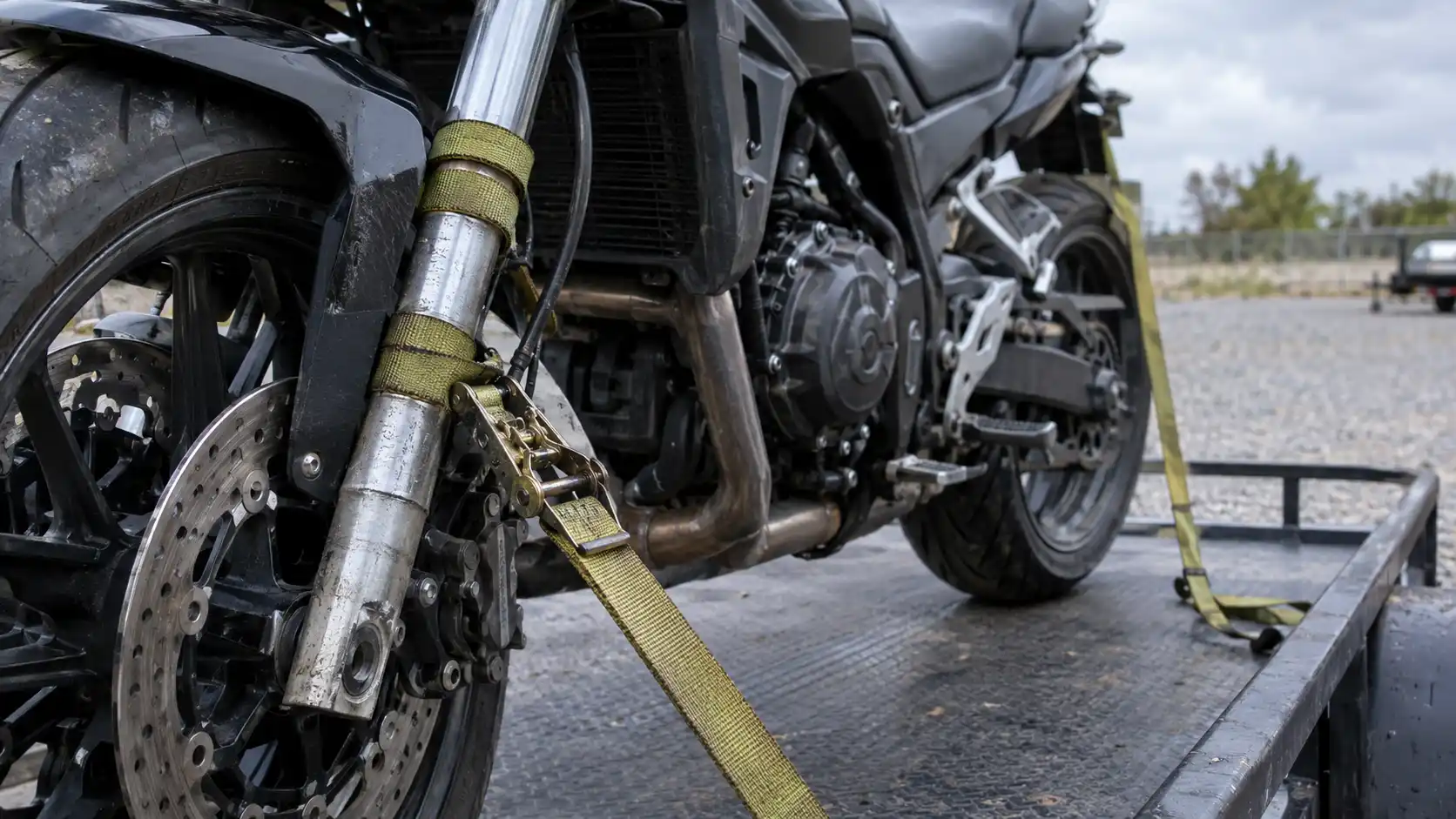
How to tow a motorcycle safely, load it onto a trailer, flatbed, or hitch carrier, and secure it at four separate points using heavy-duty ratchet straps. Start by placing a sturdy ramp on level ground and using a helper to guide the bike forward until the front tire locks firmly into a center wheel chock. Attach the first two straps to a structural frame point, like the lower triple trees, pulling them forward and outward at a 45-degree angle.
Crank these front straps down evenly until the front forks compress by roughly 50%, which eliminates bouncing and keeps the hooks from slipping out over road bumps.
Start With What Shape Your Bike Is In
Your bike’s condition picks the method. A bike that rolls and steers can go on almost any rig. A bike that leaks or won’t roll needs a flatbed. Rideable means you can ride or walk it up a ramp. Non-rideable means it needs a push or a winch.
| Bike’s condition | Best method | Why |
| Rides fine | Trailer, hitch carrier, or flatbed | It steers and rolls, so loading is simple. |
| Starts but feels unsafe | Trailer or flatbed | Bad brakes or tires make a ramp ride risky. Walk it up with a helper. |
| Won’t start (dead battery, breakdown) | Trailer or motorcycle tow truck | The wheels still turn. Two people can push it, or a winch can pull it. |
| Crashed or leaking (crash damage, fuel leak) | Flatbed tow truck | Bent parts and fuel leaks need a pro. Fuel near heat is a fire risk. |
| Locked or seized wheel (seized engine) | Flatbed with a winch | The wheel won’t turn. Never drag it, and skip the dolly. |
A dead battery alone is the easy case, since the bike still rolls. If a wheel won’t turn, check for a disc lock before you blame a seized engine.
Motorcycle Transport Methods Compared
| Method | Best For | Weight Capacity | Cost | Ease of Use | Tow Vehicle Requirements |
|---|---|---|---|---|---|
| Motorcycle Trailer | Long trips & any bike type | ~1,530 lbs | Varies by location/dates | Medium | Hitch receiver, correct ball, working lights |
| Hitch-Mounted Carrier | Light bikes & dirt bikes | ~600 lbs | Less than a trailer | Medium | Strong hitch receiver with a high tongue rating |
| Tow Dolly | Short trips & small bikes | ~800 lbs | Varies by brand | Harder | Hitch; bike must fit dolly; rear wheel must spin safely |
| Flatbed Tow Truck | Broken or damaged bikes | Fits most bikes | $85–$150 hook-up + $4.50–$5/mile | Easy (Pro does it) | None |
Gear and Bike Prep Before You Load
Gather this gear first:
- Loading ramp: Length sets the angle, so a longer ramp gives a gentler climb. Pick one with a weight capacity above your bike’s weight, plus yours if you ride up.
- Wheel chock: It holds the front wheel upright.
- Ratchet straps: Bring four, rated well above the bike’s weight.
- Soft loops: Loop them around solid parts so hooks never touch paint.
- Cam buckle straps: These work as backups on light bikes. They pull less than ratchets.
- Gloves: Straps and ramps bite.
Then prep the bike:
- Read the owner’s manual. It says whether to leave the bike in gear or in neutral. Follow it.
- Set tire pressure to the number on the sticker. Firm tires keep the bike upright.
- Remove bags and loose items. Tighten the windshield and fold in the mirrors.
- Turn off the fuel valve, also called the fuel petcock, if your bike has one. Tighten the gas cap.
- Look under the bike for leaks. A leak means you need a flatbed and should tell the driver.
- Pull the key. Keep the handlebars free while you load, since the straps hold them later.
- Flip the kickstand up once the straps take the weight.
Loading and Unloading Without Dropping the Bike
- Park on flat, firm ground. Lock the ramp to the deck so it can’t slide.
- On a flatbed, slide the deck out to its full length. A longer deck gives a flatter ramp angle.
- Line the bike up straight with the ramp.
- If the bike starts and you have a spotter, ride it up slowly in first gear. If not, keep the engine off and push with a helper.
- Keep a hand on the front brake the whole way up. Squeeze to stop any roll.
- Stop in the middle of the deck, near the cab or trailer nose. This keeps the center of gravity low and forward.
- Roll the front wheel into the wheel chock. Use the kickstand until the straps take over.
To unload, go in reverse. Hold both grips and squeeze the front brake before you undo the last strap. Feather the brake as you walk the bike down. On a tilting flatbed, the bike wants to roll back, so stay ready. Put the kickstand down only on flat ground.
Where to Strap It, Which Angle, and How Tight
Use at least four straps: two in front and two in back. That is a four-point tie-down. Heavy bikes may need six.
- Best spots: The frame and solid mounts come first. The triple tree is next, which is the clamp that holds the fork tubes at the top. Use soft loops around it.
- Handlebar: It works on many bikes with soft loops. On clip-ons, use the triple tree instead.
- Skip these: One fork tube alone, brake lines, mirrors, and plastics. They bend or snap.
- Strap angle: Aim for about 45 degrees, so straps pull down and out. Straight-down straps do less to stop a sideways slide.
- Tension: Tighten until the front suspension compresses. Stop before it bottoms out. Snug is enough.
- Rear wheel: Add a strap over it, or chock it, so the tail can’t swing.
- Recheck: Stop after the first few miles. Straps settle. Pull each one and tug the bike.
Driving With a Bike in Tow
- Hitch class: Your hitch, ball, and tow vehicle must handle the trailer plus the bike.
- Tongue weight: This is the downward push on the hitch. Aim for 9 to 15 percent of the loaded trailer’s weight. Too little causes trailer sway. U-Haul tells renters to load the trailer heavier in front.
- Trailer wiring: Plug it in. Have a helper check the brake lights and turn signals.
- Stopping distance: It grows with a load behind you. Brake early and turn wide.
- Speed limits: Slow down. U-Haul’s motorcycle trailer lists 55 mph. Some states set lower trailer limits, so check yours.
- Overhead clearance: A bike on a flatbed or carrier adds height and length. Watch garages and drive-throughs.
- First stop: Pull over within a few miles and recheck every strap.
Trailer plate and light rules differ by state. Check your state’s DMV page before you leave.
When a Motorcycle Tow Truck Is the Smarter Call
Call a motorcycle tow truck when the bike won’t roll, leaks, is damaged, or you have no trailer.
Ask for a flatbed. It carries the bike level, with straps at four points. Tell the dispatcher:
- Your bike’s make, model, and weight
- If it is custom or lowered, since ground clearance affects loading
- If it is a trike or has a sidecar
- Your exact location
- If it rolls, starts, or leaks
Ask for an arrival time too, since response time varies. On a highway shoulder, stay well off the road, behind the guardrail if there is one. Turn on your hazard lights if your bike has them.
A careful tow operator uses soft loops, at least four straps, and winching for a bike that won’t roll.
What it costs. Towing bills usually mix a hook-up fee with a per-mile rate. Here are two 2026 rate sheets from Idaho towing companies. Bill Ricks Towing lists $150 to hook up a motorcycle, plus $4.50 per towed mile. TBS Towing lists $85 plus $5 per mile.
| Towed distance | Bill Ricks Towing | TBS Towing |
| 15 miles | $217.50 | $160 |
| 30 miles | $285 | $235 |
Bill Ricks also charges $3.75 per mile for the truck’s drive to you. These are Idaho prices, so rates in your area differ. Distance, time of day, winching, and wait time all change the total. Recovery work can bill by the hour, and one sheet lists $250 an hour for light-duty recovery.
Redline Roadside & Towing LLC provides Motorcycle Towing in the West Valley. It runs alongside our Light Duty Towing service.
Mistakes That Damage Bikes During Towing
Knowing how to tow a motorcycle also means knowing what to skip.
- Towing on its own wheels with a tow rope or tow strap. A rolling bike can’t steer or brake behind a car. One wobble can drop it and make a road hazard. It also spins the drivetrain with the engine off. Never do it.
- Overtightening. Crushing straps stress fork seals and bend parts. Snug is enough.
- Using only two straps. The bike shifts, and strap slip lets it fall.
- An off-center load. It makes a trailer sway.
- A bottomed-out suspension. The straps go slack over bumps.
- Leaving a wheel lock on. A disc lock can jam the wheel while you push.
- Skipping the recheck. Straps loosen in the first few miles.
Can You Tow a Trailer With a Motorcycle?
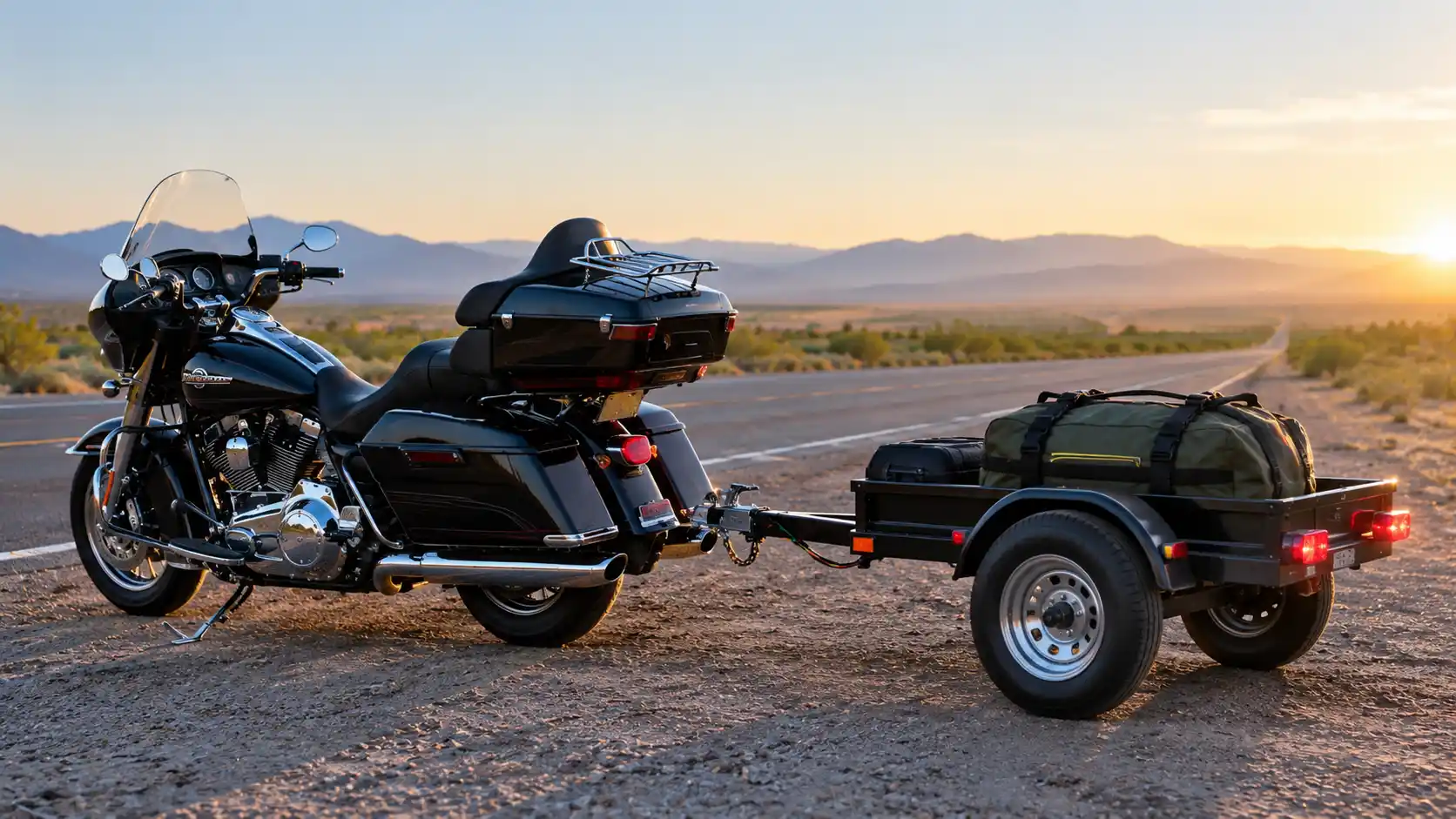
Most motorcycles have no tow rating. Towing with a motorcycle is a no unless the owner’s manual says yes. A hitch bolted on does not add a rating.
Some touring motorcycles and trikes have a manufacturer rating or an approved hitch. Look for the tow limit, the GVWR (gross vehicle weight rating), and the tongue weight limit. Keep the motorcycle trailer light, with weight over the axle. If your manual is silent, ask a dealer before you buy a hitch.
Conclusion
Now you know how to tow a motorcycle the safe way. Check the bike’s condition first. Pick the method that fits: trailer, hitch carrier, dolly, or flatbed. Prep the bike, load it slowly, and use four straps at a good angle. Recheck after a few miles, and skip the rope every time.
Bike down or stuck? Give us your make, model, and location, and we will send the right truck. Contact us, tell us what happened, and we will take it from there.
FAQs
Can I tow a motorcycle with a rope or strap?
No. A rolling bike can’t steer or brake, so use a trailer, flatbed, or carrier.
How many tie-downs do I need?
Use four at minimum, two front and two back. Heavy bikes may need six.
Can a bike be towed in neutral?
Only if the owner’s manual allows it. A trailer or flatbed keeps the wheels off the road.
What does a motorcycle tow cost?
Two 2026 Idaho sheets list $85 to $150 to hook up, plus $4.50 to $5 per mile. Towing cost factors include distance, time, and winching.
Can I tow a bike with a small car?
Only if the hitch and car rating fit the load. Many hitch carriers top out near 600 lb, so check that hitch carrier limit first.
Can I tow a trailer with my bike?
Only if the owner’s manual gives a tow rating. Would you rather have a pro handle it? Call Redline Roadside & Towing LLC and we will send a truck.