What is medium duty towing? It is the towing of cars weighing between 10,001 and 26,000 pounds, including RVs, box trucks, big vans, and compact buses. These vehicles require a stronger truck with a larger winch and the appropriate brakes since they are too hefty for a car tow.
These cars are towed around the West Valley by Phoenix’s Redline Roadside & Towing LLC. Weight restrictions, truck kinds, prices, and how to determine which tow you require before making a call are all covered in this book.
Medium Duty Towing Weight Limits: The Quick Answer
Many drivers ask what is medium duty towing and what weight it covers. The quick answer is simple. A medium duty tow moves a vehicle with a GVWR from 10,001 to 26,000 pounds.
The 10,001 to 26,000 Pound Rule
GVWR stands for gross vehicle weight rating. It is the most weight the maker says the vehicle can safely carry, including the truck itself, fuel, people, and cargo. Tow companies sort jobs by this number.
Curb weight is what the vehicle weighs empty. Loaded weight is what it weighs right now, with cargo on board. Neither one sets the class. For example, a box truck that weighs 9,000 pounds empty may carry a 14,500 pound rating, so it counts as medium duty.
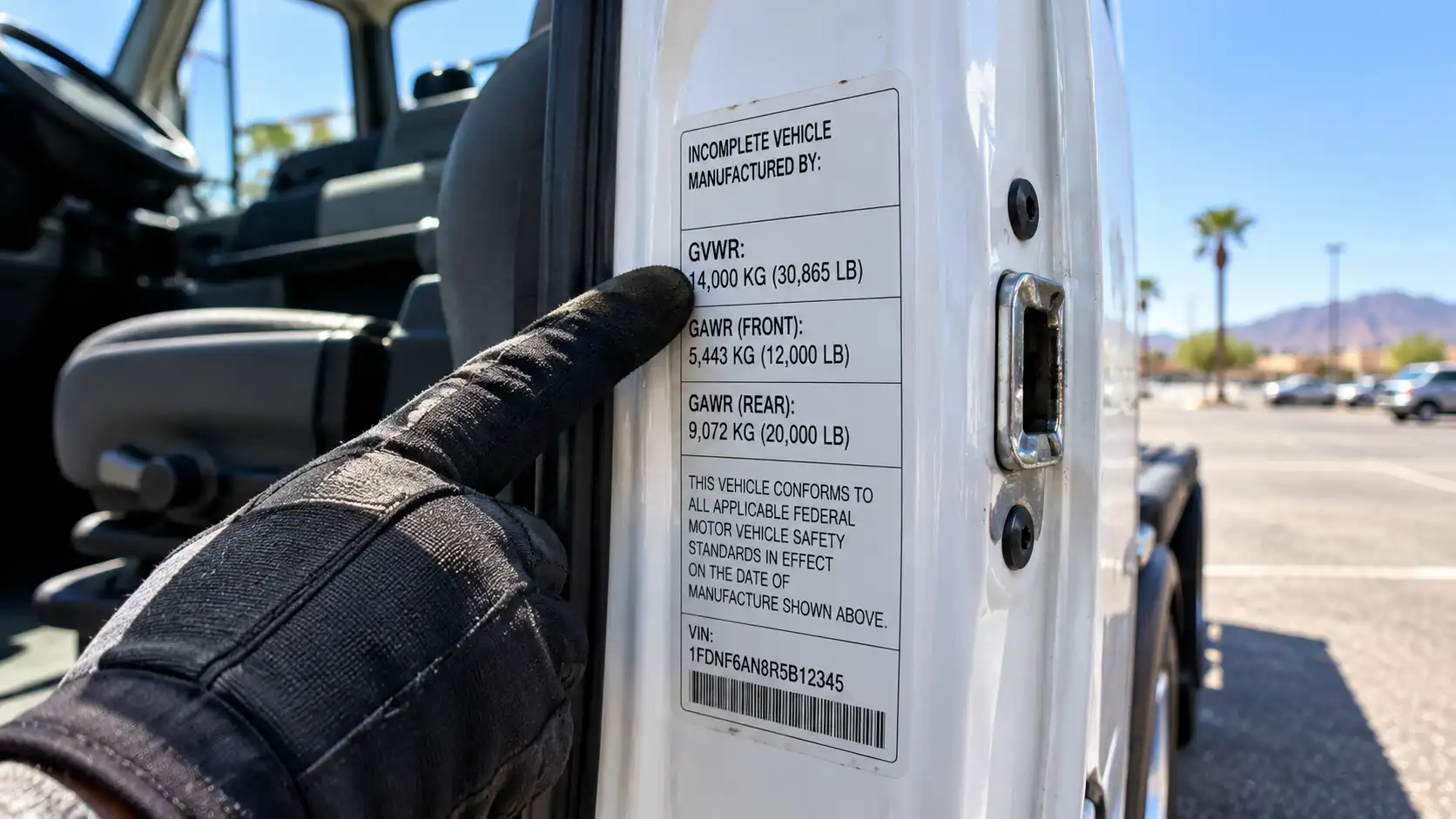
You can find the GVWR on the door jamb sticker. Open the driver door and look at the label on the frame. The federal system calls this range FHWA Classes 3 to 6. So what weight is medium duty tow? Anything rated 10,001 to 26,000 pounds.
Light, Medium, and Heavy Duty Compared
This table shows where each duty level starts and stops.
| Duty Level | GVWR | Class | Example Vehicles | Typical Tow Truck | CDL Note |
| Light duty | Under 10,000 lb | Classes 1 to 2 | Cars, SUVs, half-ton pickups | Flatbed or wheel-lift | No CDL for the vehicle |
| Medium duty | 10,001 to 26,000 lb | Classes 3 to 6 | Box trucks, shuttle buses, RVs | Medium wrecker or medium flatbed | Under the Class B line |
| Heavy duty | Over 26,000 lb | Classes 7 to 8 | Tractor-trailers, transit buses, dump trucks | Heavy wrecker, rotator, or heavy flatbed | CDL Class B starts at 26,001 lb |
Why Some Sources Show Different Numbers
You may see other numbers online. The EPA uses its own band for emissions rules. It calls vehicles from 8,501 to 10,000 pounds GVWR medium duty passenger vehicles, which covers some big SUVs and vans. The DOE and the FHWA use eight weight classes instead. The Department of Energy’s Alternative Fuels Data Center lists them in its vehicle weight classes chart, and a Wikipedia page on truck classification covers the same ground.
Class 2b sits right on the line, at 8,501 to 10,000 pounds. Some tow shops price these heavy pickups as medium duty because they need more lifting strength. Others start medium duty at 10,001. Ask the company which line it uses before you book.
What Is Considered a Medium Duty Truck?
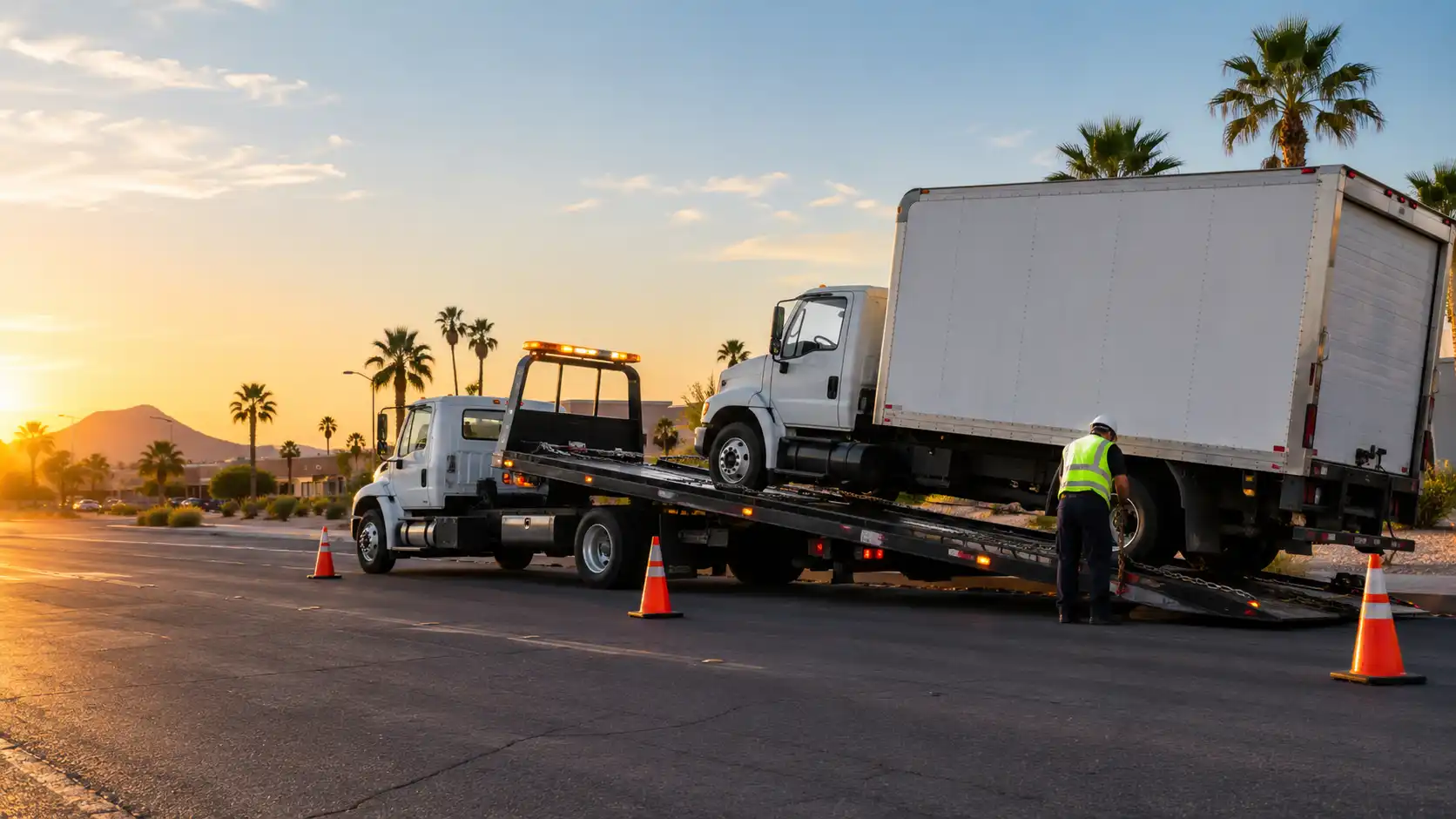
People often ask what is considered a medium duty truck. The answer comes from the GVWR sticker, not from how big the truck looks.
Class 3 to Class 6 Explained
- Class 3 (10,001 to 14,000 lb): Heavy trucks, like the Ford F-350 dual.
- Class 4 (14,001 to 16,000 lb): Ford E-450 cutaway vans are often used as small delivery trucks or shuttle buses.
- Class 5 (16,001 to 19,500 lb): Work trucks, Ford F-450 and F-550. A few F-450 configurations end up in Class 4.
- Class 6 (19,501 to 26,000 lb): Bigger Isuzu box trucks and freightliner M2 trucks.
Verify the sticker at all times. The same model is sold by manufacturers with varying ratings.
Everyday Vehicles That Count as Medium Duty
- Box trucks used for moving and freight
- Delivery vans, including large step vans
- Shuttle buses used by hotels, churches, and schools
- RVs, including a motorhome or a fifth wheel too heavy for a pickup to pull
- Utility and bucket trucks used by power and phone crews
- Construction equipment moved on a car hauler or a heavy flatbed
Many of these are work vehicles. Every hour one sits broken down costs a business money, so a fast, correct tow matters.
Vehicles That Look Medium Duty but Are Not
Size can fool you. A light duty pickup like an F-250 usually rates at or under 10,000 pounds, so a standard flatbed can handle it. At the other end, a tractor-trailer or a full size transit bus often tops 26,000 pounds. Those need heavy duty gear. Check the sticker, not the looks.
What Is a Medium Duty Tow Truck?
A medium duty tow truck is built to lift or carry vehicles in the 10,001 to 26,000 pound range. It has a stronger frame, bigger lift gear, and air brakes. Most come in two main styles.
Integrated Tow Trucks and Wreckers
A wrecker has a boom and winch mounted behind the cab. The boom lifts and the winch pulls, which helps when a truck sits in a ditch or on a soft shoulder. An integrated tow truck adds a built-in wheel-lift or underlift. The wheel-lift cradles the tires. The underlift is a steel arm that slides under the axle and raises one end. A self-loader is a compact wheel-lift rig that fits lighter jobs in tight spots.
Medium Duty Flatbeds
A rollback is a flatbed with a bed that tilts and slides back to the ground. Many people call it a tilt bed. A winch pulls the vehicle up the bed, so no wheels drag. That is damage-free loading. Flatbeds suit vehicles with low bumpers, broken transmissions, or air-ride suspension. Chassis class matters too. A Class 5 or 6 chassis carries more weight than a Class 4.
Truck Specs That Matter
- Boom and winch capacity: Ask for the winch line pull and the boom rating in tons. A loaded box truck needs far more pull than a car.
- Hydraulics: Strong hydraulics lift smoothly and hold the load steady.
- Reinforced frame: The frame must handle the weight without flexing.
- Air brake system: The truck links to the towed vehicle’s air system so the brakes work during the tow.
- Tie-downs: Chains and straps must be rated for the load.
How Medium Duty Towing Works Step by Step
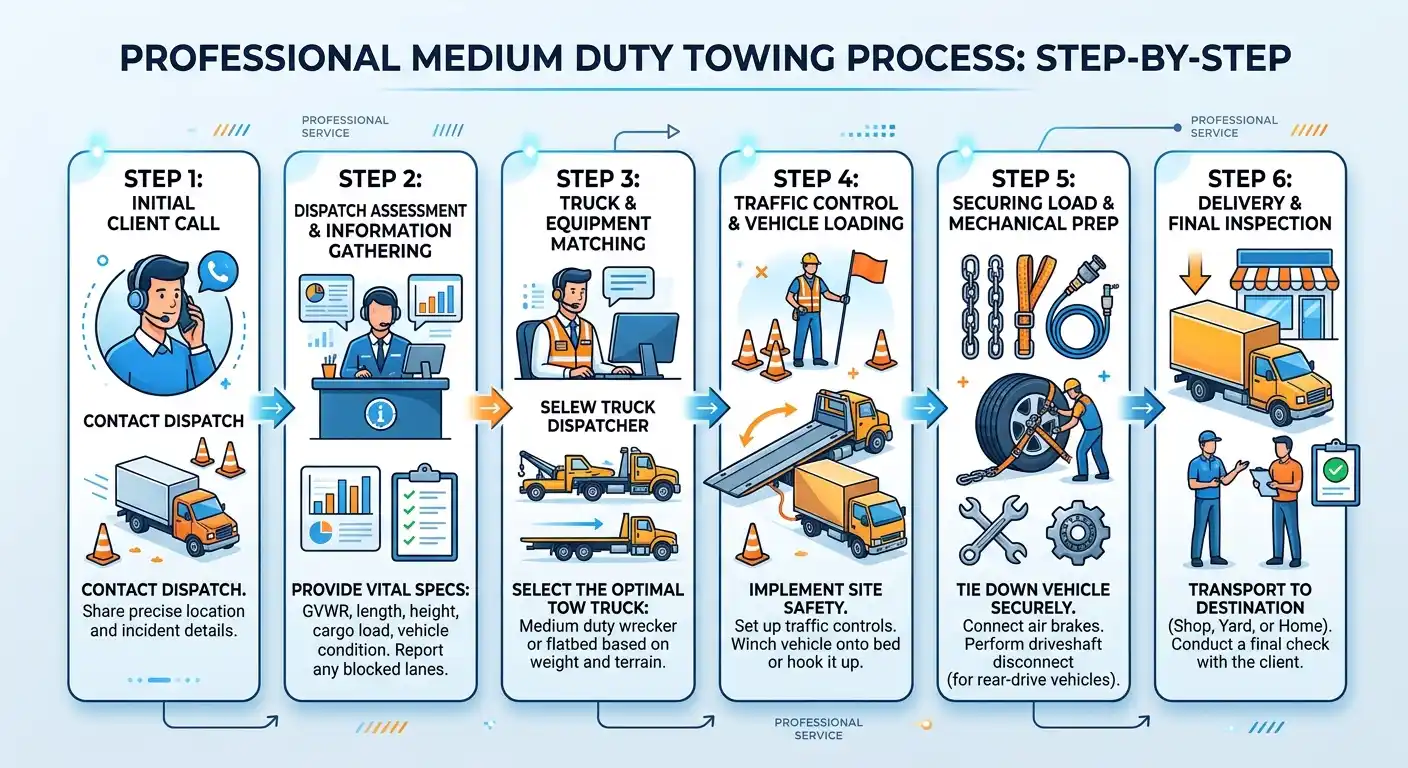
- The call. You call dispatch and share where you are and what happened.
- The dispatcher’s questions. The dispatcher asks for the GVWR, length, height, load, location, and condition. Cargo on board and a blocked lane change the plan.
- Matching the truck. Dispatch picks a wrecker or a medium duty flatbed that fits your weight and your lot or road.
- Hookup or loading. On a busy road, the driver sets up traffic control first. Then the driver hooks up or winches the vehicle onto the bed.
- Securing the load, air brake and driveshaft handling. The driver ties down the vehicle and connects or sets the air brakes. On many rear-drive trucks, the driver does a driveshaft disconnect to protect the transmission.
- Delivery. The driver brings the vehicle to your shop, yard, or home base and checks it with you.
When You Need Medium Duty Towing
- A breakdown on a Phoenix freeway or surface street
- Accident recovery for a box truck, bus, or work truck
- Fleet and delivery downtime, where each hour costs money
- RV problems, such as a blown tire or a dead engine on the way out of town
- Construction equipment moves between job sites
- A load shifted in a tight Phoenix lot, leaving the truck stuck
Watch for signs that the wrong truck came. The truck looks too small. The driver asks you to unload cargo to make it work. No one asked your weight on the phone. Speak up before hookup.
Medium Duty Towing Cost
Typical Rates in 2026
Rates change by region. These numbers come from public 2026 rate sheets that tow companies filed with the Idaho Transportation Department. Phoenix prices follow their own market, so read these as ranges, not quotes.
| Rate Sheet | Hookup Fee | Hourly Rate | Per Mile | After-Hours Fee |
| Idaho sheet, Jan 2026 (flatbed, 4,001 to 11,000 lb) | $125 | $300 recovery | $5 towed mile | $100 gate fee |
| Idaho sheet, Jan 2026 (medium duty) | $375 | $300 labor | $7.50 | $125 lot access |
| Idaho sheet, May 2026 (10,001 to 26,000 lb) | $225 | Not listed | $7.50 loaded | $175 release fee |
| Idaho sheet, Mar 2026 (medium duty) | Hourly only | $315 | $7 | $85 call-out |
| Idaho sheet, Jan 2026 (medium and heavy) | $550 | Not listed | $6 | Not listed |
| Idaho sheet, Jan 2026 (breakdown and winch-out) | $275 | $350 winch-out | $8 | Not listed |
Across these sheets, hookup runs $125 to $550, the per mile rate runs $5 to $8, and hourly work runs $300 to $350. Some sheets also set a two hour minimum charge on hourly work.
What Changes the Price
- Distance: Every loaded mile adds to the bill.
- Time of day: Nights, weekends, and holidays often add an after-hours fee.
- Weight: A 24,000 pound truck costs more to tow than a 11,000 pound van.
- Recovery or winching time: A truck in a ditch or sand takes more time, and crews bill that time by the hour.
- Storage: Daily storage for medium vehicles ran $65 to $190 on the sheets above.
If your vehicle weighs more than 26,000 pounds, prices jump. Read our guide on what is heavy duty tow for those rates.
When a Tow Becomes Heavy Duty
The line sits at 26,001 pounds GVWR. Above it, a vehicle moves into FHWA Classes 7 and 8, and the tow needs a heavy wrecker or a rotator. A CDL Class B covers any single vehicle with a GVWR of 26,001 pounds or more, according to the FMCSA’s CDL class rules.
The job can also turn heavy when the scene is hard. A rollover, a loaded trailer, or a truck stuck on its side takes more trucks, more crew, and more time, even if the vehicle is rated medium duty. If you want the weight rating basics first, read our post on what is towing capacity.
Call Redline for Medium Duty Towing in Phoenix
24/7 Medium Duty Towing in Phoenix AZ from Redline Roadside & Towing LLC means a live dispatcher at any hour. Our trucks reach you in 10 to 25 minutes across Phoenix, Avondale, Tolleson, Laveen, and the West Valley.
Have this ready when you call:
- The GVWR from the door jamb sticker
- The vehicle type, such as box truck, bus, or RV
- Your exact location
- The condition, including any cargo on board or a blocked lane
Stuck with a medium duty truck right now? Call 602-549-8722. Give dispatch your GVWR and location, and we will send the right truck the first time.
Conclusion
Now you know what is medium duty towing: moving vehicles rated 10,001 to 26,000 pounds with a truck built for that weight. If your box truck, bus, or RV is down in the Valley, call Redline Roadside & Towing LLC for a fast, correct tow.
Need a tow or roadside assistance? Get in touch with our team for help with towing, a flat tire, a dead battery, a vehicle lockout, or other roadside problems.
FAQs
What weight is medium duty tow?
Medium duty tow covers vehicles rated 10,001 to 26,000 pounds GVWR. That matches FHWA Classes 3 to 6.
Is a box truck medium duty?
Yes, most are. Box trucks usually rate between 10,001 and 26,000 pounds, so they sit at the center of what is medium duty towing.
Is an RV medium duty?
Many motorhomes are. Small camper vans may be light duty, and large diesel coaches can pass 26,000 pounds. Check the sticker.
Is an F-350 medium duty?
Often yes. Many F-350 trucks rate above 10,000 pounds, which makes them Class 3. Some lighter setups sit at or under that line.
Do I need a CDL to be towed?
No. You do not need a CDL to be towed. The tow operator handles the license and the equipment.
How much does medium duty towing cost?
Public 2026 rate sheets show hookup fees of $125 to $550, $5 to $8 per mile, and $300 to $350 per hour for recovery work.