What makes a towing service professional? The 5 requirements that constitute a towing service professional: trained drivers, the correct equipment, the right licenses, prompt response times and clear pricing. Always ask the dispatcher whether the truck that is coming to you has a valid Arizona DPS permit sticker and visible branding to prevent damage to your car and ask if they are carrying the required equipment to protect your gearbox and bumper (flatbed for AWD or low-clearance cars).
You’ll want to know an actual hook-up charge and per-mile rate in advance to safeguard your wallet and your safety. Typical local tows range between $75 and $250. Finally, ensure that the supplier has ‘on-hook’ liability insurance to ensure you’re completely covered for any inadvertent damage while the car is being transported. Ask for an exact ETA in minutes, not a wide range.
The 7 Signs of a Professional Towing Company at a Glance
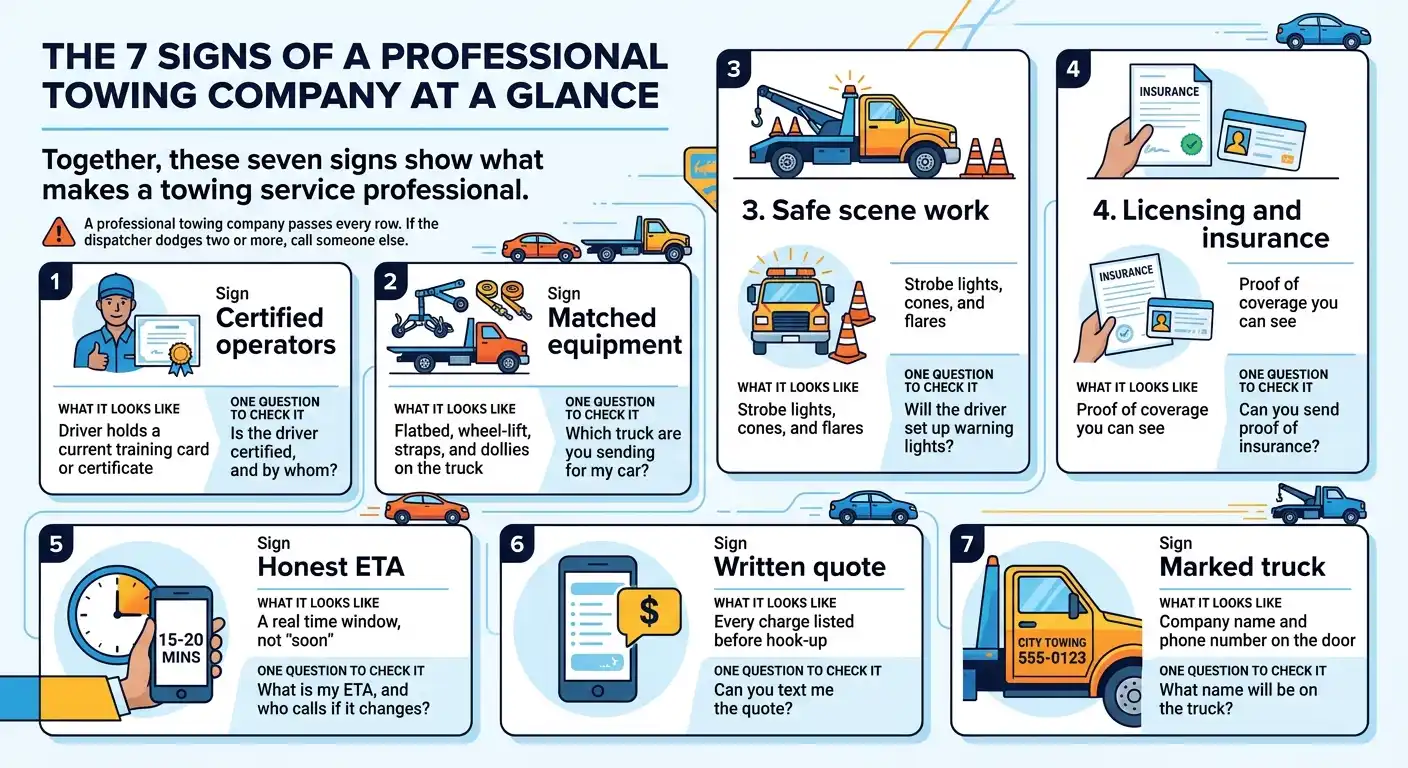
Together, these seven signs show what makes a towing service professional. A professional towing company passes every row. If the dispatcher dodges two or more, call someone else.
| Sign | What It Looks Like | One Question to Check It |
| Certified operators | Driver holds a current training card or certificate | “Is the driver certified, and by whom?” |
| Matched equipment | Flatbed, wheel-lift, straps, and dollies on the truck | “Which truck are you sending for my car?” |
| Safe scene work | Strobe lights, cones, and flares | “Will the driver set up warning lights?” |
| Licensing and insurance | Proof of coverage you can see | “Can you send proof of insurance?” |
| Honest ETA | A real time window, not “soon” | “What is my ETA, and who calls if it changes?” |
| Written quote | Every charge listed before hook-up | “Can you text me the quote?” |
| Marked truck | Company name and phone number on the door | “What name will be on the truck?” |
Trained and Certified Towing Operators
The person at the wheel matters more than the truck. Trained and certified towing operators know how to load a car without guessing.
What Certification Means
Training means someone sat through a class. Certification means they passed a test and hold proof that must be renewed. Look for the Towing and Recovery Association of America (TRAA) program, now called the Towing & Recovery Operator Certification Program. It used to be called NDCP. WreckMaster is a separate training series that many operators also take. Good operators also finish the four-hour National Traffic Incident Management Responder Training from the Federal Highway Administration (FHWA). It teaches how to park and work safely at crash scenes.
Background Checks and Drug Testing
You hand over your keys, so ask if the company screens its drivers. A professional company runs background checks and drug tests. Trucks that haul over 26,000 pounds need a driver with a Class B commercial driver license (CDL). The Federal Motor Carrier Safety Administration (FMCSA) requires drug and alcohol testing for CDL drivers.
Specialized Towing Equipment for Every Vehicle
One truck cannot carry every car the same way. A company with specialized towing equipment picks the method that fits your vehicle, not the one that is handy.
Flatbed vs. Wheel-Lift
A flatbed lifts your whole car onto the bed, so no wheel touches the road. A wheel-lift raises two wheels and rolls the car on the other two. This table shows which method fits which vehicle.
| Vehicle | Best Method | Why |
| AWD or 4WD | Flatbed | Rolling wheels can strain the drivetrain |
| Electric or hybrid | Flatbed | Rolling wheels can harm the motor and battery system |
| Low-clearance car | Flatbed with a gentle ramp angle | Protects the front lip and bumper |
| Car with transmission trouble | Flatbed | Rolling drive wheels can add damage |
| Front-wheel-drive sedan, short tow | Wheel-lift | Quick and safe when the drive wheels are lifted |
The wrong method on an AWD car can mean transmission and drivetrain damage, and that repair bill can run into the thousands.
Gear That Protects Your Vehicle
Look at the truck when it arrives. Good gear is easy to spot. You want tie-down straps in good shape, wheel nets that hold the tires without touching paint, and wheel dollies for cars with locked or damaged wheels. A winch pulls the car onto the bed smoothly, and safety chains add a backup. The truck should be clean and well maintained. Leaking fluid, frayed straps, or a rusty bed point to a company that cuts corners.
A Safe and Reliable Towing Service at the Scene
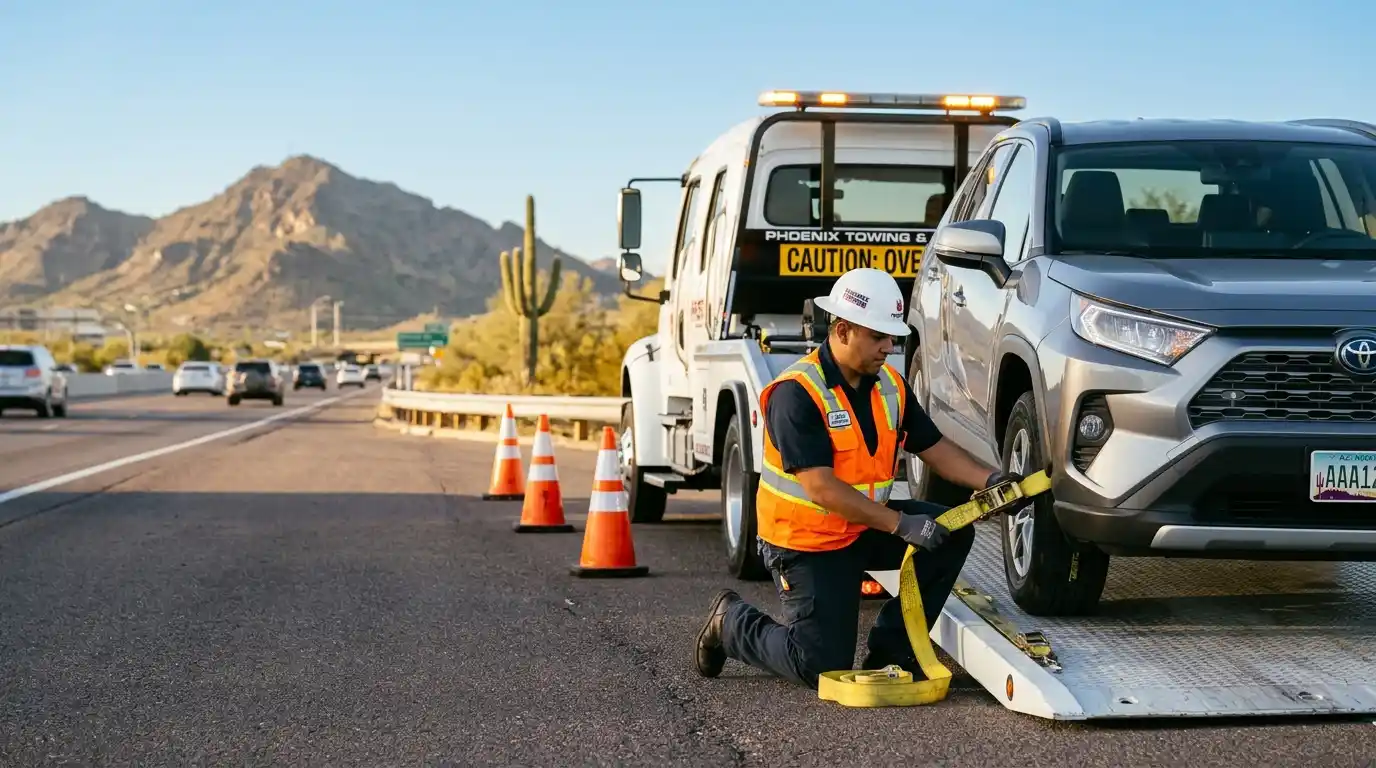
A safe and reliable towing service treats the roadside like a work zone. Scene management starts before the hook goes on. The driver turns on strobe lights, sets cones, and lays flares at night or near a blind curve. That setup guards against secondary crashes, where a passing car hits the first scene.
Arizona drivers must follow the Move Over law. It says to change lanes or slow down near any vehicle with flashing lights. A first offense carries a $275 civil penalty.
Before the truck moves, the driver checks load securement one more time. A pro also takes pre-tow photos of every side of your car.
Where to stand while you wait: well away from traffic, behind a barrier or up the embankment, never between your car and the road.
Licensing, Insurance, and Paperwork
This section is about proof. A professional towing company can show all of it within minutes.
Start with a licensed operator who is legal to run a towing business. Then look at coverage. On-hook coverage protects your car while it is attached to the truck. Garagekeepers liability protects it while it sits on the company lot. General liability covers damage to property at the scene.
Paperwork finishes the job. You should get an itemized invoice that matches the quote. A vehicle condition report at pickup and drop-off records any scratch or dent. If damage happens, a real company has a clear damage claim process and follows it in writing.
Fast Response and 24/7 Dispatch
Dispatch is the team that sends the truck and keeps you updated. A 24/7 dispatch desk means a person answers at 2 a.m., not a voicemail box.
Speed matters more in Phoenix than in many cities. Rush hour packs the freeways, and summer afternoons push past 110 degrees. A car cabin heats up fast, so waiting an hour is risky for kids and pets. A pro gives an honest arrival time and calls you if traffic changes it. Redline’s arrival time is 10 to 25 minutes.
Clear Pricing and Honest Quotes
A good quote has no surprises. Compare these charges against public numbers. The City of Phoenix publishes its police towing contract rates, which make a fair yardstick.
| Charge | What It Covers | What a Pro Quote Says |
| Hook-up fee | Connecting your vehicle and starting the tow | One flat number before the truck leaves. The city contract tow fee is $105 (June 2026) |
| Per-mile rate | Distance driven after hook-up | Rate per mile and total miles. The city contract lists $10 per mile outside city limits |
| After-hours fee | Nights, weekends, and holidays | Yes or no, with the amount. City lots charge $35 to $75 to release a car after hours |
| Winching or recovery | Pulling a car from mud, a ditch, or a tight spot | A rate per time block and a total cap |
| Storage | Holding your car on a lot | A per-day rate and the start date. City lots charge $35 per day, and Arizona caps police holds under A.R.S. 28-3511 at $25 per day |
Private tow prices in Arizona are set by each company, so these city numbers are a guide, not a limit. Redline’s accident recovery runs $100 to $500, based on the vehicle and the accident. Ask about payment methods too. A pro takes cards and digital pay, not only cash.
Red Flags and Questions to Ask Before You Say Yes
Red Flags
Knowing what makes a towing service professional also helps you spot the opposite. Walk away if you see any of these:
- An unmarked truck or no company name
- A vague price like “we’ll figure it out at the lot”
- Cash only
- Pressure to use one repair shop
- A refusal to give an invoice
- A driver who hooks an AWD car by the wheels
Six Questions to Ask on the Phone
- What is the total price quote, in writing?
- What is my ETA?
- Is the operator certified?
- What type of truck are you sending?
- Can you show proof of insurance?
- Which payment methods do you accept?
How Redline Roadside & Towing LLC Meets These Standards
Redline Roadside & Towing LLC runs 24/7 dispatch and arrives in 10 to 25 minutes. Our services cover Light Duty, Medium Duty, Heavy-Duty, Accident Recovery, and Off-Road Recovery across Phoenix, Avondale, Tolleson, Laveen, and the rest of the West Valley. We give your quote before hook-up.
Stuck right now? For 24/7 Light Duty Towing in Phoenix AZ and get a clear price and a driver on the way in minutes.
Conclusion
Now you know what makes a towing service professional: certified operators, matched equipment, safe scene work, proper paperwork, a true ETA, and a written quote. Call Redline Roadside & Towing LLC any hour for a fast, fair tow in Phoenix and surrounding areas of West Valley Arizona.
Need a tow or roadside assistance? Contact our team and let us know what happened. We’ll help you arrange the right service and get back on the road.
FAQs
What is the most important sign?
A trained operator. Good gear helps, but skill decides whether your car arrives without a scratch.
How do I know an operator is certified?
Ask for the certificate name, then check it with the group that issued it, such as TRAA.
Flatbed or wheel-lift?
Use a flatbed for AWD, 4WD, electric, hybrid, and low cars. Use a wheel-lift only for short, simple tows of front-wheel-drive cars.
How fast should a professional arrive?
A pro gives you an honest ETA when you call. Redline’s is 10 to 25 minutes.
Should I get a quote before I agree?
Yes. Get every charge in writing before the driver touches your car.